
Share how you use health apps
Tell us which health apps or trackers you use, what you track and whether you share the data. Your answers are combined with other people's and reported only as totals.
Start the health apps and trackers surveyAbout 5 minutes. No account needed. You can stop at any time.
Types of health apps
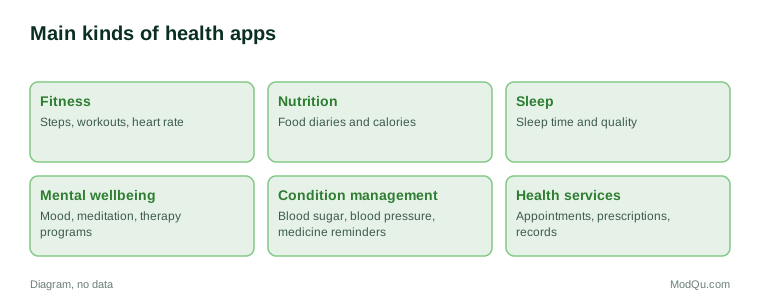
Health apps cover a wide range of uses:
- Fitness and activity: steps, workouts, running routes, heart rate.
- Nutrition: food diaries, calorie counting, water intake.
- Sleep: tracking sleep time and quality.
- Mental wellbeing: meditation, mood tracking, cognitive behavioural therapy programs.
- Women's health: period, fertility and pregnancy tracking.
- Condition management: blood sugar, blood pressure, asthma or medicine reminders.
- Health service apps: booking appointments, ordering prescriptions, viewing records, video consultations.
- Symptom checkers: tools that suggest possible causes and where to seek care.
Many are used alongside wearables such as smartwatches, fitness bands, smart rings and connected scales.
The figure below shows the main categories and examples of what each tracks.
Why people use them
Common reasons include:
- motivation to be more active or reach goals;
- understanding patterns, such as sleep or mood;
- convenience in managing appointments and prescriptions;
- managing a long-term condition between visits;
- curiosity about their own data;
- reminders to take medicines or drink water.
Example
A woman with high blood pressure uses a connected cuff that sends readings to an app. Before her next appointment she shares a three-month chart with her nurse, who can see that readings are higher in the mornings. The nurse says the chart is more useful than a single reading in the clinic.
How well they work
Evidence on health apps varies. Some apps, especially those built with health professionals and tested in studies, have shown benefits for particular uses, such as some digital therapy programs or diabetes management tools. Many others have little evidence. Accuracy also varies: step counts are generally reasonable, while sleep stage and calorie burn estimates can be less precise.
Some regulators classify certain apps as medical devices if they diagnose or treat conditions, which means they must meet stricter standards. Most wellness apps are not regulated in this way.
Keeping going
Many people stop using health apps within weeks. Reasons include losing interest, finding logging tedious, or feeling the app does not help. Features that seem to help people keep going include automatic tracking, simple goals, reminders, social features and visible progress.
Example (hypothetical figures)
A gym's members download its app. In the first week, 1,000 people log a workout. By week four, 450 are still logging, and by week twelve, 200. The gym adds automatic syncing with watches and weekly goals; the next group keeps 330 users at week twelve.
Privacy and data sharing
Health data is personal and sensitive. Questions people raise include:
- who can see their data and whether it is sold or shared with advertisers;
- whether data could be used by insurers or employers;
- where data is stored and how it is protected;
- whether they can delete their data;
- what happens if the company is sold or closes.
Rules on health data differ by country. Some apply strict health data protections to all apps that handle health information; others mainly cover health providers and insurers. Privacy policies are often long and hard to understand.
Example
A user of a period tracking app reads that the company shares some data with partners for advertising. Concerned, they switch to an app that stores data only on their phone and does not use advertising.
Sharing data with health professionals
Some health services let patients share app or device data with their care team, or use apps as part of treatment. Doctors and nurses vary in how much they want this data: it can add useful detail, but large amounts of unchecked data can be hard to use in a short appointment. Health service apps for booking, prescriptions and records are increasingly the main way some people interact with their care.
Who uses health apps
Use tends to be higher among younger adults and people who are comfortable with technology, though older adults are a growing group, especially for condition management and health service apps. Cost of devices and phone data, digital skills and language can limit access.
Risks and concerns
Concerns raised about health apps include:
- inaccurate readings leading to false reassurance or unnecessary worry;
- symptom checkers that miss serious problems or alarm people;
- unhealthy obsession with numbers;
- apps making medical claims without evidence;
- data breaches.
Costs and subscriptions
Many health apps are free to download but charge for premium features such as detailed analysis, personalized plans or coaching. Wearable devices add a further cost, and some require a monthly subscription to see full data. Some employers and insurers offer devices or app subscriptions as part of wellbeing programs, sometimes with rewards for meeting activity goals. People weigh these costs against how much they actually use the features.
Example (hypothetical figures)
A user buys a fitness band for 120 and later pays 8 a month for the app's premium plan. After a year, they have spent 216. They check how often they look at the premium charts and find it is about once a month, so they cancel the plan and keep using the free features.
What people disagree about
Some see health apps as a way to help people take more control of their health and reduce pressure on health services. Others worry that they widen gaps between people who can and cannot use them, collect too much personal data and encourage self-diagnosis. There is also debate about how strictly apps should be regulated.
Questions that businesses want answered include which apps and devices people use, what they track, how long they keep using them, whether they pay, whether they share data with professionals, and how concerned they are about privacy.
Key terms
- Health appA mobile app used to track or manage health, fitness or care.
- WearableA device worn on the body, such as a smartwatch, that collects data.
- Symptom checkerA tool that suggests possible causes of symptoms and where to seek care.
- Digital therapeuticA software-based treatment tested for a specific condition.
- Medical device softwareSoftware regulated as a medical device because it diagnoses or treats.
- Data sharingPassing personal data to other organizations.
- EngagementHow actively and for how long people use an app.
- Privacy policyA document explaining how a service collects and uses personal data.
Full glossary: digital health terms on EditingTests.com.
Health apps and trackers vocabulary test
How well do you know the language of this topic? Try 8 quick questions. Your score is shown straight away and is not saved.
What the health apps and trackers survey asks
This survey is part of ModQu's Health and Wellness survey. The health apps and trackers part takes about five minutes and covers:
- Which health or fitness apps and devices you use.
- What you track and how often.
- Whether you pay for any health app or device.
- Whether you have shared data with a doctor, nurse or other professional.
- How concerned you are about the privacy of your health data.
- What would make health apps more useful to you.
After that you can choose to continue with other short parts of the Health and Wellness survey, such as access to family doctors or virtual care and telehealth, or stop.
Ready to take part?
Your answers help show what people really think and do. Results are only ever reported as totals; no one can see your individual answers.
Start the surveyQuestions about this survey
Who can take part?
Adults who own a smartphone.
Do I have to give my name?
No. You may be asked for your age group, region and similar details so results can be broken down, but not your name. ModQu never asks for passwords, card numbers or account numbers.
How are the results used?
Answers are combined into totals and percentages and published in ModQu reports. Individual answers are never shown.
Is the vocabulary test part of the survey?
No. It is optional and separate, and your score is not stored.
Are health apps accurate?
Accuracy varies by app, device and measure. Treat readings as a guide and speak to a professional about concerns.
Can I delete my data from a health app?
Many apps allow this. Check the privacy policy and settings.