
Share your views on vaccinations
Tell us which vaccines you have had recently, where you got them and how confident you feel about them. Your answers are combined with other people's and reported only as totals.
Start the vaccinations surveyAbout 5 minutes. No account needed. You can stop at any time.
How vaccination programs work
Most countries have a national immunization schedule: a list of vaccines recommended at particular ages or for particular groups. It usually includes:
- Childhood vaccines against diseases such as measles, polio, diphtheria, tetanus and whooping cough.
- Adolescent vaccines, for example against human papillomavirus (HPV) in many countries.
- Adult boosters, such as tetanus at intervals.
- Seasonal vaccines, such as influenza, often recommended for older adults, people with certain health conditions and health workers.
- Vaccines for older adults, for example against pneumococcal disease or shingles in some countries.
- Vaccines in pregnancy in some countries, to protect the baby in its first months.
- Travel vaccines for particular destinations.
Schedules differ between countries because of differences in disease patterns, health systems and budgets. Global organizations publish recommendations that many countries use as a starting point.
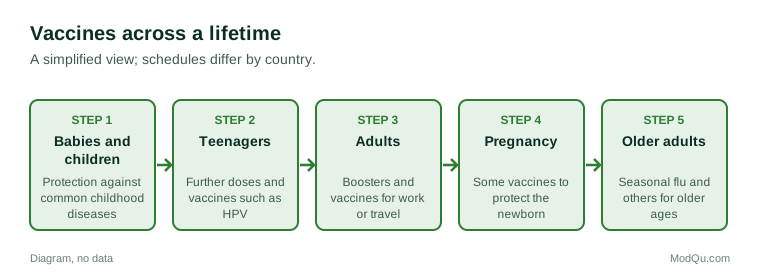
The figure below shows a simplified view of vaccines across life.
Where people get vaccinated
Depending on the country and the vaccine, people may be vaccinated at:
- a family doctor's surgery or community health centre;
- a pharmacy;
- school-based programs;
- workplace clinics;
- mass vaccination centres during campaigns;
- travel clinics;
- mobile teams that reach rural or remote areas.
Example
A man in his seventies receives a letter inviting him for a flu vaccine at his doctor's surgery. The appointments are during his working hours as a part-time volunteer driver, so he goes to a pharmacy on a Saturday instead. He says he would not have gone if the pharmacy option had not existed.
Cost and access
In many countries, vaccines on the national schedule are free. Others charge for some vaccines, or cover them through insurance. Travel vaccines are often paid for privately. Barriers to access can include cost, distance to a clinic, appointment times, language, and not knowing which vaccines are due.
Example (hypothetical figures)
A family of four plans a trip that requires two travel vaccines per person and a course of tablets against malaria. At 45 per vaccine and 30 per person for the tablets, the total is 480. They had budgeted for flights and hotels but not this, and decide to book their clinic appointment early to spread the cost.
Vaccine confidence and hesitancy
Most people in most countries accept recommended vaccines. Some delay or refuse some or all vaccines, which is often called vaccine hesitancy. Researchers describe several influences on people's decisions:
- Confidence: trust in the safety and effectiveness of vaccines, in health professionals and in the authorities that recommend them.
- Complacency: feeling that a disease is not a serious risk, often because it has become rare thanks to vaccination.
- Convenience: how easy it is to get vaccinated.
- Calculation: weighing perceived risks and benefits, often using information from many sources.
- Collective responsibility: willingness to be vaccinated to protect others.
Confidence can change after news stories, public controversies or personal experiences, and it differs between countries, communities and vaccines.
Where people get information
People draw on information from health professionals, official health websites, family and friends, news media, and social media. Health professionals are often among the most trusted sources. Misinformation spread online can reduce confidence, and many health bodies now work to answer common questions directly and in several languages.
Example
A parent reads alarming claims about a childhood vaccine in a social media group. At the child's next check-up, they ask the nurse, who explains the evidence, the side effects that are common and those that are rare, and gives them an official leaflet. The parent decides to go ahead.
Side effects and safety monitoring
Vaccines can cause side effects, usually mild and short-lived, such as a sore arm, tiredness or a mild fever. Serious side effects are rare. Countries run safety monitoring systems that collect reports of suspected side effects, and health authorities review them to spot any patterns. Some countries have compensation schemes for the rare cases of serious harm.
Vaccination for work, study and travel
Some jobs, especially in health care, require certain vaccines. Some schools and universities ask for proof of childhood vaccines. Some countries require proof of particular vaccines, such as yellow fever, for entry. Keeping a personal record of vaccinations helps in these situations, and digital records are becoming common.
Adult vaccination gaps
Adult vaccine uptake is often lower than childhood uptake. Adults may not know which vaccines they are due for, may not have a regular doctor, or may see vaccines as something for children. Older adults and people with long-term conditions are often the groups for whom health services most want to raise uptake.
Vaccination records
Keeping track of vaccinations can be surprisingly hard. Childhood records may be on paper cards that get lost, adult vaccines may be given at different places, and records may not move between countries. Many health systems now offer digital records through an app or online account, and some countries issue international certificates for travel vaccines. People who move country often have to piece together their history or repeat some vaccines because records cannot be found.
Example
A family moves to a new country with paper vaccination cards in their home language. The new school asks for proof of childhood vaccines. A local clinic helps translate the cards and records the vaccines in the national system, and offers one dose that the children had not received.
What people disagree about
Debates include whether vaccines should ever be required for work, school or travel, how to balance individual choice with protecting others, how governments should communicate uncertainty, and how to respond to misinformation without censoring debate. People also differ on how much they trust pharmaceutical companies and regulators.
Questions that businesses want answered include which vaccines people have had recently, where they got them, how easy it was, where they get information, how confident they feel about different vaccines, and what would make vaccination easier.
Key terms
- VaccineA product that trains the immune system to recognize and fight a disease.
- Immunization scheduleA country's list of recommended vaccines by age or group.
- BoosterAn extra dose to maintain protection.
- Vaccine hesitancyDelay in accepting or refusal of vaccines despite availability.
- Herd protectionIndirect protection of unvaccinated people when many others are vaccinated.
- Side effectAn unintended effect after vaccination, usually mild.
- Safety monitoringSystems that collect and review reports of suspected side effects.
- UptakeThe share of eligible people who receive a vaccine.
Full glossary: vaccine manufacturing terms on EditingTests.com.
Vaccinations vocabulary test
How well do you know the language of this topic? Try 8 quick questions. Your score is shown straight away and is not saved.
What the vaccinations survey asks
This survey is part of ModQu's Health and Wellness survey. The vaccinations part takes about five minutes and covers:
- Which vaccines you have had in the last few years, such as flu or travel vaccines.
- Where you were vaccinated and how easy it was.
- Whether you know which vaccines you are due for.
- Where you get information about vaccines and which sources you trust.
- How confident you feel about the safety and benefits of different vaccines.
- What would make getting vaccinated easier.
After that you can choose to continue with other short parts of the Health and Wellness survey, such as access to family doctors or virtual care and telehealth, or stop.
Ready to take part?
Your answers help show what people really think and do. Results are only ever reported as totals; no one can see your individual answers.
Start the surveyQuestions about this survey
Who can take part?
Adults.
Do I have to give my name?
No. You may be asked for your age group, region and similar details so results can be broken down, but not your name. ModQu never asks for passwords, card numbers or account numbers.
How are the results used?
Answers are combined into totals and percentages and published in ModQu reports. Individual answers are never shown.
Is the vocabulary test part of the survey?
No. It is optional and separate, and your score is not stored.
Does this page tell me which vaccines to have?
No. Ask a health professional or check your national health service's schedule.
Can I get vaccinated at a pharmacy?
In many countries some vaccines are available at pharmacies. Availability varies.