
Tell us about getting care
Tell us whether you have a family doctor, how long you wait and where you go when you cannot get in. Your answers are combined with other people's and reported only as totals.
Start the access to family doctors surveyAbout 5 minutes. No account needed. You can stop at any time.
What primary care is
Primary care is the first point of contact with the health system for most health concerns. It includes:
- diagnosing and treating common illnesses and injuries;
- managing long-term conditions such as diabetes, asthma and high blood pressure;
- preventive care, such as screening tests and vaccinations;
- mental health care for common conditions;
- referrals to specialists, tests and other services;
- keeping a complete record of a person's health over time.
Primary care is usually provided by family physicians, also called general practitioners, and increasingly by nurse practitioners, who can diagnose, prescribe and order tests. In many places they work with nurses, pharmacists, dietitians, social workers and other professionals in team-based clinics.
Why having a regular provider matters
Research on primary care has long linked having a regular provider with better management of chronic conditions, more preventive care and fewer emergency visits. A provider who knows a patient's history can spot changes, avoid duplicate tests and coordinate care between specialists.
People without a regular provider often use walk-in clinics, virtual care and emergency departments. These services treat immediate problems but usually do not provide ongoing care.
Example
A 58-year-old man without a family doctor has used walk-in clinics for years. Each visit deals with one problem, and no one has followed up on his slowly rising blood pressure readings. When he finally registers with a new nurse practitioner, she reviews the records he brings and starts treatment.
Why access has become harder
Many reasons contribute to the shortage of primary care:
- population growth and ageing, with more people living with several conditions;
- family physicians retiring, reducing hours or moving into other kinds of work;
- fewer medical graduates choosing family medicine in some years;
- heavy administrative work, such as forms and paperwork;
- payment models that some physicians see as poorly suited to complex patients;
- difficulty recruiting providers to rural and remote areas.
How people find a provider
Ways to find a family doctor or nurse practitioner include:
- provincial registries or waitlists that match unattached patients to providers;
- word of mouth from family, friends and colleagues;
- clinics announcing they are accepting new patients;
- team-based clinics and community health centres;
- in some cases, following a provider when they move or join a new clinic.
Waits on provincial lists can be long, and some people never hear back.
Waiting for an appointment
Even people with a family doctor can wait several days or weeks for a routine appointment. Many clinics now offer same-day or next-day slots for urgent concerns, phone or video visits, and online booking. Waiting times vary widely between clinics and regions.
Some clinics now ask patients to book through an online portal or to describe their concern to a nurse first, who decides whether a same-day visit, a later appointment, a phone call or a pharmacist is most suitable. Patients' views on these systems are mixed: some value the speed, while others find them hard to use, especially older people and those without reliable internet.
Example
A parent calls their family clinic at 8 a.m. for an appointment for a child with an ear infection. The phone line is busy for 20 minutes, and by the time they get through all same-day slots are gone. They are offered a video visit with another doctor in the clinic that afternoon instead.
Where people go when they cannot get in
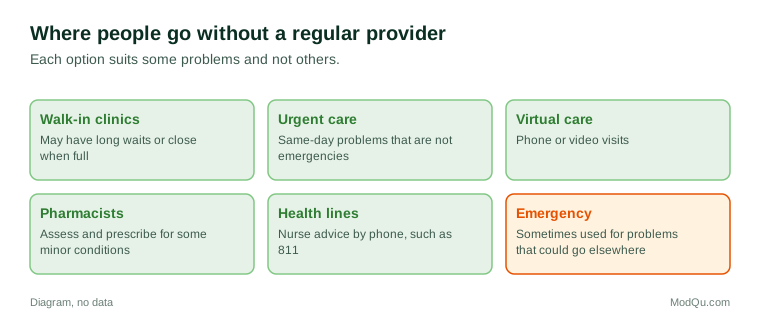
When people cannot see their own provider, or do not have one, they use:
- walk-in clinics, which may have long waits or close early when full;
- urgent care centres for problems that need same-day attention but are not emergencies;
- virtual care services, by phone or video;
- pharmacists, who in many provinces can now assess and prescribe for some minor conditions;
- telephone health lines, staffed by registered nurses, such as 811 in many provinces;
- emergency departments, sometimes for problems that could be handled elsewhere.
Some people also delay care, hoping problems will go away.
Pharmacists and other providers
The role of pharmacists has grown. In many provinces, pharmacists can renew prescriptions, give vaccines and prescribe for conditions such as urinary tract infections and minor skin conditions. Some people now see a pharmacist first for common problems. Physiotherapists, mental health counsellors and nurses also provide care that once required a doctor's visit.
What patients value
When asked what matters most in primary care, people commonly mention:
- being able to get an appointment when needed;
- seeing the same provider over time;
- being listened to and taking time to discuss concerns;
- clear explanations and shared decisions;
- follow-up on test results;
- convenient options, such as online booking and virtual visits.
People do not always agree on trade-offs. Some prefer a quick appointment with any provider; others would rather wait to see their own.
Example
Two neighbours rate the same clinic differently. One values the fast online booking and is happy to see whichever doctor is free. The other is frustrated because they have seen four different doctors in a year and has to repeat their history each time.
New models of care
Provinces are testing different approaches, including team-based clinics, attaching patients to a team rather than a single doctor, expanding nurse practitioner clinics, paying physicians differently for complex patients and reducing paperwork. Patients may notice more contact with nurses, pharmacists and other team members, and more choice between in-person and virtual appointments.
What health planners want to know
Health systems, clinics and policy makers want to understand how many people have a regular provider, how long they wait, where they go instead, what they value most and which new models they would accept.
Key terms
- Primary careFirst-contact health care for common illnesses, prevention and ongoing conditions.
- Family physicianA doctor who provides primary care to people of all ages.
- Nurse practitionerA registered nurse with advanced training who can diagnose, prescribe and order tests.
- Walk-in clinicA clinic that sees patients without a booked appointment.
- Unattached patientA person without a regular family doctor or nurse practitioner.
- ReferralA request from one provider for a patient to see a specialist or service.
- Continuity of careSeeing the same provider or team over time.
- Team-based careCare provided by several professionals working together in one practice.
Full glossary: healthcare administration terms on EditingTests.com.
Access to family doctors vocabulary test
How well do you know the language of this topic? Try 8 quick questions. Your score is shown straight away and is not saved.
What the access to family doctors survey asks
This survey is part of ModQu's Health and Wellness survey. The access to family doctors part takes about five minutes and covers:
- Whether you have a regular family doctor or nurse practitioner.
- How long you waited for your last appointment, and whether it was in person or virtual.
- Where you go when you cannot see your own provider.
- Whether you are on a waitlist for a provider, and for how long.
- What matters most to you in primary care.
- How you feel about seeing pharmacists, nurses or other team members instead of a doctor.
After that you can choose to continue with other short parts of the Health and Wellness survey, such as virtual care and telehealth or pharmacy and prescriptions, or stop.
Ready to take part?
Your answers help show what people really think and do. Results are only ever reported as totals; no one can see your individual answers.
Start the surveyQuestions about this survey
Who can take part?
Adults.
Do I have to give my name?
No. You may be asked for your age group, region and similar details so results can be broken down, but not your name. ModQu never asks for passwords, card numbers or account numbers.
How are the results used?
Answers are combined into totals and percentages and published in ModQu reports. Individual answers are never shown.
Is the vocabulary test part of the survey?
No. It is optional and separate, and your score is not stored.
Will you ask about my health conditions?
The survey asks about access to care, not your diagnoses. Any health question is optional.