
Tell us about your pharmacy
Tell us which pharmacy you use, how you pay for prescriptions and what services you use. Your answers are combined with other people's and reported only as totals.
Start the pharmacy and prescriptions surveyAbout 5 minutes. No account needed. You can stop at any time.
The role of the pharmacy
A community pharmacy dispenses prescription medicines, sells non-prescription products and provides health advice. Pharmacists check that prescriptions are safe and appropriate, look for drug interactions, explain how to take medicines and answer questions about side effects. For many people, the pharmacist is the health professional they see most often.
Pharmacies operate in many settings: large chains, independent stores, pharmacies inside grocery stores, hospital outpatient pharmacies and online or mail-order pharmacies.
How people choose a pharmacy
People choose and stay with a pharmacy for several reasons:
- convenience: close to home or work, open long hours, drive-through service;
- relationship: knowing the pharmacist, who knows their history;
- cost: dispensing fees and prices that vary between pharmacies;
- loyalty programs linked to the store;
- services: vaccines, medication reviews, blister packs, delivery;
- stock: having medicines available without waiting.
Example
A woman who takes several medicines for heart disease and diabetes uses the same independent pharmacy for 15 years. When a chain pharmacy opens closer to her home with lower dispensing fees, she stays because her pharmacist calls her when something on a new prescription looks wrong and arranges her pills in weekly packs.
What pharmacists can now do
The scope of pharmacy practice has expanded in many provinces. Depending on the province, pharmacists can:
- renew or extend prescriptions for ongoing conditions;
- adapt prescriptions, for example changing the dose or form;
- give vaccines, including flu shots and travel vaccines;
- assess and prescribe for some minor conditions, such as urinary tract infections, cold sores, allergic rhinitis and minor skin conditions;
- order some lab tests;
- conduct medication reviews for people taking several medicines.
Many people are not aware of these services, and some prefer to see a doctor even for minor conditions.
How prescription costs work
The price paid at the counter usually has two parts:
- the cost of the drug, which depends on the medicine and whether a generic version is available;
- the dispensing fee, charged by the pharmacy for its professional service.
Drug prices in Canada are reviewed by a federal board for patented medicines, and provinces negotiate prices for drugs on public plans. Generic drugs, which contain the same active ingredient as brand-name drugs, usually cost much less.
Example (hypothetical figures)
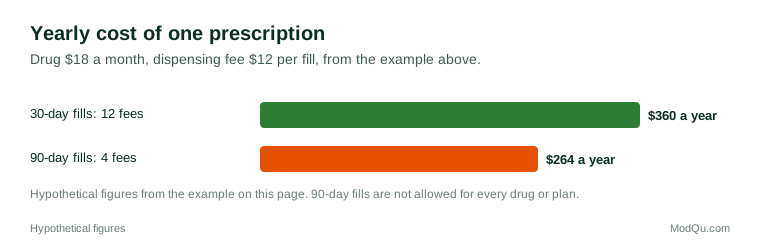
A patient fills a 30-day prescription every month. The drug costs $18 and the dispensing fee is $12, so each fill costs $30, or $360 a year. Switching to 90-day fills, where allowed, means four fees instead of twelve, saving $96 a year in fees.
Drug coverage
Who pays for prescriptions depends on a person's circumstances:
- provincial drug plans cover seniors, people on social assistance and some others, often with deductibles and co-payments;
- workplace benefits cover many employees and their families;
- individual drug plans are bought by some people without other coverage;
- federal programs cover certain groups, such as First Nations and Inuit through Non-Insured Health Benefits, and veterans;
- out-of-pocket payment for people with no coverage.
Quebec requires residents to have drug coverage, through a private plan or the public plan. Other provinces have different rules. National pharmacare measures for some medicines have been introduced, but coverage still varies across the country.
Skipping medicine because of cost
Some people do not fill prescriptions, skip doses or split pills to make medicine last longer because of cost. This is more common among people without drug coverage, people with low incomes and people taking several medicines. Skipping medicine can lead to worse health and more expensive care later.
Example
A self-employed electrician with high blood pressure has no drug plan. When money is tight, he takes his pill every second day to stretch the supply. At his next check-up, his blood pressure is high again, and his doctor explains a lower-cost generic option he had not known about.
Generic and brand-name drugs
Generic drugs must meet the same standards for quality and effectiveness as the brand-name versions. Pharmacists often substitute generics unless the prescriber or patient requests the brand. Some people prefer brand names out of habit or concern about differences in fillers or appearance. Drug plans often pay only the generic price.
Non-prescription products and advice
Much of what pharmacies sell does not need a prescription: pain relievers, cold and allergy medicines, vitamins, first aid supplies and skin care. Many people ask the pharmacist which product to choose, especially for children or when they already take other medicines. Some products are kept behind the counter so that the pharmacist can give advice before sale. People often compare prices between pharmacies and grocery stores for these products, while relying on their regular pharmacy for prescriptions.
Delivery, apps and online pharmacies
Prescription delivery, refill reminders and mobile apps have become common. Some people use online pharmacies that mail medicines. Patients value convenience but some miss the face-to-face contact. Health regulators warn about unlicensed online sellers offering cheap medicines without prescriptions, which may be counterfeit.
Shortages
Drug shortages occur from time to time, caused by manufacturing problems, supply chain disruptions and sudden increases in demand. Pharmacists may need to find alternatives, contact prescribers or ration supplies. Shortages of common medicines such as children's pain relievers have caught public attention in recent years.
What pharmacies and health planners want to know
Pharmacy chains, independent pharmacies, drug plans and governments want to understand why people choose a pharmacy, which services they use, how they pay, whether cost stops them filling prescriptions and what they think of pharmacists taking on more care.
Key terms
- Dispensing feeThe fee a pharmacy charges for preparing and providing a prescription.
- Generic drugA medicine with the same active ingredient as a brand-name drug, usually cheaper.
- Drug planInsurance that pays some or all of the cost of prescriptions.
- Co-paymentThe part of a prescription cost the patient pays under a drug plan.
- FormularyThe list of drugs a plan covers.
- Prescription renewalExtending a prescription for an ongoing condition.
- Drug interactionWhen one medicine affects how another works.
- Medication reviewA pharmacist's review of all the medicines a person takes.
Full glossary: pharmacy operations terms on EditingTests.com.
Pharmacy and prescriptions vocabulary test
How well do you know the language of this topic? Try 8 quick questions. Your score is shown straight away and is not saved.
What the pharmacy and prescriptions survey asks
This survey is part of ModQu's Health and Wellness survey. The pharmacy and prescriptions part takes about five minutes and covers:
- Which kind of pharmacy you use most, and why you chose it.
- How you pay for prescriptions: a public plan, workplace benefits, an individual plan or out of pocket.
- Whether you have skipped or delayed a prescription because of cost.
- Which pharmacist services you have used, such as vaccines, renewals or minor ailment prescribing.
- Whether you use or would use prescription delivery or a pharmacy app.
- What would make you switch pharmacy.
After that you can choose to continue with other short parts of the Health and Wellness survey, such as access to family doctors or virtual care and telehealth, or stop.
Ready to take part?
Your answers help show what people really think and do. Results are only ever reported as totals; no one can see your individual answers.
Start the surveyQuestions about this survey
Who can take part?
Adults who take prescription medicine.
Do I have to give my name?
No. You may be asked for your age group, region and similar details so results can be broken down, but not your name. ModQu never asks for passwords, card numbers or account numbers.
How are the results used?
Answers are combined into totals and percentages and published in ModQu reports. Individual answers are never shown.
Is the vocabulary test part of the survey?
No. It is optional and separate, and your score is not stored.
Will you ask which medicines I take?
No. The survey asks about how you use pharmacies and pay for prescriptions, not about specific medicines or conditions.