
Tell us how you sleep
Tell us how much you sleep, what affects it and what you do to sleep better. Your answers are combined with other people's and reported only as totals.
Start the sleep surveyAbout 5 minutes. No account needed. You can stop at any time.
How much sleep people need
Sleep needs vary between people and change with age. Canadian guidelines for adults aged 18 to 64 recommend seven to nine hours of good-quality sleep a night on a regular basis, with consistent bed and wake times. Adults aged 65 and over are advised to get seven to eight hours. Children and teenagers need more.
Many adults report getting less than seven hours on work nights, and some catch up on weekends. Sleep quality matters as well as quantity: waking often or not feeling rested can be as much of a problem as too few hours.
What affects sleep
Common influences on sleep include:
- work schedules, especially shift work and long hours;
- stress and worry, including money, health and family concerns;
- caffeine and alcohol, particularly later in the day;
- screens before bed, which can delay sleep;
- young children and caregiving;
- noise, light and temperature in the bedroom;
- pain and health conditions;
- partners who snore or keep different hours;
- pets in the bedroom.
Example
A nurse who works rotating shifts sleeps well on days off but struggles after night shifts, waking after four hours because of daylight and household noise. Blackout curtains, earplugs and an agreement with her family about quiet hours help her get closer to seven hours.
Common sleep problems
The most common sleep problems include:
- insomnia: trouble falling asleep, staying asleep or waking too early, despite the opportunity to sleep;
- obstructive sleep apnea: repeated pauses in breathing during sleep, often with loud snoring, which leads to poor-quality sleep and daytime tiredness;
- restless legs syndrome: an urge to move the legs, usually in the evening;
- circadian rhythm problems, such as those linked to shift work or jet lag;
- narcolepsy and other less common disorders.
Many people with sleep apnea do not know they have it. Partners often notice the snoring and pauses first.
Example
A man in his fifties falls asleep in meetings and while watching television. His wife says he snores loudly and sometimes stops breathing for a few seconds. A sleep study confirms obstructive sleep apnea. After he starts using a CPAP machine, he says he feels more awake than he has in years.
What people do to sleep better
People try many approaches:
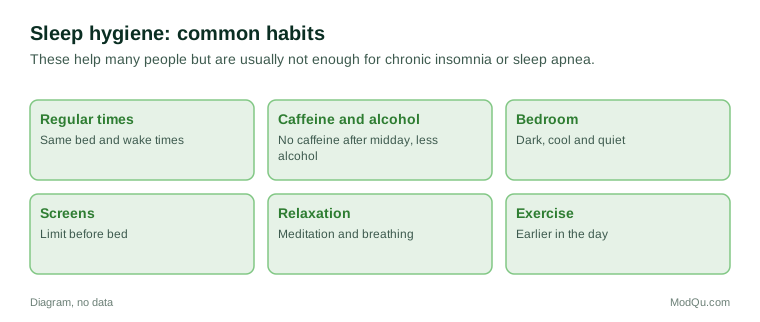
- regular bed and wake times;
- avoiding caffeine after midday and limiting alcohol;
- keeping the bedroom dark, cool and quiet;
- limiting screens before bed;
- relaxation, meditation and breathing exercises;
- white noise machines and apps;
- exercise earlier in the day;
- new mattresses, pillows and bedding;
- sleep tracking.
These habits, often called sleep hygiene, help many people, but are usually not enough on their own for chronic insomnia or sleep apnea.
Sleep aids and medication
Some people use sleep aids:
- over-the-counter products, such as antihistamine-based sleep aids;
- natural health products, such as melatonin, which is sold without prescription in Canada, and herbal products;
- prescription medicines, usually recommended only for short periods because of side effects and the risk of dependence for some types.
For chronic insomnia, clinical guidelines often recommend cognitive behavioural therapy for insomnia (CBT-I) as a first treatment. It is offered by some psychologists, sleep clinics and online programs.
Sleep trackers and apps
Smartwatches, rings, bed sensors and phone apps estimate sleep time and stages. Many users find them interesting and motivating. Others become anxious about their scores, a pattern sometimes called orthosomnia. Consumer devices are not as accurate as clinical sleep studies, particularly for sleep stages.
Mattresses and the sleep market
The market for sleep products has grown, including mattresses sold online and delivered in a box, adjustable beds, cooling pillows and weighted blankets. Shoppers weigh comfort, price, trial periods, return policies and reviews. Many find it hard to compare mattresses because of different names and specifications.
Example (hypothetical figures)
A couple spends $1,400 on a mattress bought online with a 100-night trial. After two months, one partner has back pain. They return it under the trial, pay a $100 return fee and buy a firmer model in a store, where they can lie on it first.
Sleep and work
Tiredness affects work performance and safety, especially in transport, health care and other jobs with long or irregular hours. Some employers now include sleep in wellness programs. Remote workers report mixed effects: some sleep longer without a commute, others find work spills into the evening.
Getting help
People who regularly feel unrefreshed, snore loudly, stop breathing during sleep or struggle with insomnia for more than a few weeks are usually advised to speak to a health professional. Diagnosis may involve a sleep study at home or in a clinic. Waits for sleep clinics can be long in some areas. Drowsy driving is a particular concern: people who often feel sleepy during the day are advised not to drive until the cause has been found and treated.
Teenagers and sleep
Teenagers naturally tend to fall asleep and wake later than adults, which can clash with early school start times. Late-night phone use adds to the problem. Some school boards have explored later start times, and many parents try to set rules about devices at bedtime.
What sleep businesses and health planners want to know
Mattress and bedding companies, app and device makers, pharmacies, sleep clinics and health agencies want to understand how well people sleep, what problems they face, what products and treatments they use and what they would pay to sleep better.
Key terms
- InsomniaOngoing difficulty falling or staying asleep despite the chance to sleep.
- Obstructive sleep apneaRepeated pauses in breathing during sleep caused by a blocked airway.
- CPAPA machine that keeps the airway open during sleep using air pressure.
- Circadian rhythmThe body's internal 24-hour clock.
- MelatoninA hormone involved in sleep timing, also sold as a supplement.
- Sleep hygieneHabits and surroundings that support good sleep.
- Sleep studyA test that records breathing, brain activity and movement during sleep.
- CBT-ICognitive behavioural therapy for insomnia.
Full glossary: sleep medicine terms on EditingTests.com.
Sleep vocabulary test
How well do you know the language of this topic? Try 8 quick questions. Your score is shown straight away and is not saved.
What the sleep survey asks
This survey is part of ModQu's Health and Wellness survey. The sleep part takes about five minutes and covers:
- How many hours you usually sleep on work nights and days off.
- How you rate the quality of your sleep.
- What most often disturbs your sleep.
- What you do to help you sleep, including any sleep aids or supplements.
- Whether you track your sleep with a device or app.
- Whether you have talked to a health professional about sleep, and what happened.
After that you can choose to continue with other short parts of the Health and Wellness survey, such as access to family doctors or virtual care and telehealth, or stop.
Ready to take part?
Your answers help show what people really think and do. Results are only ever reported as totals; no one can see your individual answers.
Start the surveyQuestions about this survey
Who can take part?
Adults.
Do I have to give my name?
No. You may be asked for your age group, region and similar details so results can be broken down, but not your name. ModQu never asks for passwords, card numbers or account numbers.
How are the results used?
Answers are combined into totals and percentages and published in ModQu reports. Individual answers are never shown.
Is the vocabulary test part of the survey?
No. It is optional and separate, and your score is not stored.
Will you ask about medicines I take for sleep?
Only in general terms, such as whether you use any sleep aid. You do not need to name products, and you can skip any question.