
Tell us about your eye care
Tell us when you last had an eye exam, where you buy glasses or lenses and what matters most to you. Your answers are combined with other people's and reported only as totals.
Start the eye care and glasses surveyAbout 5 minutes. No account needed. You can stop at any time.
Who provides eye care
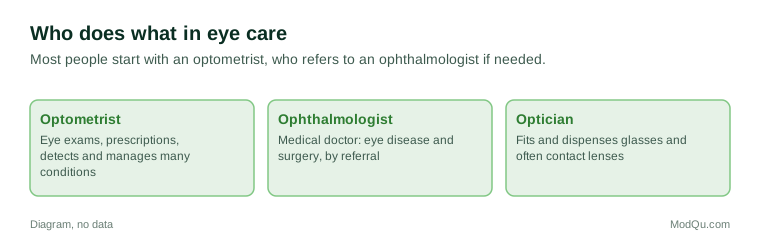
Three main professions look after eyes:
- Optometrists are primary eye care providers. They perform eye exams, prescribe glasses and contact lenses, and detect, diagnose and manage many eye conditions. In many provinces they can prescribe some medicines.
- Ophthalmologists are medical doctors who specialize in eye disease and surgery, including cataract surgery and treatment for glaucoma and macular degeneration.
- Opticians fit and dispense glasses and, in many provinces, contact lenses, based on a prescription.
Most people start with an optometrist, who refers them to an ophthalmologist if needed.
Eye exams and how often to have them
Eye exams check vision and also the health of the eyes. They can detect problems such as glaucoma, cataracts, diabetic eye disease and macular degeneration, often before symptoms appear. Optometrists generally recommend regular exams for children and for adults, with more frequent checks for older adults and people with diabetes or other risk factors.
Public coverage for eye exams varies by province. Children, seniors and people with certain medical conditions are often covered; adults aged 20 to 64 often are not, unless they have a medical reason or benefits coverage.
Example
A 42-year-old has not had an eye exam since university because her vision seemed fine. She books one after noticing she holds her phone further away to read. The optometrist confirms early presbyopia, the normal age-related loss of near focus, and also checks her eye pressure, which is normal.
Common vision problems
The most common reasons people need glasses or contacts are:
- myopia (nearsightedness): distant objects look blurry;
- hyperopia (farsightedness): near objects can be hard to focus on;
- astigmatism: blurred or distorted vision from an irregularly shaped cornea or lens;
- presbyopia: gradual loss of near focus, usually starting in the 40s.
Myopia has become more common in children in many parts of the world, and researchers link it partly to more near work and less time outdoors.
Buying glasses
People buy glasses from:
- optometry clinics with their own dispensaries;
- optical chain stores;
- independent opticians;
- warehouse and big-box stores;
- online retailers.
Prices vary widely depending on frames, lens type and coatings. Common lens options include single vision, bifocals, progressive lenses, anti-reflective coatings, blue-light filtering and photochromic lenses that darken in sunlight.
Example (hypothetical figures)
A shopper is quoted $650 at a clinic for designer frames and progressive lenses with coatings. An online retailer offers similar progressive lenses with basic frames for $220. Their benefits plan pays up to $250 every two years. They choose the clinic for the first pair because they have never worn progressives and want help with fitting, and buy a backup pair online later.
Buying glasses online
Online eyewear stores offer lower prices and wide frame choice, with virtual try-on tools. Customers need a current prescription and, for some lenses, a measurement of the distance between the pupils. Concerns include fit, lens accuracy, and the lack of adjustments and follow-up. Progressive lenses are generally considered harder to buy online successfully than single-vision lenses.
Contact lenses
Contact lens wearers choose between daily disposables, two-week and monthly lenses, and specialty lenses for astigmatism, presbyopia or certain conditions. Contact lenses need a fitting by an eye care professional. Wearers buy lenses from clinics, opticians and online. Poor lens hygiene, such as sleeping in lenses not designed for it or rinsing with tap water, raises the risk of serious eye infections.
Laser surgery and other options
Some people choose laser vision correction, such as LASIK or PRK, to reduce or eliminate the need for glasses. It is usually paid privately. Candidates must have stable prescriptions and healthy eyes. People weigh cost, recovery time, risks and the chance they may still need reading glasses as they age.
Example
A 30-year-old who swims and plays hockey is tired of contact lenses. After an assessment, she has laser surgery. Ten years later she is still happy with the result, though her optometrist reminds her she will likely need reading glasses in her mid-40s.
Children's eyes
Children rarely complain about poor vision because they assume everyone sees the way they do. Problems may show up as difficulty reading, headaches, sitting close to the television or trouble in school. Optometrists recommend a first eye exam in early childhood and regular exams through the school years. Several provinces cover children's eye exams, and some run programs that provide free glasses to young children who need them.
Eye health and ageing
The risk of eye disease rises with age. Cataracts, which cloud the lens of the eye, are very common in older adults and are treated with surgery that is covered by provincial health plans. Glaucoma and macular degeneration can cause permanent vision loss if not treated early, which is one reason regular exams are recommended for older adults.
Screens and eye strain
Many people spend hours a day looking at screens and report tired eyes, dryness or headaches. Advice often includes taking regular breaks, such as looking at something far away every 20 minutes, adjusting screen distance and lighting, and blinking more often. Blue-light filtering lenses are widely sold, though professional bodies differ on how much benefit they provide.
Costs and coverage
Many people pay for eye exams and eyewear through workplace benefits, which often provide a set amount every one or two years. People without coverage pay out of pocket, and cost is a common reason for delaying exams or wearing outdated prescriptions.
What eye care businesses want to know
Clinics, optical retailers, online stores, lens makers and insurers want to understand how often people have exams, where they buy eyewear, how much they spend, how they feel about buying online and what affects loyalty to a clinic.
Key terms
- OptometristA primary eye care provider who examines eyes and prescribes lenses.
- OphthalmologistA medical doctor specializing in eye disease and surgery.
- OpticianA professional who fits and dispenses glasses and contact lenses.
- MyopiaNearsightedness, where distant objects look blurry.
- PresbyopiaAge-related loss of the ability to focus on near objects.
- AstigmatismBlurred vision caused by an irregularly shaped cornea or lens.
- Progressive lensesLenses that change power gradually from distance to near vision.
- CataractClouding of the lens inside the eye.
Full glossary: optometry terms on EditingTests.com.
Eye care and glasses vocabulary test
How well do you know the language of this topic? Try 8 quick questions. Your score is shown straight away and is not saved.
What the eye care and glasses survey asks
This survey is part of ModQu's Health and Wellness survey. The eye care and glasses part takes about five minutes and covers:
- When you last had an eye exam, and who performed it.
- Whether you wear glasses, contact lenses or neither.
- Where you bought your last glasses or lenses, and roughly what you paid.
- Whether you would buy glasses or contact lenses online.
- How you pay for eye care: benefits, public coverage or out of pocket.
- What matters most when you choose where to buy eyewear.
After that you can choose to continue with other short parts of the Health and Wellness survey, such as access to family doctors or virtual care and telehealth, or stop.
Ready to take part?
Your answers help show what people really think and do. Results are only ever reported as totals; no one can see your individual answers.
Start the surveyQuestions about this survey
Who can take part?
Adults.
Do I have to give my name?
No. You may be asked for your age group, region and similar details so results can be broken down, but not your name. ModQu never asks for passwords, card numbers or account numbers.
How are the results used?
Answers are combined into totals and percentages and published in ModQu reports. Individual answers are never shown.
Is the vocabulary test part of the survey?
No. It is optional and separate, and your score is not stored.