
Tell us about virtual care
Tell us whether you have used phone or video appointments, how they compared with in-person visits and when you would choose them. Your answers are combined with other people's and reported only as totals.
Start the virtual care and telehealth surveyAbout 5 minutes. No account needed. You can stop at any time.
What virtual care means
Virtual care, or telehealth, is health care delivered without the patient and provider being in the same room. It takes several forms:
- phone appointments with a family doctor, nurse practitioner or specialist;
- video visits, through a secure platform or app;
- secure messaging through a clinic portal;
- remote monitoring, where devices send readings such as blood pressure, blood sugar or heart rhythm to a care team;
- virtual walk-in services, where patients without a regular provider can consult a clinician online;
- telephone health lines staffed by registered nurses.
Some virtual care is paid for by provincial health plans, some by employer benefits and some directly by patients, depending on the province and the service.
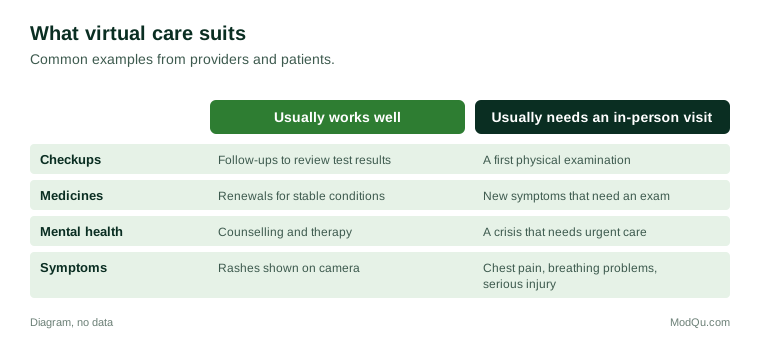
What virtual care suits
Providers and patients generally find virtual care works well for:
- follow-up appointments to review test results;
- prescription renewals for stable conditions;
- mental health counselling and therapy;
- minor problems such as rashes that can be shown on camera, or urinary symptoms;
- managing chronic conditions with home readings;
- advice on whether an in-person visit or emergency care is needed;
- specialist consultations for people in rural and remote areas.
Example
A man living four hours from the nearest city has a follow-up with his cardiologist by video. The appointment takes 15 minutes. Before virtual care, the same follow-up meant a full day off work, a long drive and a hotel night.
What it does not suit
Virtual care has limits. It is less suitable when:
- a physical examination is needed, such as listening to the chest or examining the abdomen;
- tests, procedures or vaccinations are needed;
- symptoms are severe or unclear;
- the patient has hearing, vision or cognitive difficulties that make remote visits hard;
- privacy at home is limited, for example in shared housing or abusive relationships;
- internet access or devices are unreliable.
Many clinics use virtual care to decide who needs to come in, rather than to replace in-person visits entirely.
How patients feel about it
Patients often report high satisfaction with virtual care for the right problems. Reasons include no travel, no waiting room, less time off work, and not needing child care. Concerns include feeling rushed, worrying that something will be missed without an examination, technical problems and missing the personal connection of seeing the provider face to face.
Preferences often depend on age, distance from the clinic, work schedules and the type of concern.
Example
A working parent books a video visit for a recurring skin rash and takes it from their car during a lunch break. They are pleased with the convenience. When the treatment does not work, they ask for an in-person visit, feeling the rash needs to be examined properly.
Phone or video?
Many virtual appointments are by phone rather than video. Phone visits are simple and work for almost everyone, but the provider cannot see the patient. Video visits allow some visual assessment and feel more personal to some patients, but need a suitable device, internet connection and a private space. Patients and providers often choose phone for quick follow-ups and video for new concerns.
Virtual walk-in services
Online services that let people see a clinician without an appointment have grown, especially for people without a family doctor. Some are covered by provincial plans; others charge a fee or are offered through employers. They can be quick and convenient, but they usually do not provide ongoing care, and some provinces have raised concerns about continuity and follow-up.
Example (hypothetical figures)
A traveller with an eye infection uses a private virtual service while away from home. The visit costs $79 and a prescription is sent to a nearby pharmacy within an hour. Back home, they learn their employer benefits would have covered a similar service for free.
Privacy and security
Patients want to know that virtual appointments are private. Providers are expected to use secure platforms and to confirm the patient's identity. Patients also need to think about their own privacy: who can overhear a call, whether a shared computer is safe, and whether messages are sent through secure channels rather than regular email or text.
Access and fairness
Virtual care can improve access for people far from clinics, people with mobility challenges and people with busy schedules. It can also leave some people behind, such as people without reliable internet, people with limited language skills or digital confidence, and some older adults. Health planners pay attention to who uses virtual care and who does not.
Remote monitoring at home
For people with conditions such as heart failure, diabetes and high blood pressure, remote monitoring programs provide devices that send readings to a care team. Nurses check the readings and call patients if something changes. Patients often report feeling safer and more in control, though some find the daily routine of readings tiring.
The future of virtual care
Most health systems now see virtual care as a permanent option rather than a temporary measure. Questions under discussion include how it should be paid for, which services should be virtual first, how to keep continuity with a regular provider, and how to make sure patients can still be seen in person when needed.
Key terms
- Virtual careHealth care delivered without the patient and provider in the same place.
- TelehealthAnother term for providing health services remotely.
- Video visitAn appointment held over a secure video connection.
- Remote patient monitoringDevices that send health readings from home to a care team.
- Secure messagingPrivate messages between patients and providers through a protected portal.
- Virtual walk-in clinicAn online service offering appointments without a regular provider.
- TriageDeciding how urgent a health concern is and what care is needed.
- Patient portalA secure website or app for appointments, results and messages.
Full glossary: telehealth services terms on EditingTests.com.
Virtual care and telehealth vocabulary test
How well do you know the language of this topic? Try 8 quick questions. Your score is shown straight away and is not saved.
What the virtual care and telehealth survey asks
This survey is part of ModQu's Health and Wellness survey. The virtual care and telehealth part takes about five minutes and covers:
- Whether you have had a phone or video appointment in the last year, and with whom.
- How it compared with an in-person visit.
- Which kinds of health concerns you would choose virtual care for first.
- Whether you have used an online walk-in service, and whether you paid for it.
- Any problems you had, such as technology, privacy or feeling rushed.
- How you would like to see virtual care used in future.
After that you can choose to continue with other short parts of the Health and Wellness survey, such as access to family doctors or pharmacy and prescriptions, or stop.
Ready to take part?
Your answers help show what people really think and do. Results are only ever reported as totals; no one can see your individual answers.
Start the surveyQuestions about this survey
Who can take part?
Adults who used health care in the last year.
Do I have to give my name?
No. You may be asked for your age group, region and similar details so results can be broken down, but not your name. ModQu never asks for passwords, card numbers or account numbers.
How are the results used?
Answers are combined into totals and percentages and published in ModQu reports. Individual answers are never shown.
Is the vocabulary test part of the survey?
No. It is optional and separate, and your score is not stored.
Is this survey a medical service?
No. ModQu does not provide health care or advice. If you need care, contact your provider, a nurse line such as 811 where available, or emergency services.
Will you ask which clinic or service I used?
You may be asked the type of service, such as your own clinic or an online service, but not your provider's name.