
Research · Qualitative research
Trustworthiness in Qualitative Research: Credibility, Transferability, Dependability
A concise guide to trustworthiness in qualitative research, explaining credibility, transferability, dependability and confirmability, the techniques that support each, and how to report them.
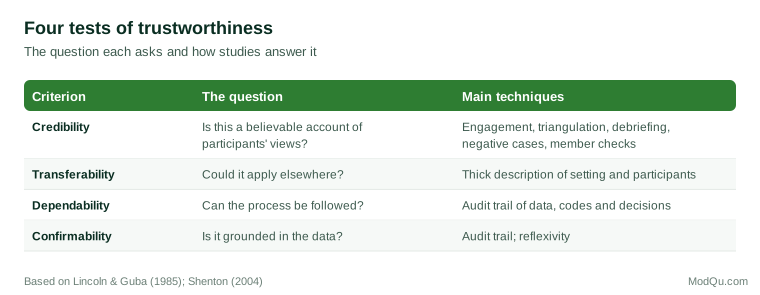
Quantitative studies are judged by validity and reliability: whether they measure what they claim to, and whether the results would be repeated. Qualitative research needs different standards, because it does not rely on statistical samples or standardised measures. Lincoln and Guba (1985) proposed that the quality of qualitative research be judged by its trustworthiness: whether readers can have confidence that the findings are worth paying attention to. They set out four criteria, of which the first three concern this article most directly: credibility, transferability and dependability. The fourth, confirmability, is discussed briefly at the end.
Credibility
Credibility asks whether the findings are a believable and accurate account of participants' experiences and views. It parallels internal validity in quantitative research. Guba (1981) and Lincoln and Guba (1985) proposed several techniques to support it:
- Prolonged engagement: spending enough time with participants or in the setting to understand it and build trust.
- Triangulation: comparing data from different sources, methods or researchers to see whether they point in the same direction.
- Peer debriefing: discussing the analysis with a colleague who can question assumptions.
- Negative case analysis: actively looking for data that do not fit the emerging findings and revising the analysis to account for them.
- Member checking: returning findings to participants to see whether they recognise them.
Member checking needs care. Birt et al. (2016) note that participants may not recognise an interpretation that goes beyond what they said, or may have changed their views since the interview. They proposed returning synthesised findings rather than raw transcripts and treating participants' responses as additional data rather than as a test the analysis must pass.
Transferability
Transferability asks whether findings might apply in other settings. It parallels external validity. Qualitative researchers cannot claim statistical generalisation, so responsibility is shared: the researcher provides a thick description of the setting, participants and context, and readers judge whether the findings are likely to hold in their own situation (Lincoln & Guba, 1985). Shenton (2004) recommended reporting the number and type of organisations and participants, the data collection methods, and the time period of the study, so that readers have the information they need.
Dependability
Dependability asks whether the research process was logical, consistent and documented. It parallels reliability. Because qualitative studies adapt as they proceed, the aim is not that another researcher would produce identical results, but that they could follow the decisions made and see why. The main technique is an audit trail: records of raw data, coding, memos, decisions about sampling and analysis, and how interpretations changed (Nowell et al., 2017). Korstjens and Moser (2018) suggest that a reader should be able to trace each finding back through the analysis to the data.
Confirmability
Confirmability asks whether findings are grounded in the data rather than in the researcher's preferences. It is supported by the audit trail and by reflexivity: the researcher's explicit account of their own position, assumptions and influence on the study.
An example
Consider a hypothetical study of how nurses experience a new electronic records system, based on 20 interviews across three hospitals. To support credibility, the researcher spends two weeks observing shifts before interviewing, compares interview accounts with observation notes, discusses emerging themes with a colleague outside the project and actively looks for nurses whose experience contradicts the main pattern. To support transferability, the report describes each hospital's size, staffing and previous system, and the roles and experience of the nurses interviewed. To support dependability and confirmability, the researcher keeps dated memos, a coding log showing how codes were merged and renamed, and a reflexive note on their own background as a former nurse and how it may have shaped the questions asked.
None of these steps guarantees that the findings are correct. Together, they give readers the means to judge how far to trust them.
Building trustworthiness in, not checking it afterwards
Morse et al. (2002) argued that rigour should be built into the research process through ongoing verification, such as coherence between question and method, appropriate sampling and analysis concurrent with data collection, rather than assessed only at the end. Tracy (2010) similarly emphasised that quality depends on how a study is conducted, not on whether its report lists the right techniques.
Criticisms of the framework
Lincoln and Guba's criteria are widely used but not universally accepted. Some researchers argue that framing qualitative quality as a parallel to quantitative validity keeps qualitative research in the shadow of quantitative standards. Others note that techniques such as member checking and inter-coder agreement can be applied as box-ticking exercises without improving the work. Tracy (2010) proposed broader criteria, such as sincerity, resonance and meaningful coherence, that apply across qualitative traditions. Whichever framework is used, the underlying aim is the same: to make the research process visible and the findings defensible.
Reporting
A trustworthy qualitative report describes what was done to support each criterion, with enough specific detail for readers to judge it. "Member checking was used" says little; "summaries of the four main themes were sent to all 18 participants, 11 replied, and two suggested changes that were incorporated" says much more.
References
Birt, L., Scott, S., Cavers, D., Campbell, C., & Walter, F. (2016). Member checking: A tool to enhance trustworthiness or merely a nod to validation? Qualitative Health Research, 26(13), 1802–1811. https://doi.org/10.1177/1049732316654870
Guba, E. G. (1981). Criteria for assessing the trustworthiness of naturalistic inquiries. Educational Communication and Technology Journal, 29(2), 75–91. https://doi.org/10.1007/BF02766777
Korstjens, I., & Moser, A. (2018). Series: Practical guidance to qualitative research. Part 4: Trustworthiness and publishing. European Journal of General Practice, 24(1), 120–124. https://doi.org/10.1080/13814788.2017.1375092
Lincoln, Y. S., & Guba, E. G. (1985). Naturalistic inquiry. SAGE.
Morse, J. M., Barrett, M., Mayan, M., Olson, K., & Spiers, J. (2002). Verification strategies for establishing reliability and validity in qualitative research. International Journal of Qualitative Methods, 1(2), 13–22. https://doi.org/10.1177/160940690200100202
Nowell, L. S., Norris, J. M., White, D. E., & Moules, N. J. (2017). Thematic analysis: Striving to meet the trustworthiness criteria. International Journal of Qualitative Methods, 16(1). https://doi.org/10.1177/1609406917733847
Shenton, A. K. (2004). Strategies for ensuring trustworthiness in qualitative research projects. Education for Information, 22(2), 63–75. https://doi.org/10.3233/EFI-2004-22201
Tracy, S. J. (2010). Qualitative quality: Eight "big-tent" criteria for excellent qualitative research. Qualitative Inquiry, 16(10), 837–851. https://doi.org/10.1177/1077800410383121