
Research · Qualitative research
Researcher Positionality and Reflexivity in Knowledge Production
What researcher positionality and reflexivity mean, why they matter for how knowledge is produced, the insider and outsider positions, and practical ways to practise and report reflexivity.
Every researcher comes to a study from somewhere. Their background, experience, training, beliefs and relationship to the people being studied shape which questions they ask, what participants tell them and how they interpret what they hear. Positionality is the researcher's position in relation to the study: who they are, and how that may influence the research. Reflexivity is the practice of examining that influence openly and continuously. Both are central to qualitative research, and increasingly recognised as relevant to all research.
Why it matters
Malterud (2001) argued that a researcher's background and position affect what they choose to investigate, the methods they judge most adequate, the findings considered most appropriate and the framing of conclusions. This is not a flaw to be eliminated, because no one can study the social world from nowhere. It is a condition to be acknowledged and examined, so that readers can judge how the researcher's position may have shaped the results.
Finlay (2002) described reflexivity as thoughtful, self-aware analysis of the intersubjective dynamics between researcher and researched. She identified several forms, from introspection on one's own experience to critical examination of power relations in the research, and warned against reflexivity that becomes self-indulgent, focusing on the researcher at the expense of the participants.
Insider and outsider positions
A common way to think about positionality is the distinction between insiders, who share an identity, experience or role with participants, and outsiders, who do not.
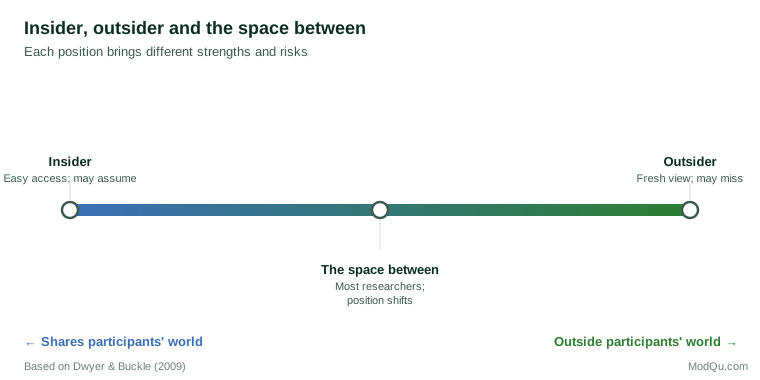
Insiders often gain access and trust more easily, understand the language and context, and can ask informed questions. They may also take shared assumptions for granted, or participants may leave things unsaid because they assume the researcher already knows. Outsiders may notice what insiders overlook and ask naive questions that reveal assumptions, but they may struggle to gain trust or to understand what they hear. Dwyer and Buckle (2009) argued that most researchers occupy a space between: rarely fully inside or outside, with positions that shift during the study. Berger (2015) described how her own position, as someone who had and had not shared participants' experiences in different studies, changed what she noticed and how participants responded.
Practising reflexivity
Reflexivity is a practice, not a single statement. Useful habits include:
- writing a short positionality statement before the study, covering relevant background, assumptions and expectations;
- keeping a reflexive journal throughout, noting reactions, surprises and moments when assumptions were challenged;
- discussing interpretations with colleagues who hold different positions;
- reviewing interview transcripts for how one's own questions and responses shaped the conversation.
Holmes (2020) suggests that researchers consider their position in relation to the subject, the participants and the research context, and recognise that positionality can change over time.
An example
Consider a hypothetical study of small business owners' experience of applying for bank loans, conducted by a researcher who previously worked as a loan officer. Their background helps them understand the process and ask precise questions, and owners may value talking to someone who knows how banks think. But owners may also treat the researcher as a representative of the bank and soften their criticism, and the researcher may find some complaints unreasonable because they know the bank's side. A reflexive approach would note this position at the outset, record moments in interviews when owners seemed guarded, and ask a colleague without banking experience to review the coding of complaints.
Beyond qualitative research
Reflexivity is most often discussed in qualitative research, but positionality also affects quantitative studies, through the choice of questions, the wording of survey items, the categories used for analysis and the interpretation of results. A brief reflexive note can strengthen any study whose findings depend on judgement.
Reporting
A reflexive report states briefly who the researcher is in relation to the study, how this may have influenced access, data and interpretation, and what was done to examine that influence. The aim is not confession but transparency: giving readers what they need to judge the findings.
References
Berger, R. (2015). Now I see it, now I don't: Researcher's position and reflexivity in qualitative research. Qualitative Research, 15(2), 219–234. https://doi.org/10.1177/1468794112468475
Dwyer, S. C., & Buckle, J. L. (2009). The space between: On being an insider-outsider in qualitative research. International Journal of Qualitative Methods, 8(1), 54–63. https://doi.org/10.1177/160940690900800105
Finlay, L. (2002). "Outing" the researcher: The provenance, process, and practice of reflexivity. Qualitative Health Research, 12(4), 531–545. https://doi.org/10.1177/104973202129120052
Holmes, A. G. D. (2020). Researcher positionality: A consideration of its influence and place in qualitative research. A new researcher guide. Shanlax International Journal of Education, 8(4), 1–10. https://doi.org/10.34293/education.v8i4.3232
Malterud, K. (2001). Qualitative research: Standards, challenges, and guidelines. The Lancet, 358(9280), 483–488. https://doi.org/10.1016/S0140-6736(01)05627-6