
ModQu · Modern Queries
Know what your market thinks before you decide.
ModQu surveys the right people on the topics that matter to your business and delivers the findings as ready-to-use data and reports.
How ModQu works
From your question to an answer you can act on
We find the questions your market is asking, survey the people who matter, and turn their answers into clear data and reports.
We find the questions
We choose the topics businesses need to understand and write the questions that get to the heart of each one.
We survey the people who matter
Each topic has its own short survey, answered by the people it concerns. Answers are combined and reported only as totals.
You get data and reports
The findings arrive as ready-to-use data and clear reports, so you can decide with confidence.
Survey areas
34 surveys, 496 topics
Every survey area is made up of topics. Choose an area to see its topics, what each one covers and who answers it.
- Money and Banking 20
- Insurance 16
- Health and Wellness 23
- Shopping and Retail 20
- Technology at Home 16
- Media and Entertainment 16
- Travel and Hospitality 17
- Home and Property 18
- Cars and Getting Around 17
- Work and Careers 17
- Education and Learning 16
- Food and Drink 18
- Energy and Environment 15
- Government and Public Services 17
- Charities and Giving 14
- Arts, Culture and Sport 11
- Pets and Animals 14
- Life Stages and Family 16
- Business and Professional Services 17
- Law and Rights 15
- Beauty and Personal Care 14
- Household Life 14
- Leisure and Lifestyle 14
- Communities and Society 13
- Sports 14
- Brands and Advertising 12
- Fashion and Style 11
- Parenting and Children 10
- Digital Life and the Internet 11
- Religion and Spirituality 10
- Science and Technology Attitudes 10
- Politics and Current Affairs 10
- Personal Development 10
- Safety and Emergencies 10
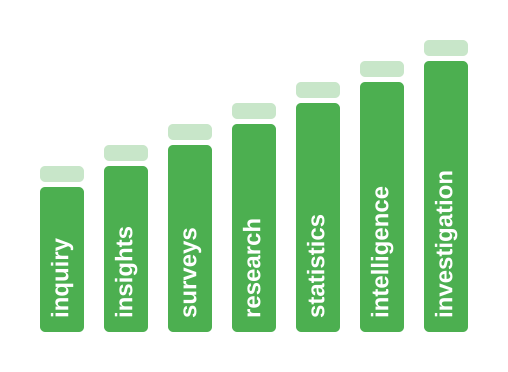
The seven disciplines
The Generation of Knowledge
Good answers rest on good method. Our library of 886 referenced articles explains each discipline behind ModQu's work.
Inquiry
The art of asking good questions and reasoning carefully toward answers.
Insights
What makes a finding useful, and how teams turn data into decisions.
Surveys
How surveys are designed, sampled, fielded and checked, from the first questionnaires to online panels.
Research
The methods and standards behind sound research, from study design to reporting the results.
Statistics
The numbers behind the findings: describing data, testing ideas and reading results correctly.
Intelligence
Turning scattered information into knowledge an organisation can act on.
Investigation
Methods for establishing facts in business, markets, science and public life.
The Generation of Knowledge
How knowledge is created, tested, shared and trusted.
From the library
Start reading
Scholarly, referenced articles with original charts and diagrams. Search the full library or look up a term in the glossary.
- SurveysHow the 1936 Literary Digest Poll Changed Survey Sampling Forever
The Literary Digest asked millions of Americans how they would vote in 1936 and got the answer badly wrong. Here is what went wrong and what survey research learned.
- StatisticsCorrelation Is Not Causation: Spurious Relationships in Data
The main ways a correlation can appear without a causal link, with classic examples, a visual guide to Simpson's paradox, and practical checks before acting on a relationship in data.
- InsightsThe Say-Do Gap: When Stated Attitudes Diverge From Behaviour
Why what people say in surveys often differs from what they do, what research shows about the size of the gap, and how to design research that narrows it.
- InquiryBayesian Reasoning in Everyday Inquiry
How Bayes' theorem describes learning from evidence, why people find it hard, and a simple method that makes Bayesian reasoning easy to apply in everyday decisions.
- IntelligenceSuperforecasting: What Research Says About Accurate Prediction
What a decade of forecasting tournaments revealed about who predicts well, how accuracy is measured, and which habits make forecasts better.
- The Generation of KnowledgeThe DIKW Pyramid: Data, Information, Knowledge, Wisdom
Where the data-information-knowledge-wisdom hierarchy came from, what each level means, how it applies to survey research, and why its critics argue the pyramid should also be read from the top down.
Tell us what your business needs to know.
Contact us