
Insights · Generating insight
The Say-Do Gap: When Stated Attitudes Diverge From Behaviour
Why what people say in surveys often differs from what they do, what research shows about the size of the gap, and how to design research that narrows it.
People tell researchers they will buy the eco-friendly brand, exercise more, save for retirement and read the terms and conditions. Then many of them do not. The difference between stated attitudes or intentions and actual behaviour is known in the insights industry as the say-do gap. It is one of the oldest findings in social science, and one of the most important for anyone who uses survey data to make decisions. Understanding why the gap exists, and when it is large or small, is the difference between research that predicts the market and research that misleads.
A classic demonstration
In the early 1930s the sociologist Richard LaPiere travelled across the United States with a young Chinese couple at a time when prejudice against Asian people was widespread and openly expressed. Together they visited 251 hotels, restaurants and cafés. They were refused service only once. Some months later, LaPiere wrote to the same establishments asking whether they would accept "members of the Chinese race" as guests. Of the 128 that replied, 92% said they would not (LaPiere, 1934).
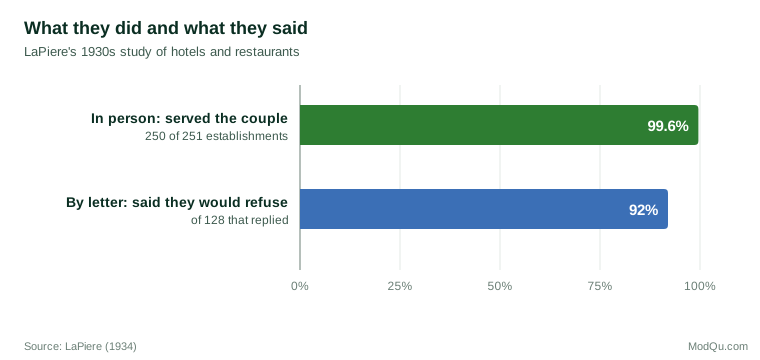
The study has well-known limitations. The people who answered the letter were not necessarily those who had served the travellers, and a well-dressed couple accompanied by a white American in person is a very different "attitude object" from an abstract question about a racial group. Yet these limitations are themselves part of the lesson: a survey question and a real situation can differ in exactly the ways that determine behaviour.
How large is the gap?
By the late 1960s enough studies had accumulated for a systematic review. Wicker (1969) examined dozens of studies that measured both attitudes and behaviour towards the same object and concluded that attitudes were usually only weakly related to behaviour, and often unrelated. This finding prompted something of a crisis in social psychology and a search for the conditions under which attitudes do predict behaviour. Later meta-analyses found a stronger average link, a correlation of about .38 (Kraus, 1995), and showed that attitudes predict better when, for example, they are based on direct experience (Glasman & Albarracín, 2006).
Two developments improved matters considerably. The first was the principle of correspondence. Ajzen and Fishbein (1977) showed that attitudes predict behaviour much better when both are measured at the same level of specificity. A general attitude towards the environment predicts recycling poorly; a specific attitude towards recycling one's own household waste every week predicts it much better. The second was the theory of planned behaviour (Ajzen, 1991), which holds that behaviour follows from intentions, and intentions from three sources: attitudes towards the behaviour, perceived social norms, and perceived control over whether one can carry it out. Across 185 studies, the theory accounted for 27% of the variance in behaviour (Armitage & Conner, 2001).
Even with these improvements, the gap does not close. Sheeran (2002) reviewed meta-analyses of the link between intentions and behaviour and found that intentions typically account for less than a third of the variation in behaviour. Experimental evidence is more telling still. Webb and Sheeran (2006) analysed studies that successfully changed people's intentions and then measured whether behaviour changed too. A medium-to-large change in intention produced only a small-to-medium change in behaviour.
Inclined abstainers
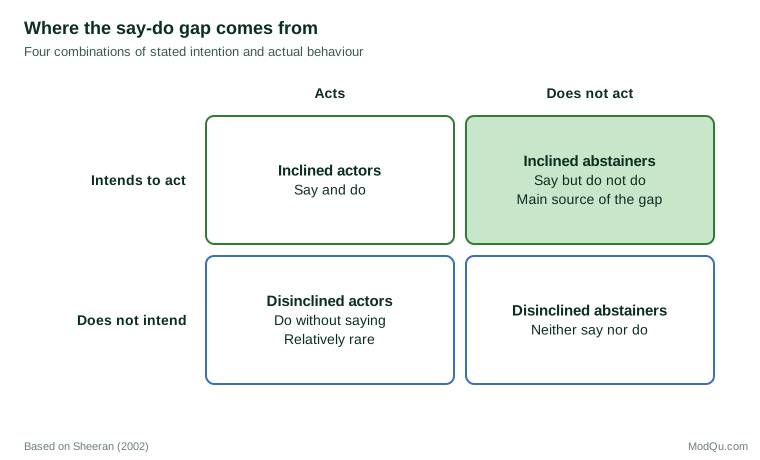
Sheeran (2002) drew attention to the structure of the gap. When people are grouped by what they intend and what they then do, most of the mismatch comes from one group: people who intend to act but do not, whom he called inclined abstainers. Far fewer people do something they had not intended to do. For commercial research this matters, because it means that stated purchase intention usually overstates demand rather than understating it.
Why people say one thing and do another
Research points to several distinct causes. They call for different remedies, so it pays to tell them apart.
Social desirability. Respondents tend to give answers that present them favourably, over-reporting socially approved behaviour such as voting, giving to charity or buying ethical products, and under-reporting disapproved behaviour. Tourangeau and Yan (2007) review the evidence and show that misreporting is larger for sensitive topics and is reduced when questionnaires are self-administered rather than delivered by an interviewer.
Hypothetical questions. A survey asks people to imagine a choice without its real costs. When Auger and Devinney (2007) compared conventional survey questions about ethical product features with methods that forced respondents to make trade-offs, the importance of ethical features fell sharply. Without a price to pay, it costs nothing to say that a feature matters.
Situational barriers. Behaviour happens in a specific context, with competing demands, habits, prices and availability. Carrington et al. (2010) argue that the gap between ethical intentions and ethical purchasing is explained in part by whether consumers form concrete plans, whether they have actual control in the shopping situation, and what happens in that situation. Specific if-then plans for when and where to act help people follow through (Gollwitzer, 1999), and White et al. (2019) review further factors that help close the gap for sustainable behaviour.
Limited self-knowledge. People do not always know why they do what they do. Nisbett and Wilson (1977) showed that when people explain the causes of their own choices, they often give plausible reasons that do not match the factors that actually influenced them. Asking respondents why they bought something, or what would make them switch, can therefore produce confident but inaccurate answers.
Time and change. Intentions are measured at one moment and behaviour happens later. The longer the interval, the more circumstances, prices, competitors and priorities change. Asking can also alter behaviour: Chandon et al. (2005) found that measuring intentions strengthened their link with later purchase among the people surveyed.
Habit. Much everyday behaviour, such as the brands people buy routinely or the way they travel to work, is driven by habit rather than by deliberate choice. A survey invites respondents to think deliberately about a decision they normally make automatically. Their answers describe what they would choose if they stopped to think, which may differ from what they do when they do not. Ouellette and Wood (1998) found that for behaviour performed often in stable settings, past behaviour predicts future behaviour better than intentions do.
These causes often operate together. A shopper who says they will buy the sustainable option may be partly giving the approved answer, partly ignoring the price premium, and partly forgetting that they usually buy whatever is on the shelf at eye level.
When stated intentions predict well
The gap is not constant. Morwitz et al. (2007) analysed many studies linking purchase intentions to later sales and found that intentions were more predictive for existing products than for new ones, for durable goods than for non-durable goods, for short time horizons than for long ones, and when respondents were asked about specific brands or models rather than product categories. These patterns give practical guidance about when survey intentions can be taken nearly at face value and when they must be heavily discounted.
Narrowing the gap in practice
Good research design cannot eliminate the say-do gap, but it can reduce it and make the remaining gap predictable.
- Ask about specific behaviour. Follow the principle of correspondence: ask about a defined action, target, context and time frame. "How many times in the past seven days did you…" is more useful than "How important is it to you to…".
- Measure past behaviour, not only intentions. Recent past behaviour is usually the best single predictor of future behaviour, and it is less open to wishful thinking than a forecast.
- Use probability scales. Juster (1966) showed that asking people to rate the probability that they will buy, on a scale from 0 to 10, predicted later purchases better than simple yes/no intention questions.
- Force trade-offs. Methods such as conjoint analysis and best-worst scaling make respondents choose between bundles of features and prices, which better reflects real decisions (Auger & Devinney, 2007; Green & Srinivasan, 1990).
- Reduce social pressure. Self-administered online questionnaires, neutral wording and assurances of confidentiality reduce socially desirable answering (Tourangeau & Yan, 2007).
- Calibrate against outcomes. Where possible, compare past survey intentions with actual sales or behaviour, and use the ratio to adjust new estimates. A company that knows that only a fraction of its "definitely will buy" respondents typically buy can turn stated intentions into realistic forecasts.
- Combine survey and behavioural data. Linking survey responses, with consent, to transaction or usage data shows where the gap lies and why.
A worked example: from stated intention to forecast
Suppose a company tests a new subscription service with a survey of 1,000 target customers. Asked how likely they are to subscribe in the next three months, 15% say "definitely", 25% say "probably", and the rest say they might or would not. Taken at face value, the survey suggests that up to 40% of the target market will sign up. A team that plans capacity on that basis is likely to be disappointed.
A more realistic forecast discounts each answer by the rate at which similar answers have turned into behaviour in the past. Suppose the company's records from earlier launches show that about half of "definitely" respondents and about one in six of "probably" respondents actually bought within the stated period, and that very few of the others did. The forecast then becomes roughly 0.5 × 15% + 0.17 × 25%, or about 12% of the target market. These conversion rates are illustrative; the right figures differ between categories, which is why the evidence from Morwitz et al. (2007) on new versus existing products, and on short versus long time horizons, is useful when a company has no history of its own.
The example also shows why the type of question matters. A probability scale, as Juster (1966) proposed, lets respondents express degrees of likelihood, and those degrees can be calibrated in the same way. A single yes/no question forces people who are uncertain to choose one side, which loses information and usually exaggerates the "yes" answer.
Questions to ask of any stated-preference finding
When reviewing research that reports what people say they want, value or intend to do, a short set of questions helps judge how far the findings can be trusted as a guide to behaviour:
- How specific was the question? Did it ask about a defined action in a defined context, or about a general attitude? General questions rarely predict specific behaviour well (Ajzen & Fishbein, 1977).
- Was there a cost to the answer? Did respondents have to trade off price, convenience or other features, or could they say "yes" to everything?
- Is the topic socially sensitive? Questions about ethics, health, money or prejudice invite answers that present respondents in a good light (Tourangeau & Yan, 2007).
- How far in the future is the behaviour? The longer the horizon, the larger the gap is likely to be.
- Is the product or behaviour familiar? People forecast their behaviour more accurately for things they have done before than for new products or new habits (Morwitz et al., 2007).
- Who might the inclined abstainers be? Which barriers, such as price, availability, effort or habit, could stop people who intend to act from doing so?
- Is there behavioural evidence to compare? Past purchases, usage data or results from small field tests can show whether stated preferences translate into action.
Research that scores well on these questions can be used with reasonable confidence. Research that scores poorly is not worthless, since it may still reveal what people value and why, but its numbers should not be read as a forecast of what they will do.
What the gap tells us
The say-do gap is sometimes taken as proof that surveys cannot be trusted. That conclusion is too strong. Surveys remain the most direct way to learn what people think, feel and intend, and to reach the reasons behind behaviour that transaction data alone cannot show. The gap is better understood as a known and measurable property of survey data, like sampling error. Researchers who ask specific questions, measure behaviour as well as intention, and calibrate against outcomes can turn stated responses into reliable insight. Those who take every stated intention at face value will consistently overestimate demand.
References
Ajzen, I. (1991). The theory of planned behavior. Organizational Behavior and Human Decision Processes, 50(2), 179–211. https://doi.org/10.1016/0749-5978(91)90020-T
Ajzen, I., & Fishbein, M. (1977). Attitude-behavior relations: A theoretical analysis and review of empirical research. Psychological Bulletin, 84(5), 888–918. https://doi.org/10.1037/0033-2909.84.5.888
Armitage, C. J., & Conner, M. (2001). Efficacy of the theory of planned behaviour: A meta-analytic review. British Journal of Social Psychology, 40(4), 471–499. https://doi.org/10.1348/014466601164939
Auger, P., & Devinney, T. M. (2007). Do what consumers say matter? The misalignment of preferences with unconstrained ethical intentions. Journal of Business Ethics, 76(4), 361–383. https://doi.org/10.1007/s10551-006-9287-y
Carrington, M. J., Neville, B. A., & Whitwell, G. J. (2010). Why ethical consumers don't walk their talk: Towards a framework for understanding the gap between the ethical purchase intentions and actual buying behaviour of ethically minded consumers. Journal of Business Ethics, 97(1), 139–158. https://doi.org/10.1007/s10551-010-0501-6
Chandon, P., Morwitz, V. G., & Reinartz, W. J. (2005). Do intentions really predict behavior? Self-generated validity effects in survey research. Journal of Marketing, 69(2), 1–14. https://doi.org/10.1509/jmkg.69.2.1.60755
Glasman, L. R., & Albarracín, D. (2006). Forming attitudes that predict future behavior: A meta-analysis of the attitude-behavior relation. Psychological Bulletin, 132(5), 778–822. https://doi.org/10.1037/0033-2909.132.5.778
Gollwitzer, P. M. (1999). Implementation intentions: Strong effects of simple plans. American Psychologist, 54(7), 493–503. https://doi.org/10.1037/0003-066X.54.7.493
Green, P. E., & Srinivasan, V. (1990). Conjoint analysis in marketing: New developments with implications for research and practice. Journal of Marketing, 54(4), 3–19. https://doi.org/10.1177/002224299005400402
Juster, F. T. (1966). Consumer buying intentions and purchase probability: An experiment in survey design. Journal of the American Statistical Association, 61(315), 658–696. https://doi.org/10.1080/01621459.1966.10480897
Kraus, S. J. (1995). Attitudes and the prediction of behavior: A meta-analysis of the empirical literature. Personality and Social Psychology Bulletin, 21(1), 58–75. https://doi.org/10.1177/0146167295211007
LaPiere, R. T. (1934). Attitudes vs. actions. Social Forces, 13(2), 230–237. https://doi.org/10.2307/2570339
Morwitz, V. G., Steckel, J. H., & Gupta, A. (2007). When do purchase intentions predict sales? International Journal of Forecasting, 23(3), 347–364. https://doi.org/10.1016/j.ijforecast.2007.05.015
Nisbett, R. E., & Wilson, T. D. (1977). Telling more than we can know: Verbal reports on mental processes. Psychological Review, 84(3), 231–259. https://doi.org/10.1037/0033-295X.84.3.231
Ouellette, J. A., & Wood, W. (1998). Habit and intention in everyday life: The multiple processes by which past behavior predicts future behavior. Psychological Bulletin, 124(1), 54–74. https://doi.org/10.1037/0033-2909.124.1.54
Sheeran, P. (2002). Intention–behavior relations: A conceptual and empirical review. European Review of Social Psychology, 12(1), 1–36. https://doi.org/10.1080/14792772143000003
Tourangeau, R., & Yan, T. (2007). Sensitive questions in surveys. Psychological Bulletin, 133(5), 859–883. https://doi.org/10.1037/0033-2909.133.5.859
Webb, T. L., & Sheeran, P. (2006). Does changing behavioral intentions engender behavior change? A meta-analysis of the experimental evidence. Psychological Bulletin, 132(2), 249–268. https://doi.org/10.1037/0033-2909.132.2.249
White, K., Habib, R., & Hardisty, D. J. (2019). How to SHIFT consumer behaviors to be more sustainable: A literature review and guiding framework. Journal of Marketing, 83(3), 22–49. https://doi.org/10.1177/0022242919825649
Wicker, A. W. (1969). Attitudes versus actions: The relationship of verbal and overt behavioral responses to attitude objects. Journal of Social Issues, 25(4), 41–78. https://doi.org/10.1111/j.1540-4560.1969.tb00619.x