
Insights · Generating insight
Pain Points and Gain Points in Customer Experience
How to identify the moments in a customer journey that frustrate or delight customers, why negative moments usually matter more, and how research on memory and switching helps decide which points to fix first.
Every customer experience contains moments that go well and moments that go badly. Pain points are the frustrations, obstacles and anxieties customers meet when trying to get something done. Gain points are the moments that deliver more than customers expected or that make the experience noticeably easier or more pleasant. Finding these points, and judging which matter most, is one of the most practical forms of customer insight.
Pains and gains in the customer journey
Lemon and Verhoef (2016) described the customer experience as a journey through many touchpoints before, during and after purchase, some controlled by the firm and some not. Pain and gain points can occur at any of them. Osterwalder et al. (2014) used the terms "pains" and "gains" in their value proposition design method, describing pains as the bad outcomes, risks and obstacles customers face when trying to get a job done, and gains as the outcomes and benefits they want. A good value proposition relieves important pains and creates important gains.
Rawson et al. (2013) argued that companies often measure satisfaction with individual touchpoints while missing problems that arise across the whole journey, such as having to repeat information to several departments. A journey can be made up of touchpoints that each score well and still be frustrating overall. Pain point research therefore needs to look at the journey as the customer experiences it, not only at each interaction.
Why pains usually matter more than gains
A large body of research shows that negative experiences have stronger effects than positive ones of similar size. Kahneman and Tversky (1979) found that losses loom larger than equivalent gains in people's choices. Baumeister et al. (2001) reviewed evidence across many areas of psychology and concluded that bad events, feedback and experiences generally have greater and longer-lasting effects than good ones.
Service research shows the same pattern. Keaveney (1995) asked customers who had switched service providers why they left, and found that core service failures and failed service encounters with staff were the most frequently cited reasons, ahead of price. Dixon et al. (2010) argued, from research on customer service interactions, that reducing the effort customers must make to resolve problems does more for loyalty than trying to exceed their expectations. Their conclusion was that removing pain points is usually a better investment than adding moments of delight.
This does not mean that gains are unimportant. Gain points distinguish an offer from competitors and give customers reasons to recommend it. But a gain rarely compensates for a serious pain elsewhere in the journey.
How memory shapes the experience
Customers do not remember every moment of an experience equally. Redelmeier and Kahneman (1996) studied patients undergoing uncomfortable medical procedures and found that their later evaluations were strongly related to the worst moment and the final moments, while the total duration of discomfort had little effect. This "peak-end" pattern suggests that the most intense pain point and the way an experience ends deserve particular attention, because they shape what customers remember and therefore what they tell others and whether they return.
Finding pain and gain points
Several methods help identify pain and gain points.
Critical incident technique. Flanagan (1954) developed a method of collecting specific accounts of events that were notably effective or ineffective. Bitner et al. (1990) applied it to service encounters, asking customers to describe particular occasions when they were especially satisfied or dissatisfied, and classified the incidents to reveal the employee behaviours that caused them. Asking for specific incidents produces richer and more accurate information than asking for general opinions.
Journey mapping. Mapping the stages of an experience with customers, and asking how they felt at each stage, shows where experience rises and falls.
Behavioural data. Drop-off rates, repeated contacts, complaint volumes and time taken at each stage reveal where customers struggle, even if they do not mention it.
Open-ended feedback. Comments in surveys and reviews, coded by journey stage and theme, show which pains are most common and how customers describe them.
An example
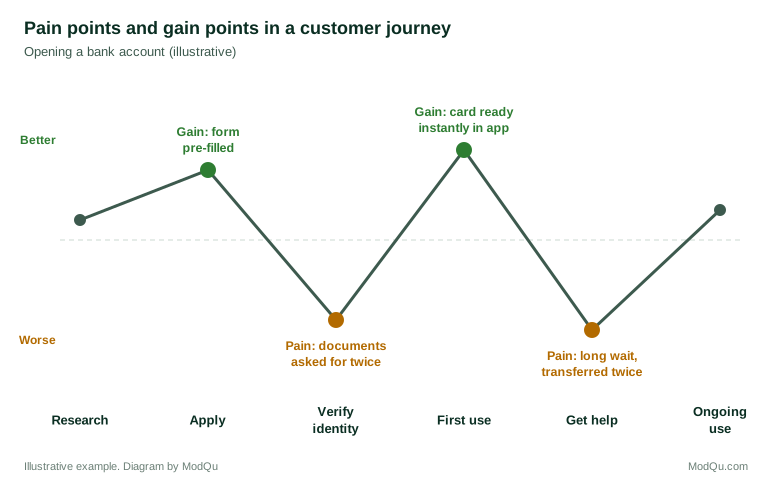
In the illustrative journey above, a new bank customer finds the application easy because much of the form is pre-filled, and is pleased that a card is available in the app immediately. But identity verification requires the same documents to be submitted twice, and the first call for help involves a long wait and two transfers. Following the peak-end pattern, the call for help is likely to dominate the customer's memory of the experience if it is the most recent and most intense moment. A bank that invested only in adding further gains, such as a welcome offer, would leave the two pains in place. Fixing the duplicated document request and the help process would probably do more for retention and recommendation, because these are the moments most likely to be remembered and retold.
Deciding what to fix
Not every pain point deserves equal attention. Useful questions for prioritising include: How many customers experience it? How severe is it? Does it occur at a peak or at the end of the experience? Is it linked to customers leaving or complaining? And how costly is it to fix? Pain points that are common, severe, memorable and linked to loss of customers are the clearest priorities.
Key takeaways
Pain points and gain points are the moments in a customer journey that frustrate or delight. Research shows that negative experiences usually have stronger effects than positive ones, and that customers remember the worst moment and the end of an experience most clearly. Critical incidents, journey maps, behavioural data and open-ended feedback reveal where these points lie. Fixing common, severe and memorable pains generally does more for loyalty than adding delight, although gains remain important for distinguishing an offer.
References
Baumeister, R. F., Bratslavsky, E., Finkenauer, C., & Vohs, K. D. (2001). Bad is stronger than good. Review of General Psychology, 5(4), 323–370. https://doi.org/10.1037/1089-2680.5.4.323
Bitner, M. J., Booms, B. H., & Tetreault, M. S. (1990). The service encounter: Diagnosing favorable and unfavorable incidents. Journal of Marketing, 54(1), 71–84. https://doi.org/10.1177/002224299005400105
Dixon, M., Freeman, K., & Toman, N. (2010). Stop trying to delight your customers. Harvard Business Review, 88(7/8), 116–122.
Flanagan, J. C. (1954). The critical incident technique. Psychological Bulletin, 51(4), 327–358. https://doi.org/10.1037/h0061470
Kahneman, D., & Tversky, A. (1979). Prospect theory: An analysis of decision under risk. Econometrica, 47(2), 263–291. https://doi.org/10.2307/1914185
Keaveney, S. M. (1995). Customer switching behavior in service industries: An exploratory study. Journal of Marketing, 59(2), 71–82. https://doi.org/10.1177/002224299505900206
Lemon, K. N., & Verhoef, P. C. (2016). Understanding customer experience throughout the customer journey. Journal of Marketing, 80(6), 69–96. https://doi.org/10.1509/jm.15.0420
Osterwalder, A., Pigneur, Y., Bernarda, G., & Smith, A. (2014). Value proposition design: How to create products and services customers want. Wiley.
Rawson, A., Duncan, E., & Jones, C. (2013). The truth about customer experience. Harvard Business Review, 91(9), 90–98.
Redelmeier, D. A., & Kahneman, D. (1996). Patients' memories of painful medical treatments: Real-time and retrospective evaluations of two minimally invasive procedures. Pain, 66(1), 3–8. https://doi.org/10.1016/0304-3959(96)02994-6