
Insights · Generating insight
Segmentation as a Source of Insight
How dividing customers into meaningful groups reveals insight that averages hide, the main bases and methods of segmentation, and what makes a segmentation useful rather than merely interesting.
Averages conceal. A finding that customers are "moderately satisfied" or "somewhat interested" in a new product may describe almost nobody, if the average combines a group that is delighted with one that is indifferent. Segmentation, dividing a market into groups of customers who are similar to each other and different from other groups, is one of the most reliable ways to reveal what averages hide.
The idea of segmentation
Smith (1956) introduced market segmentation as a strategy that recognises differences in customer needs and adjusts products and marketing to them, in contrast to product differentiation, which tries to shape demand around a single product. Dickson and Ginter (1987) later clarified the distinction, defining segmentation in terms of differences in customers' demand and differentiation in terms of differences in how customers perceive products.
For insight work, segmentation matters because the most useful insights are often about specific groups: why one group is leaving, what another group values that competitors do not provide, or which group would respond to a new offer.
Bases for segmentation
Customers can be grouped on many bases, and the choice determines what kind of insight the segmentation produces.
Demographic and firmographic bases, such as age, income, company size or industry, are easy to measure and to target, but often explain little about why customers behave as they do.
Behavioural bases, such as purchase frequency, channel use or product holdings, describe what customers do and are often available from transaction data.
Needs and benefits bases group customers by what they want. Haley (1968) argued that the benefits people seek from a product are the basic reasons for differences in their behaviour, and proposed benefit segmentation as a decision-oriented research tool. In Haley's classic illustration, toothpaste buyers fell into groups seeking decay prevention, bright teeth, flavour or low price, each with a distinct profile.
Attitudinal and psychographic bases group customers by values, attitudes or lifestyles.
Yankelovich and Meer (2006) argued that many segmentations fail because they use bases chosen for their general descriptive appeal, such as lifestyle profiles, rather than for their relevance to a specific business decision. They recommended choosing the basis according to the decision: a segmentation for pricing should group customers by price sensitivity, one for product design by needs.
Methods
Needs-based and attitudinal segments are usually identified statistically from survey data. Cluster analysis, of which k-means is the most widely used form, groups respondents so that those within each cluster are as similar as possible (Steinley, 2006). Latent class and mixture models estimate segments as unobserved groups with different patterns of response, and allow the number of segments to be compared statistically (Wedel & Kamakura, 2000). Dolnicar et al. (2018) emphasised that these methods always produce segments, whether or not natural groups exist in the data, and that the analyst must check whether the solution is stable across repeated runs and samples before relying on it.
Where the insight lies
Segmentation produces insight when the segments differ in ways that matter for a decision. Comparing segments on size, value, needs and current performance often reveals that a small group accounts for a large share of revenue, that the most valuable group is the least satisfied, or that a group of customers has needs no current offer meets.
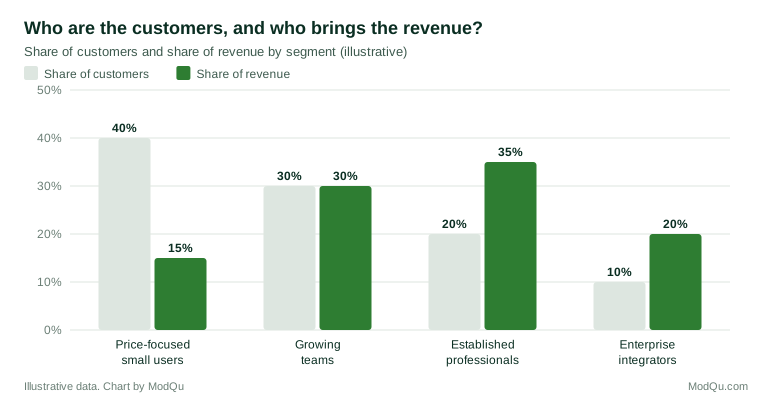
In this example, the largest segment by number of customers contributes the smallest share of revenue, while established professionals, only a fifth of customers, provide more than a third of revenue. A product plan based on the average customer would be dominated by the needs of the price-focused group. A plan based on the segmentation would give more weight to the needs of the groups that create most value.
Comparing segments on satisfaction and loyalty adds a further layer. If the established professionals were also the least satisfied group, the segmentation would point to a clear priority: protecting the customers who matter most to revenue before they leave. Such combinations of value and risk are among the most actionable findings segmentation can produce.
What makes a segmentation useful
Christensen et al. (2005) argued that segmentations based on product categories or customer characteristics often miss the circumstances and goals that actually drive purchase, and proposed segmenting by the job a customer is trying to get done. Whatever the basis, a useful segmentation has several features: segments that are meaningfully different in needs or behaviour, large enough to matter, stable over time, identifiable so that customers can be assigned to them, and actionable for the decisions at hand.
Dibb and Simkin (2009) studied why segmentation projects often fail to change practice, and identified problems of implementation as much as analysis: lack of senior support, poor links between the segmentation and existing data systems, and segments that sales and service staff cannot recognise. Many organisations address this by building a short scoring model that assigns customers in the database to segments using a few questions or behavioural variables.
Key takeaways
Segmentation reveals insight that averages hide by showing how groups of customers differ. The basis chosen, demographic, behavioural, needs, or attitudinal, determines what kind of insight results and should follow the decision at hand. Statistical methods always produce segments, so stability and meaning must be checked. The most valuable insights usually come from comparing segments on size, value, needs and performance, and the most valuable segmentations are those the organisation can recognise and act upon.
References
Christensen, C. M., Cook, S., & Hall, T. (2005). Marketing malpractice: The cause and the cure. Harvard Business Review, 83(12), 74–83.
Dibb, S., & Simkin, L. (2009). Implementation rules to bridge the theory/practice divide in market segmentation. Journal of Marketing Management, 25(3–4), 375–396. https://doi.org/10.1362/026725709X429808
Dickson, P. R., & Ginter, J. L. (1987). Market segmentation, product differentiation, and marketing strategy. Journal of Marketing, 51(2), 1–10. https://doi.org/10.1177/002224298705100201
Dolnicar, S., Grün, B., & Leisch, F. (2018). Market segmentation analysis: Understanding it, doing it, and making it useful. Springer. https://doi.org/10.1007/978-981-10-8818-6
Haley, R. I. (1968). Benefit segmentation: A decision-oriented research tool. Journal of Marketing, 32(3), 30–35. https://doi.org/10.1177/002224296803200306
Smith, W. R. (1956). Product differentiation and market segmentation as alternative marketing strategies. Journal of Marketing, 21(1), 3–8. https://doi.org/10.1177/002224295602100102
Steinley, D. (2006). K-means clustering: A half-century synthesis. British Journal of Mathematical and Statistical Psychology, 59(1), 1–34. https://doi.org/10.1348/000711005X48266
Wedel, M., & Kamakura, W. A. (2000). Market segmentation: Conceptual and methodological foundations (2nd ed.). Kluwer Academic. https://doi.org/10.1007/978-1-4615-4651-1
Yankelovich, D., & Meer, D. (2006). Rediscovering market segmentation. Harvard Business Review, 84(2), 122–131.