
Research · Qualitative research
Netnography: Studying Online Communities
What netnography is and how to use it to study online communities, covering its origins in marketing research, the steps of a netnographic study, the three kinds of data, analysis, the debate about passive observation, ethics, and practical uses for brands.
Netnography is ethnography adapted to online communities and social media. The term, combining "internet" and "ethnography", was introduced by Robert Kozinets in the late 1990s to describe a method for studying the cultures that form in online forums, newsgroups and, later, social media platforms. It has become one of the main qualitative approaches for understanding how consumers and other groups talk, share and build meaning online. This article explains the method, its steps and its ethical challenges.
Origins
Kozinets (1999) argued that online "communities of consumption", groups of people who gather online around a shared interest in a product or activity, were becoming important sources of information and influence for consumers, and that marketers needed to understand them. Kozinets (2002) then set out netnography as a research method, illustrated by a study of an online coffee newsgroup. The study showed how members discussed brewing techniques, judged brands, shared rituals and developed a shared vocabulary of quality, providing insight into coffee culture that surveys could not.
The method drew on traditional ethnography, with its emphasis on immersion, participant observation and interpretation of cultural meaning (Hammersley & Atkinson, 2019), and on earlier work on virtual ethnography, which treated online interaction as a cultural setting in its own right (Hine, 2000).
What netnography studies
Netnography is suited to questions about the shared culture of an online group: its language, values, norms, rituals, hierarchies and conflicts, and how members use products, brands or ideas within it. Research on brand communities illustrates the kind of insight it produces. Muniz and O'Guinn (2001) identified the shared consciousness, rituals and sense of moral responsibility that bind brand communities. Schau et al. (2009) identified practices through which members create value for each other and for the brand, such as welcoming newcomers, sharing customisations and documenting milestones.
Netnography is also used for sensitive topics, where people may discuss online what they would not say in an interview. Langer and Beckman (2005) studied an online forum about cosmetic surgery and argued that netnography could provide access to frank discussion that other methods would struggle to obtain. The online disinhibition effect, in which people say things online that they would not say in person, contributes to this frankness (Suler, 2004).
The steps of a netnographic study
Kozinets (2015, 2020) set out netnography as a series of procedures that researchers move through, often returning to earlier steps.
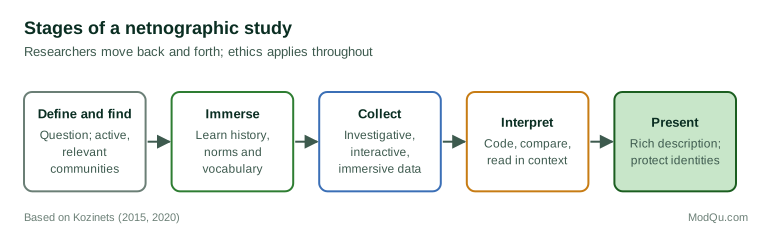
The researcher first defines the research question and identifies suitable online sites: communities that are relevant to the question, active, with substantial and detailed interaction among many members. Next, the researcher becomes familiar with the community, reading its history, learning its norms and vocabulary, and observing how members interact. Data are then collected and analysed, often over weeks or months, and interpretations are refined and presented.
Three kinds of data
Kozinets (2020) distinguished three types of data. Investigative data are existing posts, comments and images that the researcher finds and selects; they are produced without the researcher's involvement. Interactive data are produced through the researcher's engagement with the community, such as replies to questions the researcher posts or online interviews with members. Immersive data are the researcher's own field notes, recording observations, reactions and emerging interpretations.
Most netnographies rely heavily on investigative data, which are abundant. Kozinets emphasises that immersive field notes are essential, because they capture the researcher's developing understanding and distinguish netnography from simple content analysis of posts.
Analysis and interpretation
Analysis follows ethnographic principles. The researcher codes posts and field notes, looks for patterns in language and practice, and interprets them in terms of the community's culture. Attention is paid to context: who is posting, in reply to whom, with what reaction from others. A post that receives a stream of agreement means something different from one that provokes argument or is ignored. The final account presents the culture with rich description and extracts, as in traditional ethnography.
Participation or observation?
A long-running debate concerns how far the researcher should participate. Kozinets (2002) originally recommended that researchers disclose their presence and engage with the community, in line with ethnographic participation. In practice, many studies observe passively, collecting posts without ever interacting. Costello et al. (2017) reviewed netnographic studies and found that many relied on passive observation, and argued that this missed opportunities for the deeper understanding that participation brings. Bartl et al. (2016) found a rapid growth in netnographic studies across disciplines, with wide variation in how closely they followed the method.
Passive observation is closer to content analysis than to ethnography. It can still be valuable, but studies should describe what they did accurately rather than claiming the full method.
Choosing communities
The choice of sites shapes everything that follows. Kozinets (2015) suggested that good sites are relevant to the research question, active, interactive, substantial in the number of members and posts, heterogeneous in the views expressed, and rich in detailed content. A large, busy forum with short, repetitive posts may be less useful than a smaller community where members write long, considered accounts.
Platforms differ too. Forums and discussion boards keep long threads and histories, which suit the study of norms and debates over time. Social media platforms produce brief, fast-moving posts, often linked to images and video, which suit the study of how topics spread and how people present themselves. Many netnographies combine several sites, which helps to show whether patterns are specific to one community or shared more widely.
Quality
The quality of a netnography can be judged by the usual standards of ethnography: the depth and duration of immersion, the richness of the data, the transparency of the analysis and the plausibility of the interpretation. Kozinets (2002) recommended member checks, sharing interpretations with community members to see whether they recognise them, as a way of strengthening credibility. Reports should state which sites were studied and for how long, how data were selected, whether and how the researcher participated, and how ethical issues were handled.
Ethics
Netnography raises the ethical questions common to all research on existing online spaces. Eysenbach and Till (2001) argued that whether a community is technically public is less important than whether its members perceive it as private, and that researchers should consider the potential for harm, especially in communities dealing with health or other sensitive matters. Quoted posts can often be traced back to their authors through search engines, so quotations may need to be paraphrased or used only with permission. The Association of Internet Researchers recommends that ethical decisions be made case by case, weighing the expectations of the community, the vulnerability of its members and the risks of identification (franzke et al., 2020).
Kozinets (2015) recommends that researchers disclose their presence and purpose when they participate, seek permission for quotations where appropriate, and protect the identities of members in published work.
Netnography for brands
For businesses, netnography offers a way to understand customers in their own words and settings. A hypothetical example: an outdoor equipment brand studies three hiking forums for four months, observing and occasionally asking questions with members' knowledge. The study shows that experienced hikers judge equipment less by weight or price than by stories of how it performed in bad weather, and that the most respected members are those who repair gear rather than replace it. The brand responds by publishing repair guides and collecting field stories from customers, rather than advertising specifications.
Netnography is not a substitute for measuring how widespread views are. Online communities are self-selected and often dominated by their most active members. Findings show the culture of the community studied, which may be influential but is not representative of all customers.
Conclusion
Netnography adapts the commitments of ethnography, immersion, attention to culture and interpretive depth, to online communities. Done well, it reveals the language, values and practices of groups that shape opinions and behaviour, using data that people produce naturally. Its value depends on genuine immersion, careful analysis and ethical treatment of the people whose words become data.
References
Bartl, M., Kannan, V. K., & Stockinger, H. (2016). A review and analysis of literature on netnography research. International Journal of Technology Marketing, 11(2), 165–196. https://doi.org/10.1504/IJTMKT.2016.075687
Costello, L., McDermott, M.-L., & Wallace, R. (2017). Netnography: Range of practices, misperceptions, and missed opportunities. International Journal of Qualitative Methods, 16(1). https://doi.org/10.1177/1609406917700647
Eysenbach, G., & Till, J. E. (2001). Ethical issues in qualitative research on internet communities. BMJ, 323(7321), 1103–1105. https://doi.org/10.1136/bmj.323.7321.1103
franzke, a. s., Bechmann, A., Zimmer, M., Ess, C., & the Association of Internet Researchers. (2020). Internet research: Ethical guidelines 3.0. Association of Internet Researchers. https://aoir.org/reports/ethics3.pdf
Hammersley, M., & Atkinson, P. (2019). Ethnography: Principles in practice (4th ed.). Routledge.
Hine, C. (2000). Virtual ethnography. SAGE. https://doi.org/10.4135/9780857020277
Kozinets, R. V. (1999). E-tribalized marketing? The strategic implications of virtual communities of consumption. European Management Journal, 17(3), 252–264. https://doi.org/10.1016/S0263-2373(99)00004-3
Kozinets, R. V. (2002). The field behind the screen: Using netnography for marketing research in online communities. Journal of Marketing Research, 39(1), 61–72. https://doi.org/10.1509/jmkr.39.1.61.18935
Kozinets, R. V. (2015). Netnography: Redefined (2nd ed.). SAGE.
Kozinets, R. V. (2020). Netnography: The essential guide to qualitative social media research (3rd ed.). SAGE.
Langer, R., & Beckman, S. C. (2005). Sensitive research topics: Netnography revisited. Qualitative Market Research, 8(2), 189–203. https://doi.org/10.1108/13522750510592454
Muniz, A. M., Jr., & O'Guinn, T. C. (2001). Brand community. Journal of Consumer Research, 27(4), 412–432. https://doi.org/10.1086/319618
Schau, H. J., Muñiz, A. M., Jr., & Arnould, E. J. (2009). How brand community practices create value. Journal of Marketing, 73(5), 30–51. https://doi.org/10.1509/jmkg.73.5.30
Suler, J. (2004). The online disinhibition effect. CyberPsychology & Behavior, 7(3), 321–326. https://doi.org/10.1089/1094931041291295