
Research · Qualitative research
Discourse Analysis in Social and Market Research
What discourse analysis is and how it is used in social and market research, covering the idea that language constructs as well as describes, the main approaches from conversation analysis to critical discourse analysis, how an analysis proceeds, and practical commercial applications.
Most research treats language as a window: people's words are taken as reports of what they think, feel or do. Discourse analysis treats language as an action in its own right. It asks not only what people say, but what their words do: how they construct a version of events, present the speaker in a particular light, justify a position or make some options seem natural and others unthinkable. This article explains the main ideas behind discourse analysis, its principal approaches and how it can be applied in social and market research.
Language as action
Potter and Wetherell (1987) set out the foundations of discourse analysis in social psychology. They argued that people's accounts vary with context, often in ways that a single underlying attitude cannot explain. The same person may describe immigration positively when talking about a friend and negatively when talking about jobs. Rather than treating such variation as noise around a "true" attitude, discourse analysis treats it as evidence of what the talk is doing in each setting. Edwards and Potter (1992) developed this into discursive psychology, which studies how psychological concepts such as memory, blame and intention are handled in everyday talk.
A related idea is that discourse constructs social reality. Phillips and Hardy (2002) describe discourse analysis as the study of how sets of texts bring objects, identities and relationships into being. Terms such as "customer", "stakeholder" or "talent" are not neutral labels; each frames people in a particular way and makes certain actions seem appropriate.
Main approaches
Discourse analysis is a family of approaches that differ in focus and scale.
Conversation analysis studies the fine detail of talk in interaction: how turns are taken, how questions are answered, how disagreements are managed. Sacks et al. (1974) showed that ordinary conversation follows systematic rules for turn-taking that participants orient to without being aware of them. Conversation analysis is useful for studying service encounters, sales calls and consultations, where the structure of the interaction shapes the outcome.
Discursive psychology examines how people construct accounts of themselves and others, and what those accounts accomplish, such as avoiding blame or appearing reasonable (Edwards & Potter, 1992).
Critical discourse analysis studies how discourse reproduces or challenges power and inequality. Fairclough (1992) proposed a three-dimensional model in which every communicative event is examined as text, as discursive practice and as social practice.
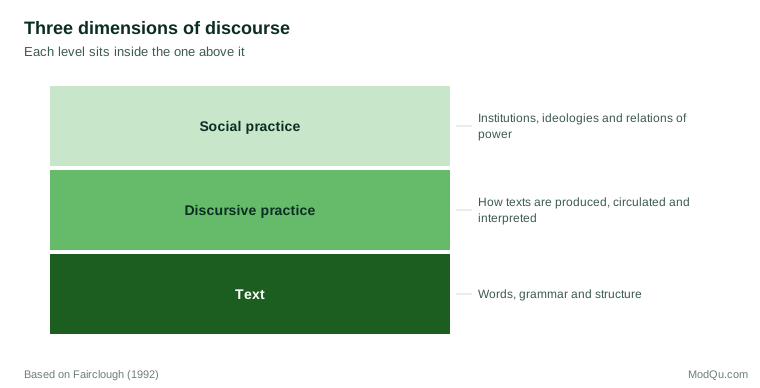
At the level of text, the analyst examines vocabulary, grammar and structure. At the level of discursive practice, the analyst examines how texts are produced, distributed and interpreted. At the level of social practice, the analyst connects these to wider institutions, ideologies and relations of power (Fairclough, 2003). Wodak and Meyer (2016) describe a range of methods within this tradition.
Foucauldian discourse analysis, drawing on Foucault (1972), examines how broad systems of knowledge, such as medical or economic discourses, define what can be said, who can speak with authority and how subjects are positioned.
Gee (2014) offers an accessible introduction that bridges these approaches, with practical tools for asking what any piece of language is doing.
How an analysis proceeds
Discourse analysis does not follow a fixed recipe, but most studies share several steps. The researcher selects a body of texts or recordings relevant to the question: interview transcripts, recorded conversations, policy documents, advertisements, websites or social media posts. Talk is transcribed in detail, sometimes including pauses, overlaps and emphasis. The analyst reads closely, looking for patterns in how things are described, which terms are used and avoided, how accounts are justified, and how they vary across contexts. Potter and Wetherell (1987) used the term interpretative repertoires for recurring sets of terms and metaphors that people draw on to describe and evaluate things.
Claims are supported by detailed extracts, so that readers can check the interpretation against the data. Starks and Trinidad (2007) note that, compared with phenomenology or grounded theory, discourse analysis focuses less on the experience behind the words and more on how the words themselves work.
Applications in organisations and markets
Alvesson and Kärreman (2000) reviewed the use of discourse analysis in organisation studies and distinguished studies of talk in specific situations from studies of broad discourses that shape organisational life. Both are relevant to applied research. A close analysis of how managers talk about "change" in meetings can show how resistance is framed and dismissed. A broader analysis of how a sector talks about "sustainability" can show which practices are presented as responsible and which are left out.
In consumer research, Thompson and Haytko (1997) analysed how young consumers talked about fashion, showing that they drew on competing cultural discourses, such as individuality and conformity, to construct their identities. For brands, discourse analysis can show how customers talk about a category, which repertoires they use to justify their choices and how competitors' messages position the brand implicitly.
A brief hypothetical example illustrates its value. A bank analyses complaints about a new fee. A content count shows that most mention "fairness". Discourse analysis shows something more specific: complainants construct themselves as "loyal customers" who have been "taken for granted", drawing on a repertoire of broken relationship rather than of price. The response that follows is to acknowledge the relationship, not to defend the fee level.
Quality in discourse analysis
Because discourse analysis is interpretive, its quality depends on transparency. Potter and Wetherell (1987) suggested several checks. Coherence asks whether the analysis accounts for the broad pattern of the data and for exceptions. Participants' orientation asks whether the interpretation is supported by how participants themselves respond to each other's talk: if one speaker treats a remark as an accusation, that is evidence that it functioned as one. Fruitfulness asks whether the analysis makes sense of new material and generates new insights. Above all, readers should be able to see the extracts on which each claim rests and judge for themselves whether the interpretation is convincing.
Discourse analysts also need to reflect on their own position. The analyst's account is itself a piece of discourse, constructing a version of the data, so it should be offered as a reasoned interpretation rather than as a neutral report (Phillips & Hardy, 2002).
Strengths and limits
Discourse analysis reveals how meaning is made, contested and used, which other methods often take for granted. Its limits are that it is time-consuming, depends on interpretive skill, and does not tell researchers what people privately think or what they do outside the talk being analysed. Its findings concern the workings of language, and they are most useful when that is what matters to the question. It can be combined with other methods: a survey can show how widely a view is held, while discourse analysis shows how that view is expressed, justified and challenged, which is often what communication and policy decisions depend on.
Conclusion
Discourse analysis treats language as action. It shows how words construct versions of reality, position people and justify choices. For social and market researchers, it offers a way to understand not only what people say but why they say it that way, and with what effect.
References
Alvesson, M., & Kärreman, D. (2000). Varieties of discourse: On the study of organizations through discourse analysis. Human Relations, 53(9), 1125–1149. https://doi.org/10.1177/0018726700539002
Edwards, D., & Potter, J. (1992). Discursive psychology. SAGE.
Fairclough, N. (1992). Discourse and social change. Polity Press.
Fairclough, N. (2003). Analysing discourse: Textual analysis for social research. Routledge.
Foucault, M. (1972). The archaeology of knowledge (A. M. Sheridan Smith, Trans.). Pantheon Books.
Gee, J. P. (2014). An introduction to discourse analysis: Theory and method (4th ed.). Routledge.
Phillips, N., & Hardy, C. (2002). Discourse analysis: Investigating processes of social construction. SAGE. https://doi.org/10.4135/9781412983921
Potter, J., & Wetherell, M. (1987). Discourse and social psychology: Beyond attitudes and behaviour. SAGE.
Sacks, H., Schegloff, E. A., & Jefferson, G. (1974). A simplest systematics for the organization of turn-taking for conversation. Language, 50(4), 696–735. https://doi.org/10.2307/412243
Starks, H., & Trinidad, S. B. (2007). Choose your method: A comparison of phenomenology, discourse analysis, and grounded theory. Qualitative Health Research, 17(10), 1372–1380. https://doi.org/10.1177/1049732307307031
Thompson, C. J., & Haytko, D. L. (1997). Speaking of fashion: Consumers' uses of fashion discourses and the appropriation of countervailing cultural meanings. Journal of Consumer Research, 24(1), 15–42. https://doi.org/10.1086/209491
Wodak, R., & Meyer, M. (Eds.). (2016). Methods of critical discourse studies (3rd ed.). SAGE.