
Research · Qualitative research
Phenomenology and the Study of Lived Experience
How phenomenological research studies lived experience, covering its philosophical roots, descriptive and interpretive approaches, interpretative phenomenological analysis, interviewing for experience, bracketing, analysis steps, quality, limits and uses in consumer and organisational research.
Phenomenology is the study of experience as it is lived and felt by the person having it. Phenomenological research asks what an experience is like: what it is like to receive a serious diagnosis, to lose a job, to become a parent, to use a product every day, or to work in a team that is failing. It aims to describe the structure and meaning of such experiences in depth, from the point of view of the people who have them. The approach began as a movement in philosophy in the early twentieth century and has since been developed into a family of research methods used in psychology, health, education, management and consumer research. This article explains its roots, describes its main approaches and sets out how phenomenological studies are designed, analysed and judged.
Philosophical roots
Edmund Husserl, the founder of phenomenology, called for a return "to the things themselves": to describe phenomena as they appear in experience, before they are explained by scientific theories or everyday assumptions. A central idea is intentionality: consciousness is always consciousness of something, so experience can be studied as the relationship between a person and what they experience (Sokolowski, 2000). In his late work, Husserl (1970) introduced the lifeworld, the world of everyday lived experience that precedes and underlies scientific abstraction.
To describe experience freshly, Husserl proposed the epoché, or phenomenological reduction: setting aside, or "bracketing", assumptions about the world in order to attend to how things are actually experienced. This idea remains central to descriptive phenomenological research.
Martin Heidegger (1962), Husserl's student, changed the direction of phenomenology. He argued that people are always already "being-in-the-world", engaged in practical activities and shaped by history and culture, so that experience cannot be separated from interpretation. On this view, understanding is always interpretive, and phenomenology becomes hermeneutic: a matter of interpreting meaning rather than describing pure experience. Maurice Merleau-Ponty (1962) emphasised the role of the body in experience, arguing that perception and action are embodied before they are conceptual. Moran (2000) and Gallagher and Zahavi (2012) provide accessible introductions to these ideas and their relevance to the study of the mind.
From philosophy to research method
Philosophical phenomenology usually involves reflection on one's own experience. Phenomenological research, by contrast, gathers accounts of experience from other people, usually through interviews, and analyses them systematically. Several methods have been developed to do this, and they differ mainly in how they position themselves between Husserl's descriptive aim and Heidegger's interpretive one (Finlay, 2009).
Descriptive phenomenology
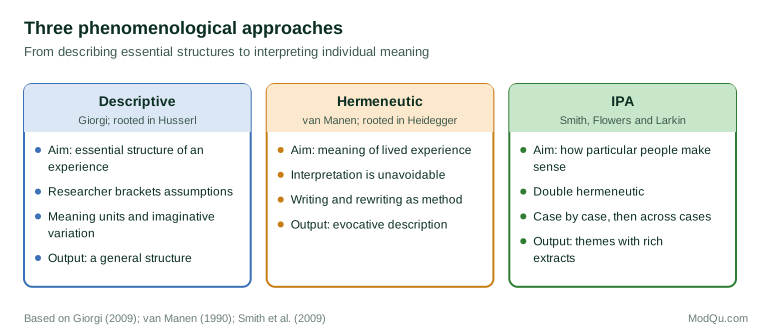
Giorgi (2009) developed a descriptive phenomenological method for psychology based on Husserl. The researcher adopts the phenomenological attitude, setting aside theories and assumptions, and analyses participants' descriptions to identify the essential structure of the experience: the features without which it would not be that experience. The method involves reading the whole description, dividing it into meaning units, transforming each unit into a statement of its psychological meaning and synthesising these into a general structure. Giorgi uses imaginative variation, mentally altering features of the experience to see which are essential and which are incidental.
Colaizzi (1978) and Moustakas (1994) proposed related procedures. Moustakas distinguished textural descriptions of what participants experienced from structural descriptions of how they experienced it, combining them into a statement of the essence of the experience. Colaizzi's method includes a step of returning findings to participants to check that they recognise their experience in them.
Hermeneutic phenomenology
van Manen (1990) developed a hermeneutic phenomenology oriented to practice in fields such as education and health care. He treats writing itself as a research method: the researcher develops understanding by writing and rewriting descriptions that bring the experience to life for readers. van Manen suggested four lifeworld existentials as guides to reflection: lived space, lived body, lived time and lived human relations. A study of waiting for test results, for example, might examine how time seems to slow, how the body registers anxiety, how familiar spaces feel different and how relationships with others change. In later work, van Manen (2014) emphasised that phenomenology aims at insight into meaning rather than at a fixed set of procedures.
Dahlberg et al. (2008) developed reflective lifeworld research, which seeks a middle way. It emphasises openness to the phenomenon and a disciplined attitude of "bridling" the researcher's understanding, restraining premature conclusions without claiming to eliminate all assumptions.
Interpretative phenomenological analysis
Interpretative phenomenological analysis (IPA), developed by Smith et al. (2009), has become the most widely used phenomenological method in psychology and health research. IPA combines phenomenology with hermeneutics and an idiographic focus on the particular case. It describes its approach as a double hermeneutic: the researcher is trying to make sense of the participant trying to make sense of their experience. Larkin et al. (2006) summarised IPA's two aims as "giving voice" to participants' concerns and "making sense" of them interpretively.
IPA studies use small, fairly homogeneous samples, so that each case can be analysed in depth before patterns across cases are sought. Smith et al. (2009) suggest that three participants may be enough for a student project and that between four and ten interviews are typical for professional doctorates, with larger samples possible in funded studies.
Choosing an approach
The choice between approaches depends on the aim of the study. If the aim is to identify what is common and essential to an experience across people, such as the core structure of being misdiagnosed, descriptive phenomenology is suitable. If the aim is to evoke the meaning of an experience for practitioners, so that they can respond to it with greater sensitivity, hermeneutic phenomenology is suitable. If the aim is to understand in depth how a small number of people make sense of a significant event in their lives, and how their accounts differ as well as converge, IPA is suitable.
Each choice has consequences. Descriptive studies need a stance of bracketing and a method for identifying essential features. Hermeneutic studies need extended writing and rewriting, and readers must be able to follow the interpretive reasoning. IPA studies need a homogeneous sample, careful case-by-case analysis and enough space in the report to show individual variation. Starks and Trinidad (2007) recommend that researchers make the choice explicit at the design stage, because it shapes the research question, the sample, the interview and the form of the findings.
A related decision is whether to adopt phenomenology as a full philosophical framework or to borrow phenomenological ideas, such as a focus on lived experience, within a more general qualitative study. Both are legitimate, but the study should say which it is doing. Claiming to follow a phenomenological method while conducting a generic thematic analysis of interview topics is a common weakness that reviewers notice (Norlyk & Harder, 2010).
Designing a phenomenological study
The research question should ask about the meaning or nature of an experience: "What is it like to...?" or "How do people experience...?". Questions about causes, frequencies or processes over time are better suited to other methods.
Participants are chosen because they have lived through the experience in question and can describe it. Englander (2012) argued that the key sampling criterion is that participants have had the experience and can articulate it, and that a small number of rich descriptions is often more valuable than many brief ones.
Interviewing for experience
Phenomenological interviews aim to elicit concrete descriptions of lived experience rather than opinions or explanations. The interviewer asks participants to describe specific occasions in detail: "Can you tell me about a time when...? What happened? What was that like for you?". Thompson et al. (1989), introducing phenomenological interviewing into consumer research, recommended that interviews begin with an open request to describe a specific experience and then follow the participant's account, with the interviewer asking for elaboration rather than introducing new topics. Questions that invite participants to theorise ("Why do you think...?") tend to move away from experience towards explanation and are used sparingly.
Bracketing and reflexivity
Researchers bring their own experience and assumptions to the study. In descriptive phenomenology, the aim is to bracket these as far as possible. In interpretive approaches, they are seen as an unavoidable part of understanding, to be made explicit and examined. Tufford and Newman (2012) described practical ways to bracket, including writing memos throughout the study, keeping a reflexive journal and discussing one's preconceptions with a colleague before and during analysis. Whatever the approach, the researcher should record their relationship to the topic and how it may have shaped the analysis.
Analysis
Analysis methods differ between approaches, but share a movement from close engagement with individual accounts towards a description or interpretation of the experience as a whole. The steps of IPA illustrate the process.
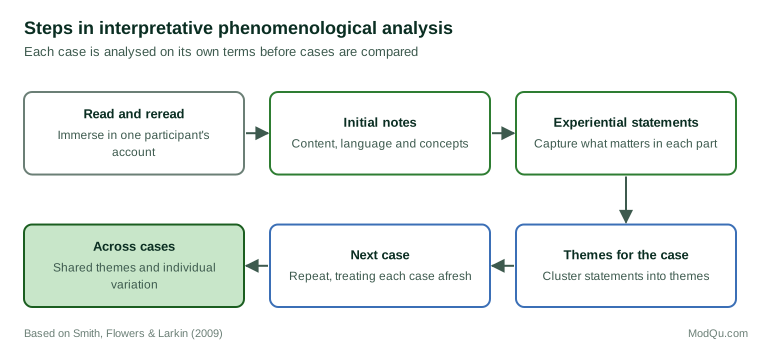
The analyst reads and rereads the first transcript, making detailed notes on its content, language and concepts. From these notes, the analyst develops experiential statements or emergent themes that capture what is important in each part of the account. These are clustered into themes for that case. The analyst then moves to the next case, treating it on its own terms, before looking for patterns across all cases, noting both shared themes and individual variation (Smith et al., 2009).
Throughout, the analyst moves between the parts of the text and the whole, an interpretive process known as the hermeneutic circle. Thompson et al. (1989) described this as reading each passage in light of the whole interview and revising the understanding of the whole in light of each passage.
The final account presents the themes with extensive extracts from participants' own words, interpreted to show what the experience is like and what it means. A good phenomenological report allows readers who have not had the experience to understand something of it, and readers who have had it to recognise it.
Quality and common problems
Smith (2011) reviewed nearly 300 published IPA studies and proposed criteria for judging their quality. Good studies have a clear focus, strong data, rigorous analysis with enough extracts to support each theme across participants, and interpretation that goes beyond description to illuminate the experience. Weaker studies are often descriptive, with themes that summarise topics rather than interpret experience.
Norlyk and Harder (2010) reviewed published nursing studies that described themselves as phenomenological and found that many did not explain how phenomenological philosophy informed their methods, and that the methods described were sometimes indistinguishable from general qualitative analysis. Zahavi (2019) went further, arguing that some popular methods misdescribe key concepts from phenomenological philosophy, and that researchers should be clear about which ideas they are actually using. Starks and Trinidad (2007) provide a useful comparison of phenomenology with grounded theory and discourse analysis, showing how each answers different questions and produces different kinds of findings.
The general quality criteria for qualitative research also apply. A phenomenological study should describe the sample and its relationship to the experience studied, the interview approach, the analysis steps, the researcher's position and how interpretations were checked. Creswell and Poth (2018) provide a checklist for evaluating phenomenological studies alongside other qualitative traditions.
Writing phenomenological findings
Writing is central to phenomenological research, not a final step. van Manen (1990) argued that phenomenological understanding is developed through writing: the researcher drafts descriptions of the experience, reads them critically, and rewrites them until they capture its meaning in a way that readers can recognise. The aim is a text that helps readers grasp what the experience is like, not only a list of its features.
In practice, phenomenological reports usually present a small number of themes, each with a clear description and several extracts from participants' accounts. The extracts are chosen to show both the shared character of the experience and the ways it varies. In IPA, Smith et al. (2009) recommend showing how each theme appears across participants, so that readers can judge how widely it is supported, and giving space to individual cases that illuminate the theme in a distinctive way. In descriptive studies, the report culminates in a statement of the general structure of the experience, often followed by examples of how it appears in particular accounts.
Good phenomenological writing uses participants' own words, concrete detail and plain language. Abstract theoretical vocabulary can make the experience harder, not easier, to grasp.
Ethical considerations
Phenomenological interviews often ask participants to revisit difficult or intimate experiences in detail, which can be distressing. Researchers should explain the nature of the interview in advance, allow participants to stop or skip topics, watch for signs of distress and provide information about sources of support where relevant. Because samples are small and descriptions are detailed, participants may be identifiable to people who know them, even when names are removed; details that could identify them should be altered or omitted, and participants can be offered the chance to review extracts before publication.
There is also a question of interpretive authority. Interpretive approaches produce accounts that go beyond what participants said. Researchers should be clear that the analysis is their interpretation, grounded in participants' words, and should present it with respect for the participants' own understanding of their experience (Larkin et al., 2006).
Limits
Phenomenology describes experience; it does not explain its causes or measure its frequency. Its samples are small and chosen for their experience of the phenomenon, so findings cannot show how common an experience is. It depends on participants' ability to describe their experience in words, which may be limited for some experiences or some participants. And its findings are interpretive: another researcher might emphasise different aspects of the same accounts. These are not flaws so much as boundaries. Phenomenology answers questions about what experience is like, and other methods are needed for questions about how many or why.
Combining phenomenology with other methods
Phenomenological studies can be combined with other approaches in a larger programme of research. A phenomenological study can come first, identifying the dimensions of an experience that matter to people, which a survey can then measure across a population. It can also follow quantitative work, explaining what lies behind a pattern, such as low uptake of a service, by showing how the experience of using it feels to those involved. In health research, phenomenological studies are often used alongside trials to understand how patients experience a treatment, which can explain why adherence is low or why outcomes differ between groups (Smith, 2011).
When combined in this way, each method should keep its own standards. A phenomenological component should still have a clear experiential question, appropriate participants, interviews that elicit concrete description and an analysis that follows a stated approach, rather than being reduced to a few quotations that illustrate survey results.
Phenomenology in consumer and organisational research
Thompson et al. (1989) argued that consumer research had neglected consumers' actual experience in favour of abstract models of decision-making, and proposed existential-phenomenology as a way to study consumption as it is lived. Their approach, and later work drawing on it, has been used to study experiences such as shopping, gift-giving, brand relationships and the use of services. In organisational research, Sanders (1982) proposed phenomenology as a way of studying the meanings that work and organisational life hold for those involved, beyond what surveys of attitudes can capture.
A hypothetical example illustrates the commercial value. A bank wants to understand the experience of customers who have fallen behind on loan repayments. Ten phenomenological interviews reveal that the experience is dominated by shame and a sense of being watched, that letters from the bank are experienced as accusations, and that customers avoid opening them for weeks. A survey would have found that customers "did not respond to letters". The phenomenological study shows what that non-response is like from the inside, which suggests a different approach to communication altogether.
Conclusion
Phenomenological research offers a disciplined way to understand lived experience in depth. Its approaches range from descriptive methods that seek the essential structure of an experience to interpretive methods that explore its meaning for particular people. All share a commitment to concrete accounts of experience, careful attention to participants' own words, and a reflective awareness of the researcher's role. Used for the right questions, phenomenology produces understanding that helps people design services, products and policies around how experiences are actually lived.
References
Colaizzi, P. F. (1978). Psychological research as the phenomenologist views it. In R. S. Valle & M. King (Eds.), Existential-phenomenological alternatives for psychology (pp. 48–71). Oxford University Press.
Creswell, J. W., & Poth, C. N. (2018). Qualitative inquiry and research design: Choosing among five approaches (4th ed.). SAGE.
Dahlberg, K., Dahlberg, H., & Nyström, M. (2008). Reflective lifeworld research (2nd ed.). Studentlitteratur.
Englander, M. (2012). The interview: Data collection in descriptive phenomenological human scientific research. Journal of Phenomenological Psychology, 43(1), 13–35. https://doi.org/10.1163/156916212X632943
Finlay, L. (2009). Debating phenomenological research methods. Phenomenology & Practice, 3(1), 6–25. https://doi.org/10.29173/pandpr19818
Gallagher, S., & Zahavi, D. (2012). The phenomenological mind (2nd ed.). Routledge.
Giorgi, A. (2009). The descriptive phenomenological method in psychology: A modified Husserlian approach. Duquesne University Press.
Heidegger, M. (1962). Being and time (J. Macquarrie & E. Robinson, Trans.). Harper & Row. (Original work published 1927)
Husserl, E. (1970). The crisis of European sciences and transcendental phenomenology (D. Carr, Trans.). Northwestern University Press. (Original work published 1936)
Larkin, M., Watts, S., & Clifton, E. (2006). Giving voice and making sense in interpretative phenomenological analysis. Qualitative Research in Psychology, 3(2), 102–120. https://doi.org/10.1191/1478088706qp062oa
Merleau-Ponty, M. (1962). Phenomenology of perception (C. Smith, Trans.). Routledge & Kegan Paul. (Original work published 1945)
Moran, D. (2000). Introduction to phenomenology. Routledge.
Moustakas, C. (1994). Phenomenological research methods. SAGE. https://doi.org/10.4135/9781412995658
Norlyk, A., & Harder, I. (2010). What makes a phenomenological study phenomenological? An analysis of peer-reviewed empirical nursing studies. Qualitative Health Research, 20(3), 420–431. https://doi.org/10.1177/1049732309357435
Sanders, P. (1982). Phenomenology: A new way of viewing organizational research. Academy of Management Review, 7(3), 353–360. https://doi.org/10.5465/amr.1982.4285315
Smith, J. A. (2011). Evaluating the contribution of interpretative phenomenological analysis. Health Psychology Review, 5(1), 9–27. https://doi.org/10.1080/17437199.2010.510659
Smith, J. A., Flowers, P., & Larkin, M. (2009). Interpretative phenomenological analysis: Theory, method and research. SAGE.
Sokolowski, R. (2000). Introduction to phenomenology. Cambridge University Press. https://doi.org/10.1017/CBO9780511809118
Starks, H., & Trinidad, S. B. (2007). Choose your method: A comparison of phenomenology, discourse analysis, and grounded theory. Qualitative Health Research, 17(10), 1372–1380. https://doi.org/10.1177/1049732307307031
Thompson, C. J., Locander, W. B., & Pollio, H. R. (1989). Putting consumer experience back into consumer research: The philosophy and method of existential-phenomenology. Journal of Consumer Research, 16(2), 133–146. https://doi.org/10.1086/209203
Tufford, L., & Newman, P. (2012). Bracketing in qualitative research. Qualitative Social Work, 11(1), 80–96. https://doi.org/10.1177/1473325010368316
van Manen, M. (1990). Researching lived experience: Human science for an action sensitive pedagogy. State University of New York Press.
van Manen, M. (2014). Phenomenology of practice: Meaning-giving methods in phenomenological research and writing. Left Coast Press.
Zahavi, D. (2019). Getting it quite wrong: Van Manen and Smith on phenomenology. Qualitative Health Research, 29(6), 900–907. https://doi.org/10.1177/1049732318817547