
Research · Qualitative research
Ethnography and Participant Observation in Commercial Research
How ethnography and participant observation work, and how they are adapted for commercial research, covering the origins of the method, observer roles, access, field notes, analysis, the gap between what people say and do, ethics, short-form commercial ethnography and how to judge its quality.
Ethnography is the study of people in their own settings, through extended observation and conversation, to understand how they live, work and make sense of their world. Its central technique is participant observation: the researcher spends time with the people being studied, takes part in or closely watches their everyday activities, and records what happens. Ethnography began in anthropology and sociology, but it is now widely used in business, especially in product design, consumer research and studies of work. This article explains how ethnography is done, why it reveals things other methods miss, and how it is adapted, sometimes too far, for commercial research.
Origins
Malinowski (1922) set the template for modern ethnography during his fieldwork in the Trobriand Islands. He argued that the ethnographer must live among the people studied, learn their language and observe daily life directly, with the goal of grasping the native's point of view and understanding their world as they see it. In sociology, the Chicago School applied similar methods to urban life. Whyte (1943) spent more than three years in an Italian-American neighbourhood in Boston, relying heavily on a key informant, to produce a classic account of how its social groups were organised.
Geertz (1973) described the aim of ethnography as thick description: interpreting behaviour in terms of the meanings it has for the people involved. His famous example is the difference between a twitch and a wink. Physically identical, they mean quite different things, and only an understanding of context and intention can tell them apart.
Why observe rather than ask?
Most research methods rely on what people say: in surveys, interviews and focus groups, participants describe their behaviour and explain their reasons. Ethnography adds what people do. The two often differ. People forget routine actions, describe what they think they ought to do, or do not notice the workarounds and habits that shape their behaviour. Asked how they cook dinner, most people describe a simplified, idealised version. Watched cooking dinner, they reveal improvisations, interruptions and uses of products that no designer anticipated.
Studies of work show the same gap. Suchman (1987) observed people using a photocopier with an "intelligent" help system and found that users did not follow plans in the way the designers assumed; they responded to the situation moment by moment, and the system's help often failed because it could not see what users were doing. Orr (1996) studied technicians repairing photocopiers and found that much of their expertise was shared through stories exchanged over breakfast and in the field, not through the official manuals. Neither finding could have come from asking people to describe their work.
Participant observation and observer roles
Observation can involve different degrees of participation. Gold (1958) described four roles, from complete participation to complete observation, shown below.
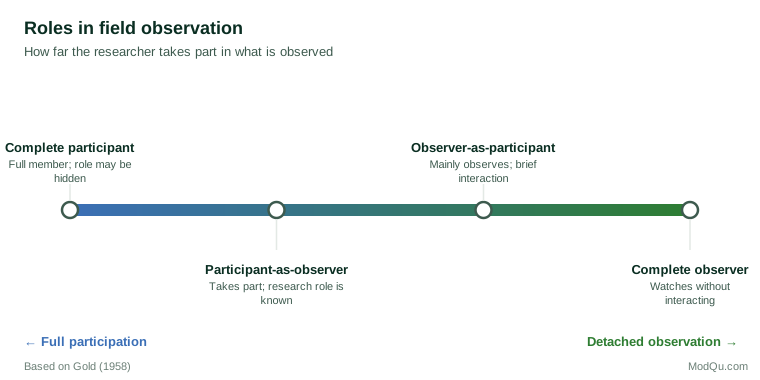
Each role involves trade-offs. A complete participant sees behaviour as it naturally happens but may face ethical problems if others do not know they are being studied, and may lose the distance needed for analysis. A complete observer remains detached but may not understand what they see. Most ethnographers work between these poles, as a participant-as-observer whose research role is known but who takes part in activities, or an observer-as-participant who mainly observes but interacts with participants through conversation and informal interviews (DeWalt & DeWalt, 2011).
Being observed can change behaviour, a problem often called the Hawthorne effect. McCambridge et al. (2014) reviewed the evidence and found that research participation can affect behaviour, but that the size and nature of the effect varied and were often poorly understood. In ethnography, the usual remedy is time: as people grow used to the researcher's presence, they tend to return to their usual routines.
Access and relationships
Ethnography depends on access. In organisations, the researcher usually needs formal permission from managers and informal acceptance from the people being observed, which are not the same thing. Hammersley and Atkinson (2019) note that gatekeepers who grant access may try to shape what the researcher sees, and that being associated with management can make staff wary. In consumer research, access means being invited into homes, cars and shopping trips, which requires trust and careful explanation of the purpose.
Key informants, people who know the setting well and are willing to explain it, are often essential. They can also bias the account if the researcher relies on them too heavily, so ethnographers seek out a range of perspectives, including people at the margins of the group.
Field notes
The primary record of ethnography is the field note. Emerson et al. (2011) describe a process that starts with brief jottings made during or soon after observation, which are expanded into full, detailed notes as soon as possible, ideally the same day. Good field notes describe concretely what happened, who was present, what was said in people's own words, and the sequence of events, separately from the researcher's interpretations, which are recorded as notes or memos.
Spradley (1980) suggested a set of dimensions to guide observation: the space, the actors, their activities, objects, acts, events, time, goals and feelings. Such a checklist is particularly useful at the start of fieldwork, before the researcher knows what will matter.
Commercial ethnography often adds photography and video, with consent. Pink (2013) discusses how visual material can capture details of settings and practices that words miss, and how participants' own photographs or videos can show their perspective.
Analysis
Ethnographic analysis is continuous. The researcher reads field notes repeatedly during fieldwork, identifies patterns and puzzles, and directs further observation towards them (Fetterman, 2010). Formal analysis usually involves coding notes and transcripts, developing themes, and testing them against the full record, paying particular attention to cases that do not fit.
The final product is usually a written account. Van Maanen (2011) distinguished several kinds of ethnographic writing, including realist tales that present the culture in a detached, authoritative voice, confessional tales that focus on the researcher's experience of fieldwork, and impressionist tales that reconstruct striking events in vivid detail. Each makes different claims about the relationship between the researcher and the people studied.
Ethnography in commercial research
Marketing researchers began to adopt ethnography in the 1980s. In the Consumer Behavior Odyssey, a team of researchers travelled across the United States in a motor home, observing and interviewing people at fairs, markets and other consumption sites. Belk et al. (1989) drew on this work to show how consumers set apart some possessions and experiences as special, almost sacred, a finding that changed how researchers think about brands, collections and gifts. Arnould and Thompson (2005) later grouped this and related work under the label consumer culture theory, which studies consumption as a cultural practice.
Arnould and Wallendorf (1994) set out the principles of market-oriented ethnography: data collected in natural settings, extended contact with participants, multiple sources of data, and interpretation that builds from the participants' own perspectives towards strategic recommendations. They emphasised that ethnography is particularly useful when managers' assumptions about how a product is used may be wrong.
In practice, commercial ethnography is used to:
- observe products in use at home or at work, revealing unmet needs and workarounds;
- accompany customers on shopping trips, both in store and online;
- understand the routines into which a new product or service must fit;
- study organisations as customers, observing how purchasing and use decisions are made;
- inform the design of services by observing staff and customers at the point of service.
Cayla and Arnould (2013) found that ethnographic research helps organisations most when it produces stories: vivid, concrete accounts of real people that managers remember and discuss, and that challenge abstract assumptions about customers.
Short-form ethnography and its risks
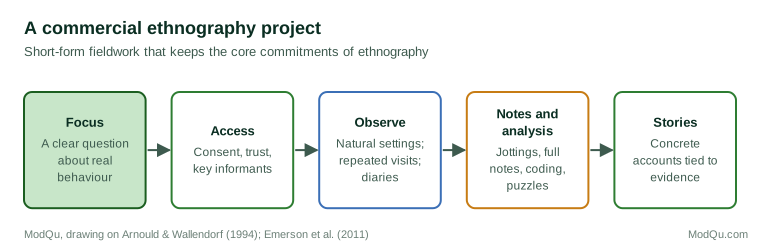
Academic ethnography often lasts months or years. Commercial projects usually allow days or weeks. Mariampolski (2006) and Ladner (2014) describe ways of adapting ethnography to these constraints: focused objectives, several shorter visits rather than one long stay, a team of observers, and participants who record their own activities between visits through diaries or photographs. Elliott and Jankel-Elliott (2003) argued that such methods can produce valuable strategic insight, provided that the researchers retain the core commitments of ethnography: observation in natural settings, attention to meaning and context, and interpretation grounded in the data.
The risk is that the name is applied to work that has lost these commitments. A two-hour visit to a customer's home, with a fixed list of questions, is closer to an in-home interview than to ethnography. It can still be useful, but it cannot reveal the routines, contradictions and tacit knowledge that only extended observation shows. Hammersley (1992) cautioned that claims about what ethnography can show must be judged against what was actually done in the field.
A brief hypothetical example shows the difference. A kitchen appliance maker wants to know why a new food processor receives poor reviews. A survey finds that owners rate it as "hard to clean". Short in-home interviews confirm this. A week of observation in eight households, with owners' own videos of meal preparation, shows something more specific: owners leave the processor in a cupboard because it is too heavy to lift onto the counter, and they use it only for large tasks, after which cleaning feels disproportionate. The problem is not cleaning but weight and storage, which changes the design response entirely.
Remote and digital ethnography
Much everyday life now happens on screens, and ethnographers have adapted. Participants can record their own activities on their phones, keep photo or video diaries over several weeks, or share their screens while they shop, search or use a service. Pink (2013) notes that such self-recorded material is not a neutral record: participants choose what to show and how to frame it, and these choices are themselves data about how they see their lives. Remote methods extend the reach of a study and reduce costs, and they can capture moments, such as late-night browsing or a morning routine, that a visiting researcher would rarely see.
Remote methods also have limits. The researcher sees only what participants decide to capture, cannot follow up on what is happening just out of frame, and misses the informal conversations and chance observations that make in-person fieldwork valuable. Ladner (2014) suggests combining remote diaries with at least some in-person visits, using the diaries to identify moments worth observing directly.
Combining ethnography with other methods
Ethnography is often most useful as part of a sequence. Observation can come first, identifying behaviours and categories that a survey then measures across a larger population. It can also follow a survey, explaining patterns that the numbers reveal but cannot explain. Arnould and Wallendorf (1994) recommended using multiple data sources within an ethnographic study as well, combining observation with interviews, documents, photographs and artefacts, so that interpretations rest on more than one kind of evidence.
Commercial teams sometimes use ethnography to build shared understanding inside the organisation. Inviting designers, engineers or managers to join field visits, under the guidance of trained researchers, can change how they think about customers more quickly than any report. The risk is that untrained observers draw strong conclusions from a single memorable visit, so their observations should feed into systematic analysis rather than replace it.
Ethics
Ethnography raises distinctive ethical issues. Observation in homes and workplaces exposes the private lives of participants and of other people present, such as family members or colleagues, who did not agree to take part. Participants should give informed consent, understand what will be recorded and how it will be used, and be able to withdraw. Covert observation, where people do not know they are being studied, is rarely justifiable in commercial research. Photographs and videos need particular care, because faces, homes and documents can identify people, and their use in presentations should be agreed in advance.
There is also an issue of representation. Ethnographic accounts describe real people, often in vivid detail. Hammersley and Atkinson (2019) note that researchers have a responsibility to represent participants fairly and to protect their identities, particularly when findings may be shared widely within a client organisation.
Judging the quality of ethnography
Good ethnography shows its evidence. Readers should be able to see how long the researcher spent in the field, in what settings and with whom, how data were recorded and analysed, and how interpretations were tested. Detailed description of specific events, rather than general statements about "what people do", is a sign of real fieldwork. So is attention to variation and contradiction: a credible ethnographic account shows that not everyone behaves the same way, and explains why.
Conclusion
Ethnography reveals what people do, not only what they say, and shows how behaviour is shaped by its setting and meaning. Its strengths are depth, attention to context and the ability to discover what no one thought to ask about. In commercial research it has transformed product design and consumer understanding, but its value depends on retaining its core commitments: extended observation in natural settings, careful field notes, interpretation grounded in evidence, and ethical respect for the people studied.
References
Arnould, E. J., & Thompson, C. J. (2005). Consumer culture theory (CCT): Twenty years of research. Journal of Consumer Research, 31(4), 868–882. https://doi.org/10.1086/426626
Arnould, E. J., & Wallendorf, M. (1994). Market-oriented ethnography: Interpretation building and marketing strategy formulation. Journal of Marketing Research, 31(4), 484–504. https://doi.org/10.1177/002224379403100404
Belk, R. W., Wallendorf, M., & Sherry, J. F., Jr. (1989). The sacred and the profane in consumer behavior: Theodicy on the odyssey. Journal of Consumer Research, 16(1), 1–38. https://doi.org/10.1086/209191
Cayla, J., & Arnould, E. (2013). Ethnographic stories for market learning. Journal of Marketing, 77(4), 1–16. https://doi.org/10.1509/jm.12.0471
DeWalt, K. M., & DeWalt, B. R. (2011). Participant observation: A guide for fieldworkers (2nd ed.). AltaMira Press.
Elliott, R., & Jankel-Elliott, N. (2003). Using ethnography in strategic consumer research. Qualitative Market Research, 6(4), 215–223. https://doi.org/10.1108/13522750310495300
Emerson, R. M., Fretz, R. I., & Shaw, L. L. (2011). Writing ethnographic fieldnotes (2nd ed.). University of Chicago Press.
Fetterman, D. M. (2010). Ethnography: Step-by-step (3rd ed.). SAGE.
Geertz, C. (1973). The interpretation of cultures: Selected essays. Basic Books.
Gold, R. L. (1958). Roles in sociological field observations. Social Forces, 36(3), 217–223. https://doi.org/10.2307/2573808
Hammersley, M. (1992). What's wrong with ethnography? Methodological explorations. Routledge.
Hammersley, M., & Atkinson, P. (2019). Ethnography: Principles in practice (4th ed.). Routledge.
Ladner, S. (2014). Practical ethnography: A guide to doing ethnography in the private sector. Left Coast Press.
Malinowski, B. (1922). Argonauts of the Western Pacific. Routledge.
Mariampolski, H. (2006). Ethnography for marketers: A guide to consumer immersion. SAGE.
McCambridge, J., Witton, J., & Elbourne, D. R. (2014). Systematic review of the Hawthorne effect: New concepts are needed to study research participation effects. Journal of Clinical Epidemiology, 67(3), 267–277. https://doi.org/10.1016/j.jclinepi.2013.08.015
Orr, J. E. (1996). Talking about machines: An ethnography of a modern job. Cornell University Press.
Pink, S. (2013). Doing visual ethnography (3rd ed.). SAGE.
Spradley, J. P. (1980). Participant observation. Holt, Rinehart and Winston.
Suchman, L. A. (1987). Plans and situated actions: The problem of human-machine communication. Cambridge University Press.
Van Maanen, J. (2011). Tales of the field: On writing ethnography (2nd ed.). University of Chicago Press.
Whyte, W. F. (1943). Street corner society: The social structure of an Italian slum. University of Chicago Press.