
Research · Qualitative research
In-Depth Interviews: Planning, Conducting and Analysing
A practical guide to in-depth interviews, covering when to use them, sampling and sample size, writing an interview guide, question types and probing, conducting remote and in-person interviews, recording and transcription, analysis, and common mistakes.
The in-depth interview is the most widely used qualitative method. A researcher talks with one person at length, usually for between 45 and 90 minutes, about their experiences, views and reasons. Kvale and Brinkmann (2015) describe the research interview as a conversation with a structure and a purpose: it is guided by the researcher, but its aim is to understand the world from the participant's point of view. Done well, an interview produces a rich, detailed account that no questionnaire could capture. Done poorly, it produces a polite conversation that confirms what the researcher already believed. This article covers planning, conducting and analysing in-depth interviews.
When to use in-depth interviews
Interviews are suited to questions about experience, meaning, reasoning and process. They work well when the topic is complex, personal or sensitive, when participants' views may be shaped by others in a group setting, or when the researcher needs to follow a person's account of a sequence of events, such as how they chose a supplier or how they came to leave a job. DiCicco-Bloom and Crabtree (2006) note that interviews are particularly valuable for exploring topics where the researcher does not yet know which questions matter most.
Interviews are less suited to measuring how common something is, or to studying behaviour that people cannot accurately describe. Nisbett and Wilson (1977) showed that people often cannot report the true causes of their own judgements and behaviour, and instead give plausible explanations that may not reflect what actually influenced them. Interview data are therefore best treated as accounts of how people understand and explain their experiences, not as direct evidence of what caused their actions. Where behaviour itself matters, interviews can be combined with observation or behavioural data.
Types of interview
Interviews vary in how structured they are. A structured interview asks the same questions in the same order, with little room for follow-up, and is closer to a spoken questionnaire. An unstructured interview begins with a broad topic and follows the participant's lead. Most qualitative research uses the semi-structured interview, which is guided by a set of topics and questions but allows the interviewer to change their order, follow up on unexpected points and ask participants to expand (Kallio et al., 2016).
McCracken (1988) described the long interview as a particular form suited to understanding cultural categories and assumptions: it uses a carefully prepared questionnaire of open questions and planned prompts, but gives participants space to speak in their own terms. Spradley (1979) described the ethnographic interview, in which the researcher aims to learn the participant's own language and categories, asking descriptive questions first and moving to questions about how the participant classifies and compares things.
Sampling and sample size
Interview participants are chosen purposively, for their ability to inform the research question, not to represent a population statistically (Patton, 2015). The sample should cover the range of people whose experiences are likely to differ in relevant ways, for example new and long-standing customers, or managers and front-line staff.
How many interviews are enough depends on the aim and the diversity of the group. Guest et al. (2006) analysed 60 interviews with women in two West African countries and found that most of the codes they eventually identified had appeared within the first 12 interviews, with the main themes present after six. Hennink et al. (2017) distinguished code saturation, the point at which no new issues appear, which they reached after about nine interviews, from meaning saturation, the point at which the issues are fully understood, which required between 16 and 24. Malterud et al. (2016) proposed the concept of information power: the more relevant information each participant holds, the fewer participants are needed. Information power is greater when the aim is narrow, the participants are highly specific to it, the study draws on established theory, the dialogue is strong and the analysis examines cases in depth.
In practice, a study of one fairly homogeneous group often needs 12 to 20 interviews, while a study comparing several groups needs enough in each group to see patterns within it. Planning a range, and deciding when to stop based on how much new information recent interviews are producing, is more defensible than fixing a number in advance.
Writing an interview guide
The interview guide lists the topics and questions to be covered. Kallio et al. (2016) reviewed the literature on developing semi-structured guides and proposed five phases: identifying whether a semi-structured interview is appropriate, drawing on existing knowledge, formulating a preliminary guide, pilot testing it, and presenting the complete guide.
A good guide usually moves from general to specific, and from easy to more difficult or sensitive topics. It begins with questions that help the participant settle in and describe their context. It then moves to the main topics, each with an opening question and a set of possible prompts. It ends by asking whether there is anything the participant would like to add, which often produces important material.
Questions should be open, short and clear. "Can you tell me about the last time you contacted our support team?" invites a description; "Was our support team helpful?" invites a yes or no. Questions about specific occasions usually produce more accurate and detailed answers than questions about what someone "usually" does. Leading questions, double questions and jargon should be avoided.
Question types and probing
Kvale and Brinkmann (2015) distinguished several kinds of question that an interviewer uses during a conversation. The table below summarises them.
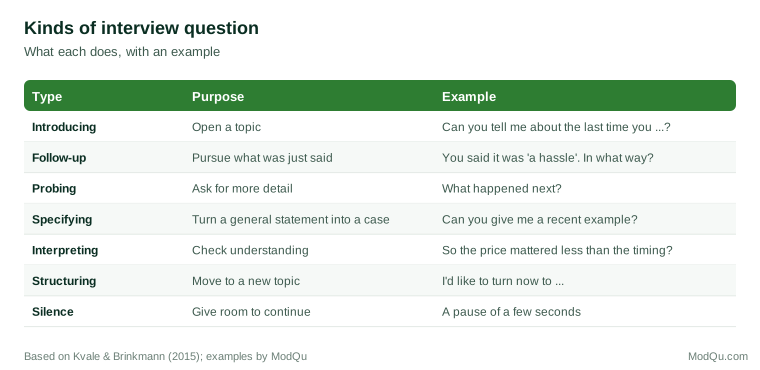
Probing is the skill that separates a good interview from a poor one. When a participant says "the process was frustrating", the interviewer asks what happened, what was frustrating about it and what they did next. Rubin and Rubin (2012) describe the aim as obtaining depth, detail, vividness and nuance. Effective probes are neutral and short: "Can you say more about that?", "What happened then?", "Can you give me an example?". Silence is also a probe; a pause of a few seconds often prompts a participant to continue.
The interviewer also listens for words and ideas that seem important to the participant and asks about them, rather than moving on to the next question in the guide. McGrath et al. (2019) emphasise active listening, flexibility and allowing the participant's account to shape the conversation, while ensuring that the main topics are covered.
Conducting the interview
Before the interview, participants should receive clear information about the purpose of the study, how the data will be used, how their identity will be protected and their right to stop at any time, and should give informed consent. At the start, the interviewer explains the format and checks that recording is acceptable.
Interviews may be conducted in person, by telephone or by video. Novick (2008) reviewed the evidence on telephone interviews and found little to support the common assumption that they produce lower quality data than face-to-face interviews. Archibald et al. (2019) found that both researchers and participants rated video interviews highly for convenience and rapport, although technical problems were common. Remote interviews widen the pool of potential participants and reduce costs, but the interviewer has fewer visual cues and must check understanding more often.
After each interview, the interviewer should write brief notes recording the setting, their impressions, any key points and any changes to make to the guide. These notes are part of the data and help the analysis.
Recording and transcription
Interviews are usually audio recorded and transcribed. Full verbatim transcription records every word, including hesitations; intelligent verbatim removes fillers but keeps the substance. Automated transcription has become accurate enough for many purposes, but transcripts should be checked against the recording, especially for names, technical terms and passages that are hard to hear. Identifying details should be removed or replaced before analysis. Recordings and transcripts are personal data, so they should be stored securely, with access limited to the research team, and deleted or archived according to the consent participants gave. Where interviews are conducted in another language, the team must decide whether to analyse in that language or in translation, and record the decision.
Analysing interview data
Analysis begins during data collection, as the researcher notices recurring points and adjusts later interviews. Formal analysis then usually involves coding: reading each transcript closely and labelling passages by their meaning (Saldaña, 2016). Codes are then grouped into themes or categories, which are refined by comparing them across participants.
Several structured approaches are available. Thematic analysis identifies patterns of meaning across a dataset through six phases, from becoming familiar with the data to writing the report (Braun & Clarke, 2006). The framework method organises coded data into a matrix, with one row per participant and one column per code, which makes it easy to compare participants and is popular in applied and policy research (Gale et al., 2013). Miles et al. (2014) describe a range of displays, such as matrices and networks, that help analysts see patterns and draw conclusions.
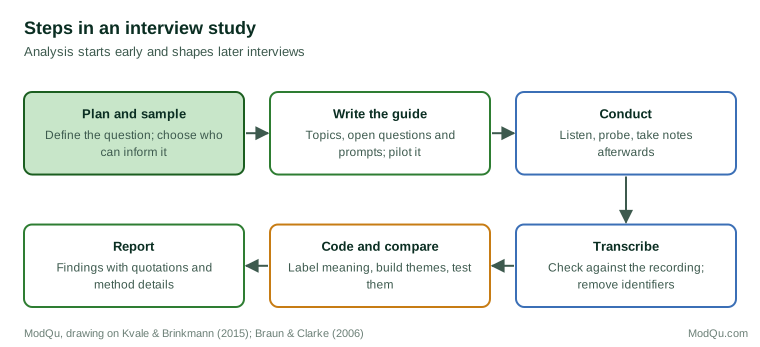
Whatever approach is used, the analysis should look for variation as well as agreement, give attention to accounts that do not fit the main pattern, and keep the link between each finding and the data that support it. Reports should use quotations to show the evidence for each theme, and should describe the sample, the interview process and the analysis in enough detail for readers to judge them. The COREQ checklist sets out what such a report should include (Tong et al., 2007).
Common mistakes
Some mistakes recur often enough to be worth naming:
- Asking about hypotheticals. "Would you use a feature that did X?" produces speculation. Asking about what people did in a recent, real situation produces evidence.
- Talking too much. The interviewer should speak for a small fraction of the time.
- Leading the participant. Suggesting answers, or showing approval of some answers, shapes what participants say.
- Moving on too quickly. The most valuable material usually comes from the second or third follow-up question.
- Analysing only for confirmation. Searching transcripts for quotations that support an existing view, rather than coding systematically, defeats the purpose of the research.
Interviews in commercial research
In commercial settings, in-depth interviews are used to understand purchase decisions, customer experience, product use, and the needs of business buyers. Weiss (1994) noted that interviews allow researchers to learn about places and events they could not observe directly, and to understand how people interpret them. A hypothetical example: a business-to-business software firm interviews 15 recent buyers and 10 prospects who chose a competitor, each about their actual decision process. The interviews show that the decision was made largely by finance staff whom the firm's sales team never met, an insight that changes how the firm sells.
Conclusion
In-depth interviews give access to people's experiences, reasons and interpretations in their own words. Their quality depends on careful planning, a well-tested guide, skilled and neutral probing, and systematic analysis that keeps findings linked to evidence. Used with an awareness of their limits, particularly that people's explanations of their own behaviour are accounts rather than proof, they remain one of the most valuable tools for generating knowledge.
References
Archibald, M. M., Ambagtsheer, R. C., Casey, M. G., & Lawless, M. (2019). Using Zoom videoconferencing for qualitative data collection: Perceptions and experiences of researchers and participants. International Journal of Qualitative Methods, 18. https://doi.org/10.1177/1609406919874596
Braun, V., & Clarke, V. (2006). Using thematic analysis in psychology. Qualitative Research in Psychology, 3(2), 77–101. https://doi.org/10.1191/1478088706qp063oa
DiCicco-Bloom, B., & Crabtree, B. F. (2006). The qualitative research interview. Medical Education, 40(4), 314–321. https://doi.org/10.1111/j.1365-2929.2006.02418.x
Gale, N. K., Heath, G., Cameron, E., Rashid, S., & Redwood, S. (2013). Using the framework method for the analysis of qualitative data in multi-disciplinary health research. BMC Medical Research Methodology, 13, Article 117. https://doi.org/10.1186/1471-2288-13-117
Guest, G., Bunce, A., & Johnson, L. (2006). How many interviews are enough? An experiment with data saturation and variability. Field Methods, 18(1), 59–82. https://doi.org/10.1177/1525822X05279903
Hennink, M. M., Kaiser, B. N., & Marconi, V. C. (2017). Code saturation versus meaning saturation: How many interviews are enough? Qualitative Health Research, 27(4), 591–608. https://doi.org/10.1177/1049732316665344
Kallio, H., Pietilä, A.-M., Johnson, M., & Kangasniemi, M. (2016). Systematic methodological review: Developing a framework for a qualitative semi-structured interview guide. Journal of Advanced Nursing, 72(12), 2954–2965. https://doi.org/10.1111/jan.13031
Kvale, S., & Brinkmann, S. (2015). InterViews: Learning the craft of qualitative research interviewing (3rd ed.). SAGE.
Malterud, K., Siersma, V. D., & Guassora, A. D. (2016). Sample size in qualitative interview studies: Guided by information power. Qualitative Health Research, 26(13), 1753–1760. https://doi.org/10.1177/1049732315617444
McCracken, G. (1988). The long interview. SAGE. https://doi.org/10.4135/9781412986229
McGrath, C., Palmgren, P. J., & Liljedahl, M. (2019). Twelve tips for conducting qualitative research interviews. Medical Teacher, 41(9), 1002–1006. https://doi.org/10.1080/0142159X.2018.1497149
Miles, M. B., Huberman, A. M., & Saldaña, J. (2014). Qualitative data analysis: A methods sourcebook (3rd ed.). SAGE.
Nisbett, R. E., & Wilson, T. D. (1977). Telling more than we can know: Verbal reports on mental processes. Psychological Review, 84(3), 231–259. https://doi.org/10.1037/0033-295X.84.3.231
Novick, G. (2008). Is there a bias against telephone interviews in qualitative research? Research in Nursing & Health, 31(4), 391–398. https://doi.org/10.1002/nur.20259
Patton, M. Q. (2015). Qualitative research & evaluation methods: Integrating theory and practice (4th ed.). SAGE.
Rubin, H. J., & Rubin, I. S. (2012). Qualitative interviewing: The art of hearing data (3rd ed.). SAGE.
Saldaña, J. (2016). The coding manual for qualitative researchers (3rd ed.). SAGE.
Spradley, J. P. (1979). The ethnographic interview. Holt, Rinehart and Winston.
Tong, A., Sainsbury, P., & Craig, J. (2007). Consolidated criteria for reporting qualitative research (COREQ): A 32-item checklist for interviews and focus groups. International Journal for Quality in Health Care, 19(6), 349–357. https://doi.org/10.1093/intqhc/mzm042
Weiss, R. S. (1994). Learning from strangers: The art and method of qualitative interview studies. Free Press.