
Research · Qualitative research
Qualitative Research: Purpose, Strengths and Standards of Quality
What qualitative research is for, the questions it answers better than numbers, its main strengths and limits, and the standards used to judge its quality, including credibility, transferability, dependability, confirmability and the main reporting checklists.
Qualitative research studies people's experiences, meanings and actions through words, observations and images rather than numbers. It asks how and why things happen, and what they mean to the people involved. A survey can show that 40% of customers who leave a service cite "poor support". Qualitative research can show what "poor support" means to them, which moments in their experience produced that judgement and what they expected instead. Denzin and Lincoln (2018) describe qualitative research as a situated activity that locates the observer in the world, studying things in their natural settings and attempting to make sense of them in terms of the meanings people bring to them. This article explains what qualitative research is for, where its strengths and limits lie, and how its quality is judged.
What qualitative research is for
Pope and Mays (1995) described qualitative methods as "reaching the parts other methods cannot reach". They identified several distinct purposes. Qualitative research can explore a topic about which little is known, generating the concepts and questions that later quantitative work can measure. It can explain quantitative findings, showing the reasons behind a pattern in survey data. It can study processes as they unfold, such as how a decision is made in an organisation. And it can examine subjects that are hard to measure, such as trust, identity or the experience of illness.
Common qualitative methods include in-depth interviews, focus groups, observation and ethnography, analysis of documents and online content, and case studies. The analysis usually involves close reading of transcripts or field notes, coding passages by their meaning, and building themes, categories or explanations from the patterns that emerge (Miles et al., 2014; Braun & Clarke, 2006).
Strengths
The first strength is depth. A single interview can reveal the reasoning behind a choice, the context in which it was made and the emotions attached to it. Geertz (1973) called the goal thick description: an account that captures not only what people do but what their actions mean in their setting.
The second is openness. Because questions are not fixed in advance, participants can raise issues the researcher did not anticipate. Many important findings in applied research come from this, when customers, patients or employees describe a problem that no one had thought to ask about.
The third is attention to context and process. Qualitative research can follow how something develops over time, and how it is shaped by the setting in which it occurs, rather than treating each observation as an isolated data point.
The fourth is flexibility. The design can be adjusted as the study proceeds, adding questions or participants when new themes emerge (Patton, 2015).
Limits
The same features impose limits. Qualitative samples are usually small and chosen purposively, so they cannot show how common a view or behaviour is in a population. A finding that some customers feel misled by a pricing page does not show what share of customers feel that way. Small (2009) argued that qualitative researchers should not borrow the language of statistical representativeness for samples that cannot support it, and should instead explain the logic by which their findings may apply elsewhere.
Qualitative analysis also depends heavily on the researcher's interpretation. Two analysts reading the same transcripts may emphasise different themes. This is not a fatal weakness, but it means that the process of interpretation must be made visible so that readers can judge it. Finally, qualitative studies take time per participant, which limits their scale and raises their cost per case.
Standards of quality
Because qualitative research does not rely on statistical tests, its quality cannot be judged by the same criteria as quantitative research. Lincoln and Guba (1985) proposed four criteria of trustworthiness as parallels to the conventional standards of validity, reliability and objectivity.
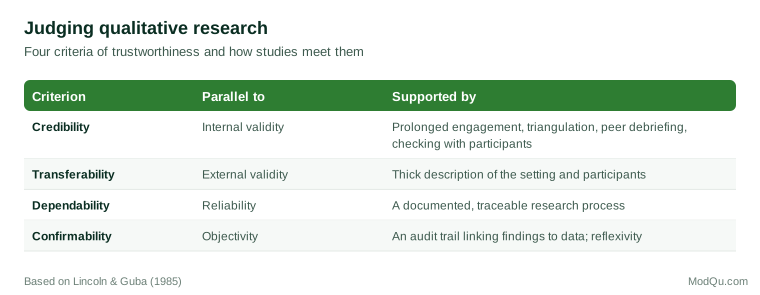
Credibility concerns whether the findings are a believable account of participants' views. It is supported by prolonged engagement with the setting, triangulation across sources or methods, discussion with peers and checking interpretations with participants. Transferability concerns whether findings may apply in other settings. The researcher cannot establish this alone, but provides enough description of the context for readers to judge. Dependability concerns whether the process was logical, traceable and documented. Confirmability concerns whether the findings are grounded in the data rather than in the researcher's preferences, which is supported by an audit trail linking conclusions to evidence.
Other authors have proposed related frameworks. Mays and Pope (2000) listed practical ways to improve quality in health research, including triangulation, respondent validation, clear exposition of methods, reflexivity, attention to negative cases and fair representation of different views. Malterud (2001) emphasised reflexivity, meaning the researcher's explicit attention to how their own position and assumptions shape the study, together with clear reasoning about how far findings can be transferred. Tracy (2010) proposed eight "big-tent" criteria that apply across qualitative traditions: a worthy topic, rich rigour, sincerity, credibility, resonance, significant contribution, ethics and meaningful coherence.
Morse et al. (2002) argued that rigour should be built in during the study rather than assessed afterwards. They recommended verification strategies applied as the work proceeds: coherence between question and method, an appropriate sample, collecting and analysing data at the same time so that each informs the other, and thinking theoretically about what the data show. Barbour (2001) warned that techniques such as multiple coding or respondent validation can become box-ticking exercises if applied mechanically; their value lies in how they are used and reported, not in whether they appear in a checklist.
Reporting standards
Several checklists now guide how qualitative studies should be reported. The COREQ checklist sets out 32 items for reports of interview and focus group studies, covering the research team, the study design and the analysis (Tong et al., 2007). The SRQR standards offer 21 items applicable across qualitative approaches (O'Brien et al., 2014). The American Psychological Association's reporting standards for qualitative research cover similar ground and emphasise describing the researcher's perspective and the methods of analysis in enough detail for readers to evaluate them (Levitt et al., 2018).
These checklists share a common aim: to make the path from data to conclusions visible. A qualitative report should state who was studied and why, how data were collected, how analysis was carried out, who did the analysis and from what perspective, and what evidence supports each main finding. Direct quotations, attributed to participants by role or code rather than name, help readers see the data behind each theme.
Choosing a qualitative approach
The choice between qualitative and quantitative methods should follow from the question. Questions that begin "how many", "how much" or "how often" call for measurement. Questions that begin "how", "why" or "what is it like" usually call for qualitative work, at least at first. Many studies combine the two: qualitative interviews to discover what matters, a survey to measure how widespread it is, and further interviews to explain the survey results.
Within qualitative research, different traditions suit different aims. Ethnography studies a culture or group through extended observation; grounded theory builds explanations of social processes from data; phenomenology describes the essence of an experience; narrative research examines the stories people tell; and case studies examine a bounded unit in depth. Each has its own procedures, and a study should state which it follows rather than describing itself only as "qualitative".
Qualitative research in applied and commercial settings
In business research, qualitative work is often used before a survey, to identify the issues and language that the questionnaire should use, and after it, to explain surprising results. It is also used on its own to understand experiences in depth, such as how customers decide between products, how employees respond to a change, or where a service journey breaks down.
Consider a hypothetical example. A software company sees in its usage data that many new customers stop using a feature within two weeks. Twenty interviews with customers who stopped, chosen to cover different company sizes and roles, reveal that most never understood what the feature was for, because its name suggested a different function. No survey would have found this, because no one would have thought to ask about the name. Renaming the feature and adding a short explanation cost little, and the follow-up usage data could then show whether the change worked, combining the strengths of both approaches.
The quality standards above apply in these settings as well. A commercial qualitative report that names its sample and selection logic, describes how interviews were analysed, shows the evidence for each finding and acknowledges what the study cannot show is far more useful to decision makers than a summary of striking quotations.
Conclusion
Qualitative research answers questions about meaning, experience and process that numbers alone cannot. Its strengths are depth, openness, attention to context and flexibility; its limits are small samples, dependence on interpretation and a high cost per case. Its quality rests not on statistical tests but on credibility, transferability, dependability and confirmability, supported by transparent methods, reflexivity and clear reporting. Judged by these standards, good qualitative research produces knowledge that is both rigorous and directly useful.
References
Barbour, R. S. (2001). Checklists for improving rigour in qualitative research: A case of the tail wagging the dog? BMJ, 322(7294), 1115–1117. https://doi.org/10.1136/bmj.322.7294.1115
Braun, V., & Clarke, V. (2006). Using thematic analysis in psychology. Qualitative Research in Psychology, 3(2), 77–101. https://doi.org/10.1191/1478088706qp063oa
Denzin, N. K., & Lincoln, Y. S. (Eds.). (2018). The SAGE handbook of qualitative research (5th ed.). SAGE.
Geertz, C. (1973). The interpretation of cultures: Selected essays. Basic Books.
Levitt, H. M., Bamberg, M., Creswell, J. W., Frost, D. M., Josselson, R., & Suárez-Orozco, C. (2018). Journal article reporting standards for qualitative primary, qualitative meta-analytic, and mixed methods research in psychology: The APA Publications and Communications Board task force report. American Psychologist, 73(1), 26–46. https://doi.org/10.1037/amp0000151
Lincoln, Y. S., & Guba, E. G. (1985). Naturalistic inquiry. SAGE.
Malterud, K. (2001). Qualitative research: Standards, challenges, and guidelines. The Lancet, 358(9280), 483–488. https://doi.org/10.1016/S0140-6736(01)05627-6
Mays, N., & Pope, C. (2000). Assessing quality in qualitative research. BMJ, 320(7226), 50–52. https://doi.org/10.1136/bmj.320.7226.50
Miles, M. B., Huberman, A. M., & Saldaña, J. (2014). Qualitative data analysis: A methods sourcebook (3rd ed.). SAGE.
Morse, J. M., Barrett, M., Mayan, M., Olson, K., & Spiers, J. (2002). Verification strategies for establishing reliability and validity in qualitative research. International Journal of Qualitative Methods, 1(2), 13–22. https://doi.org/10.1177/160940690200100202
O'Brien, B. C., Harris, I. B., Beckman, T. J., Reed, D. A., & Cook, D. A. (2014). Standards for reporting qualitative research: A synthesis of recommendations. Academic Medicine, 89(9), 1245–1251. https://doi.org/10.1097/ACM.0000000000000388
Patton, M. Q. (2015). Qualitative research & evaluation methods: Integrating theory and practice (4th ed.). SAGE.
Pope, C., & Mays, N. (1995). Reaching the parts other methods cannot reach: An introduction to qualitative methods in health and health services research. BMJ, 311(6996), 42–45. https://doi.org/10.1136/bmj.311.6996.42
Small, M. L. (2009). "How many cases do I need?" On science and the logic of case selection in field-based research. Ethnography, 10(1), 5–38. https://doi.org/10.1177/1466138108099586
Tong, A., Sainsbury, P., & Craig, J. (2007). Consolidated criteria for reporting qualitative research (COREQ): A 32-item checklist for interviews and focus groups. International Journal for Quality in Health Care, 19(6), 349–357. https://doi.org/10.1093/intqhc/mzm042
Tracy, S. J. (2010). Qualitative quality: Eight "big-tent" criteria for excellent qualitative research. Qualitative Inquiry, 16(10), 837–851. https://doi.org/10.1177/1077800410383121