
Research · Qualitative research
Grounded Theory: Building Theory From Data
How grounded theory builds explanations directly from data, covering its origins, constant comparison, coding stages, memo writing, theoretical sampling and saturation, the main schools, common misunderstandings, and how the method is used in organisational and market research.
Most research starts with a theory and tests it against data. Grounded theory works the other way round. It begins with data, usually interviews and observations, and builds a theory from them step by step, so that the resulting explanation is "grounded" in what was actually observed. The method was introduced by Glaser and Strauss (1967), and it has become one of the most widely used approaches in qualitative research, in fields from nursing and education to management and information systems. This article explains what grounded theory is, how its procedures work, how its main versions differ and what it is often mistaken for.
Origins
In the 1960s, much American sociology was dominated by large theories developed from the armchair and then tested, with qualitative research treated mainly as a preliminary step. Glaser and Strauss (1967) argued that this left sociology with theories that often did not fit the situations they claimed to explain. They proposed instead that researchers should generate theory systematically from data, and that a theory developed in this way would fit the setting, be understandable to the people in it and be useful in practice.
Their own example was a study of dying in hospitals. Glaser and Strauss (1965) observed how staff, patients and families managed information about impending death, and developed the concept of awareness contexts: situations ranging from closed awareness, in which the patient does not know they are dying, through suspicion and mutual pretence, to open awareness. The concept explained a wide range of behaviour on hospital wards and has since been applied in many other settings where people manage what others know.
The core procedures
Grounded theory is defined less by a single technique than by a set of linked procedures that run in parallel throughout the study.
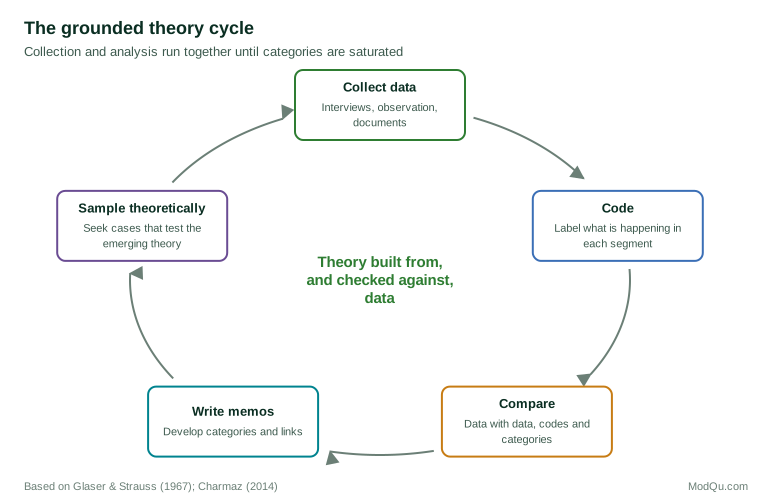
Simultaneous data collection and analysis. Analysis begins with the first interview or observation, not after all the data are collected. Early analysis shapes what is collected next.
Constant comparison. Each new piece of data is compared with earlier data, with emerging codes and with categories. Incidents are compared with incidents, then with the categories they have generated, then categories with each other. Glaser and Strauss (1967) presented this as the main engine of theory development: comparison reveals similarities and differences, the properties of each category and the conditions under which it varies.
Coding. Data are broken into segments and labelled with codes that describe what is happening. Charmaz (2014) recommends coding with gerunds, verb forms ending in "-ing", such as "hiding symptoms" or "testing the boundaries", because they keep attention on actions and processes rather than on static topics.
Memo writing. Throughout the analysis, the researcher writes memos: informal notes about codes, categories, relationships and ideas. Memos are where the theory is actually developed. They record the researcher's thinking, raise questions to pursue and, when sorted and integrated, form the basis of the written theory (Glaser, 1978).
Theoretical sampling. Rather than sampling to represent a population, the researcher chooses the next participants, sites or events to develop the emerging theory. If a category seems to depend on a condition, the researcher seeks cases where that condition is absent or different (Glaser & Strauss, 1967).
Theoretical saturation. Data collection continues until new data no longer add new properties to the categories. Saturation is reached for categories, not for topics, and it is a judgement about the theory, not a count of interviews.
Stages of coding
Coding usually proceeds in stages, although the names vary between versions of the method. In the first stage, open or initial coding, the researcher reads the data closely, line by line or incident by incident, and labels everything that seems relevant. This produces many codes. In the second stage, focused or selective coding, the researcher identifies the most significant or frequent codes and uses them to examine larger segments of data, building categories (Charmaz, 2014; Saldaña, 2016).
Strauss and Corbin (1990) added axial coding, in which the researcher relates categories to their subcategories by asking about the conditions, actions and consequences associated with each. In the final stage, the researcher identifies a core category, the central concept that relates to most other categories and explains most of the variation in the data, and integrates the theory around it. Glaser (1978) proposed theoretical codes, families of abstract relationships such as causes, contexts, conditions and consequences, that help the researcher specify how categories relate to one another.
The main schools
After their joint work, Glaser and Strauss developed different versions of the method, and a third major version emerged later. Heath and Cowley (2004) and Walker and Myrick (2006) compared them in detail.
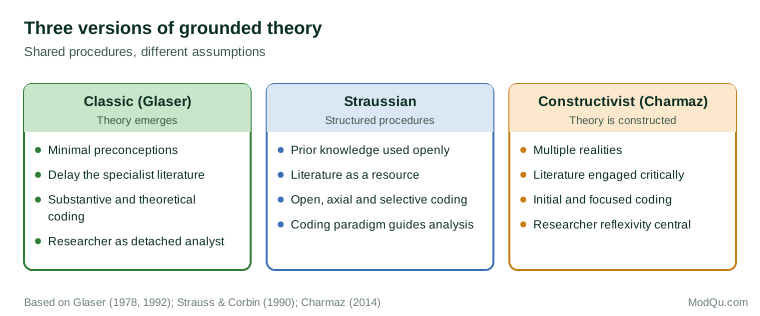
Classic or Glaserian grounded theory emphasises emergence. The researcher approaches the data with as few preconceptions as possible, lets categories emerge through constant comparison and avoids reading the specialist literature on the topic until the theory is well developed.
Straussian grounded theory, set out by Strauss and Corbin (1990) and revised by Corbin and Strauss (2015), provides more detailed procedures, including axial coding and a coding paradigm that directs attention to conditions, actions and consequences. Glaser (1992) criticised this approach strongly, arguing that it "forced" data into predetermined categories rather than letting theory emerge. Kelle (2005) argued that the debate rests on a real problem: no researcher can approach data without prior concepts, and the question is how to use them openly without letting them dominate.
Constructivist grounded theory, developed by Charmaz (2014), holds that theories are not discovered in data but constructed by researchers through their interactions with participants and data. It keeps the core procedures but emphasises reflexivity, the researcher's position and the multiple realities of participants. Bryant and Charmaz (2007) present it alongside the other versions as part of a broad family of grounded theory methods.
Researchers should state which version they follow, because the choice affects how literature is used, how coding proceeds and what claims the final theory makes.
What grounded theory is not
Because the term is so widely used, it is often misapplied. Suddaby (2006), writing as an editor of a leading management journal, listed several common misunderstandings. Grounded theory is not an excuse to ignore the literature: researchers should know the field, even if they hold that knowledge lightly during analysis. It is not the presentation of raw data: a list of themes with quotations is description, not theory. It is not theory testing or word counting. And it is not a simple routine: it requires creativity and the ability to move from data to abstract concepts.
Urquhart et al. (2010) made a similar point for information systems research, noting that many studies that described themselves as grounded theory used its coding techniques but did not produce a theory. A grounded theory study should end with an explanation: a set of related concepts that accounts for a process or pattern in the data. Dey (1999) also cautioned that key terms such as "saturation" and "emergence" are often used loosely, and that researchers should explain what they mean by them in their own study.
Related approaches
Several approaches build on grounded theory while modifying it. In management research, the Gioia methodology organises analysis into first-order concepts expressed in participants' terms, second-order themes expressed in theoretical terms, and aggregate dimensions, presented in a "data structure" diagram that shows how the theory was built (Gioia et al., 2013). Eisenhardt (1989) combined elements of grounded theory with case study design to build theory from multiple cases. Timmermans and Tavory (2012) proposed abductive analysis, in which the researcher brings broad theoretical knowledge to the data and pays particular attention to surprising findings that existing theories cannot explain, generating new hypotheses to account for them.
Grounded theory in applied and commercial research
Grounded theory is well suited to questions about processes that are poorly understood, such as how customers come to trust a new kind of service, how employees adapt to a new system, or how small firms decide to export. Birks and Mills (2015) note that its explicit procedures make it accessible to researchers outside academic sociology, while its focus on process gives findings practical value.
A brief hypothetical example illustrates the method. A research team studying why customers cancel a subscription service begins with interviews with recent cancellers. Early coding produces codes such as "forgetting to use", "feeling guilty about paying" and "waiting for a reason to leave". Memos link these into a tentative process: customers drift from use, accumulate guilt, and then cancel when a trigger, such as a price rise or a bank statement review, gives them a reason. Theoretical sampling leads the team to interview customers who drifted from use but did not cancel, to discover what kept them. The resulting theory, of disengagement followed by a triggering event, suggests interventions at the drifting stage rather than at the point of cancellation.
Grounded theory also has practical limits in applied settings. It needs time for analysis to keep pace with data collection, flexibility to change the sample as the theory develops, and analysts able to move from codes to abstract concepts. Commercial projects with fixed samples, fixed deadlines and fieldwork completed before analysis begins can borrow its coding techniques, but they cannot claim to follow the full method. Being clear about this is more credible than using the label loosely. Where the method can be followed, a sensible plan budgets for two or three rounds of fieldwork, with time between rounds for coding, memo writing and choosing the next participants.
Judging a grounded theory study
A good grounded theory study shows how the theory was built. Readers should be able to see the sampling decisions, the coding stages, examples of how codes became categories, and how the core category was identified. Glaser and Strauss (1967) suggested that a grounded theory should fit the data, work to explain what happens, be relevant to the people in the setting and be modifiable as new data appear. These remain useful tests. A reader should also be able to see the limits of the theory: the settings and people it was developed from, the conditions under which it is expected to hold, and the cases that did not fit and how they were handled.
Conclusion
Grounded theory offers a systematic way to build theory from data. Its procedures of simultaneous collection and analysis, constant comparison, coding, memo writing, theoretical sampling and saturation are designed to ensure that explanations fit the setting they describe. Its versions differ in how much structure they impose and how they view the researcher's role, but all aim to produce an explanation, not a description. Used carefully, grounded theory produces concepts that are both closely tied to evidence and useful for understanding and action.
References
Birks, M., & Mills, J. (2015). Grounded theory: A practical guide (2nd ed.). SAGE.
Bryant, A., & Charmaz, K. (Eds.). (2007). The SAGE handbook of grounded theory. SAGE. https://doi.org/10.4135/9781848607941
Charmaz, K. (2014). Constructing grounded theory (2nd ed.). SAGE.
Corbin, J., & Strauss, A. (2015). Basics of qualitative research: Techniques and procedures for developing grounded theory (4th ed.). SAGE.
Dey, I. (1999). Grounding grounded theory: Guidelines for qualitative inquiry. Academic Press.
Eisenhardt, K. M. (1989). Building theories from case study research. Academy of Management Review, 14(4), 532–550. https://doi.org/10.5465/amr.1989.4308385
Gioia, D. A., Corley, K. G., & Hamilton, A. L. (2013). Seeking qualitative rigor in inductive research: Notes on the Gioia methodology. Organizational Research Methods, 16(1), 15–31. https://doi.org/10.1177/1094428112452151
Glaser, B. G. (1978). Theoretical sensitivity: Advances in the methodology of grounded theory. Sociology Press.
Glaser, B. G. (1992). Basics of grounded theory analysis: Emergence vs forcing. Sociology Press.
Glaser, B. G., & Strauss, A. L. (1965). Awareness of dying. Aldine.
Glaser, B. G., & Strauss, A. L. (1967). The discovery of grounded theory: Strategies for qualitative research. Aldine.
Heath, H., & Cowley, S. (2004). Developing a grounded theory approach: A comparison of Glaser and Strauss. International Journal of Nursing Studies, 41(2), 141–150. https://doi.org/10.1016/S0020-7489(03)00113-5
Kelle, U. (2005). "Emergence" vs. "forcing" of empirical data? A crucial problem of "grounded theory" reconsidered. Forum Qualitative Sozialforschung / Forum: Qualitative Social Research, 6(2), Article 27. https://doi.org/10.17169/fqs-6.2.467
Saldaña, J. (2016). The coding manual for qualitative researchers (3rd ed.). SAGE.
Strauss, A., & Corbin, J. (1990). Basics of qualitative research: Grounded theory procedures and techniques. SAGE.
Suddaby, R. (2006). From the editors: What grounded theory is not. Academy of Management Journal, 49(4), 633–642. https://doi.org/10.5465/amj.2006.22083020
Timmermans, S., & Tavory, I. (2012). Theory construction in qualitative research: From grounded theory to abductive analysis. Sociological Theory, 30(3), 167–186. https://doi.org/10.1177/0735275112457914
Urquhart, C., Lehmann, H., & Myers, M. D. (2010). Putting the 'theory' back into grounded theory: Guidelines for grounded theory studies in information systems. Information Systems Journal, 20(4), 357–381. https://doi.org/10.1111/j.1365-2575.2009.00328.x
Walker, D., & Myrick, F. (2006). Grounded theory: An exploration of process and procedure. Qualitative Health Research, 16(4), 547–559. https://doi.org/10.1177/1049732305285972