
Share your experience of hospital care
Tell us about your last visit to an emergency department or hospital stay, and how it went. Your answers are combined with other people's and reported only as totals.
Start the hospitals and emergency care surveyAbout 5 minutes. No account needed. You can stop at any time.
Emergency departments and how triage works
Emergency departments (also called accident and emergency, casualty or emergency rooms) treat people with urgent and life-threatening problems. Because many people arrive at once, staff use triage to decide the order of treatment. A nurse or doctor quickly assesses each person and assigns a priority based on how serious the condition is, not on arrival time.
This means someone with a sprained ankle may wait several hours while people with chest pain, severe breathing problems or serious injuries are seen first. People who arrive by ambulance are triaged in the same way.
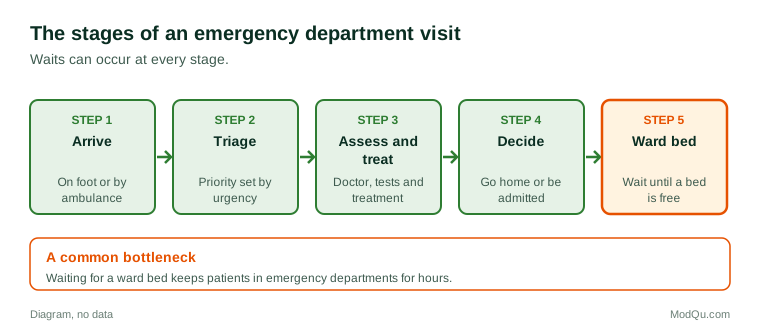
The figure below shows the typical stages of an emergency visit.
Why waits happen
Long waits in emergency departments are common in many countries. Causes include:
- more people attending, including older people with complex needs;
- shortages of doctors, nurses and beds;
- patients waiting for a hospital bed after being assessed, which blocks emergency space;
- delays in discharging patients who need care at home or in a care home;
- seasonal peaks, such as winter respiratory infections;
- people attending with problems that could be treated elsewhere.
Some countries set targets, such as a maximum time from arrival to admission or discharge, and publish performance data.
Example (hypothetical figures)
A patient arrives at 7 pm with abdominal pain. They are triaged at 7:20 pm, see a doctor at 10:10 pm, have tests and a scan, and are told at 1:30 am that they need to stay. A bed on a ward becomes free at 6:00 am. In total they spend 11 hours in the emergency department, of which 4.5 hours were waiting for a bed.
Alternatives to emergency departments
Health systems offer other options for urgent but not life-threatening problems:
- Urgent care or walk-in centres for minor injuries and illnesses.
- Out-of-hours doctors and same-day appointments.
- Pharmacists for minor ailments.
- Telephone and online advice services that direct people to the right place.
- Virtual consultations.
Many people are unsure which service to use, and campaigns often encourage people to call an advice line first unless the situation is an emergency.
Example
A parent's toddler has a high temperature late at night. Unsure what to do, they call the national health advice line. The nurse asks questions and books an appointment at an out-of-hours clinic within the hour, avoiding a long wait at the emergency department.
Hospital stays
When a person is admitted, their experience depends on many things: the ward, staffing levels, communication, food, privacy and how involved they are in decisions. Patient surveys in many countries ask about:
- being treated with dignity and respect;
- understanding what is happening and why;
- getting help with pain;
- being able to sleep, eat and wash;
- involvement of family;
- cleanliness and infection control.
Discharge and going home
Leaving hospital is a key stage. Problems at discharge include waiting for medicines or transport, unclear instructions, and lack of support at home. Older patients may need care services, equipment or adaptations before they can go home safely, and delays in arranging these keep them in hospital longer than medically needed.
Example
An older woman recovering from a hip operation is ready to leave but needs help at home with washing and dressing. Arranging home care takes nine days, during which she stays in hospital. Her family say the delay was frustrating and that she became weaker from staying in bed.
Paying for hospital care
How hospital care is paid for differs greatly between countries. Some provide care free at the point of use through taxes. Others use social or private insurance, with patients paying deductibles or co-payments. In some countries, patients pay large amounts out of pocket, and hospital bills are a major cause of financial hardship. Surprise bills, for example from services outside a person's insurance network, are a concern in some systems.
Staff and working conditions
Patients often notice how busy staff are. Staff shortages, burnout and reliance on temporary staff affect care in many countries. Patients' views of hospital care are closely linked to communication with staff, and many say that kindness and clear explanations matter as much as speed.
Complaints and feedback
Hospitals usually have ways for patients and families to give feedback, compliment staff or complain, such as patient liaison services and online forms. Many countries also run national patient experience surveys. Feedback is used to improve services, though patients often say they do not know what changed as a result.
Ambulance services
Ambulance response times are closely linked to pressure in hospitals. When emergency departments are full, ambulance crews may wait outside to hand over patients, which leaves fewer ambulances available for new calls. Many services now use call handlers and clinicians on the phone to decide whether an ambulance is needed, or whether another service would be better. Some people say they were unsure whether to call, worried about the cost of an ambulance where it is charged, or waited a long time for one to arrive.
What people disagree about
Debates include how to reduce emergency waits, whether charges or deterrents should be used for non-urgent visits, how to fund more beds and staff, the role of private hospitals, and how to improve care for older people with complex needs. People also disagree about whether targets improve care or distort priorities.
Questions that businesses want answered include when people last used an emergency department or hospital, how long they waited, how they rate the care and communication, whether they considered alternatives, how discharge went, and what they would change.
Key terms
- Emergency departmentThe part of a hospital that treats urgent and life-threatening problems.
- TriageSorting patients by how urgently they need treatment.
- AdmissionBeing formally taken into hospital as an inpatient.
- DischargeLeaving hospital after treatment.
- Urgent care centreA service for minor injuries and illnesses that are not life-threatening.
- Bed occupancyThe share of hospital beds in use.
- Delayed dischargeStaying in hospital after being medically ready to leave.
- Patient experienceHow patients perceive their care, including communication and respect.
Full glossary: emergency medicine terms on EditingTests.com.
Hospitals and emergency care vocabulary test
How well do you know the language of this topic? Try 8 quick questions. Your score is shown straight away and is not saved.
What the hospitals and emergency care survey asks
This survey is part of ModQu's Health and Wellness survey. The hospitals and emergency care part takes about five minutes and covers:
- When you last used an emergency department or stayed in hospital.
- How long you waited at each stage.
- How you rate the care, communication and respect you received.
- Whether you considered another service first, and why or why not.
- How your discharge and return home went.
- What one change would most improve hospital care for you.
After that you can choose to continue with other short parts of the Health and Wellness survey, such as access to family doctors or virtual care and telehealth, or stop.
Ready to take part?
Your answers help show what people really think and do. Results are only ever reported as totals; no one can see your individual answers.
Start the surveyQuestions about this survey
Who can take part?
Adults who used a hospital in the last two years.
Do I have to give my name?
No. You may be asked for your age group, region and similar details so results can be broken down, but not your name. ModQu never asks for passwords, card numbers or account numbers.
How are the results used?
Answers are combined into totals and percentages and published in ModQu reports. Individual answers are never shown.
Is the vocabulary test part of the survey?
No. It is optional and separate, and your score is not stored.
How do I know whether to go to an emergency department?
For life-threatening problems, call emergency services. For other urgent issues, many countries have advice lines that direct you to the right service.
Can I give feedback on my hospital care?
Most hospitals have feedback and complaint routes, and many countries run national patient surveys.