
Share your experience of health care costs
Tell us what you pay for health care yourself and whether cost has affected your decisions. Your answers are combined with other people's and reported only as totals.
Start the medical costs and paying for care surveyAbout 5 minutes. No account needed. You can stop at any time.
How health care is paid for
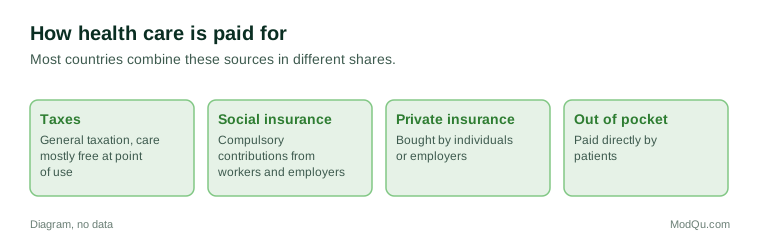
Health systems around the world are funded in a few main ways, usually in combination:
- Taxes: care is funded by general taxation and is mostly free at the point of use.
- Social health insurance: workers and employers pay compulsory contributions into health funds.
- Private insurance: individuals or employers buy health insurance.
- Out-of-pocket payments: patients pay directly, in full or in part.
The share of health spending paid out of pocket varies widely. In some countries it is a small fraction; in others, patients pay a large share of costs directly. The figure below shows the main sources.
Out-of-pocket costs in different systems
Even where most care is publicly funded, people often pay for:
- prescription charges or co-payments for medicines;
- dental care and eye care, which are often only partly covered;
- physiotherapy, counselling and other therapies;
- private appointments to avoid waiting lists;
- medical equipment and aids;
- travel and parking for appointments.
Where insurance is the main route, costs include premiums plus deductibles (the amount paid before insurance starts), co-payments (fixed amounts per visit), and coinsurance (a percentage of the bill).
Example (hypothetical figures)
A family has an insurance plan with a 1,500 deductible and 20% coinsurance after that. A child's hospital visit costs 4,000. The family pays the first 1,500, then 20% of the remaining 2,500, which is 500. Their total share is 2,000, plus their monthly premiums.
Delaying or skipping care because of cost
Surveys in many countries find that some people delay or skip care because of cost. Common examples include:
- not filling a prescription or taking less medicine than prescribed;
- skipping dental check-ups or treatment;
- delaying a visit to a doctor until a problem becomes urgent;
- not attending follow-up appointments;
- avoiding tests.
Delaying care can lead to more serious illness and higher costs later. People on low incomes, people without insurance, and those with long-term conditions are most affected.
Example
A self-employed painter has a toothache but no dental cover. He puts off seeing a dentist for months because of the cost. When he finally goes, he needs a root canal and a crown instead of a small filling, and the bill is several times higher.
Medical debt
In systems with high out-of-pocket costs, medical bills can lead to debt. People may use credit cards, payment plans, loans or savings to pay. Medical debt can affect credit records, cause stress and lead some people to avoid further care. Some countries have introduced rules on billing, payment plans, charity care and how medical debt is reported.
Paying for care abroad and medical tourism
Some people travel to another country for treatment, often dental work, cosmetic surgery, fertility treatment or operations with long waiting lists at home. Reasons include lower prices, shorter waits and treatments not available locally. Risks include complications after returning home, difficulty following up, and differing standards.
Example
A woman faces a long wait for a knee operation at home. She pays for the operation at a private hospital abroad, including travel. The operation goes well, but she has to pay privately for physiotherapy at home because her local service has a waiting list too.
Help with costs
Depending on the country, help may include:
- exemptions from charges for people on low incomes, children, older people or people with certain conditions;
- prepayment certificates or caps on yearly charges;
- hospital charity care or financial assistance programs;
- public insurance for people on low incomes;
- charities that help with specific costs;
- payment plans arranged with providers.
Many people do not know what help is available, and applying can be complicated.
Price transparency
In many systems it is hard to know in advance how much care will cost. Some countries require hospitals and insurers to publish prices or give estimates. Patients often say they want clear costs before treatment, especially for planned procedures.
The wider economic effects
High health costs affect household budgets, decisions about work, and whether people can afford other essentials. Employers that provide health insurance face rising premiums. Governments weigh the cost of public coverage against the effects of people delaying care. These questions are central to many political debates about health.
Costs for people with long-term conditions
People with chronic conditions often face repeated costs over many years: regular prescriptions, equipment, specialist visits and travel. Even small charges can add up. Some systems cap yearly costs or exempt people with certain conditions; others do not. Surveys often find that people with long-term conditions are among the most likely to report cutting back on medicines or other essentials to manage costs.
Example (hypothetical figures)
A man with three long-term conditions pays 12 per prescription item for four items a month, or 576 a year. When he learns about a prepayment certificate costing 120 a year that covers all his prescriptions, his yearly cost falls by 456.
What people disagree about
Debates include how much patients should pay directly, whether charges discourage unnecessary use or deter necessary care, the role of private insurance alongside public systems, how to control rising costs, and whether to extend public coverage to dental care, eye care and mental health.
Questions that businesses want answered include what people pay for health care themselves, which costs they find hardest, whether they have delayed or skipped care because of cost, how they pay large bills, and what help they know about.
Key terms
- Out-of-pocket paymentMoney paid directly by patients for health care.
- DeductibleThe amount paid before insurance starts paying.
- Co-paymentA fixed amount paid for each visit or prescription.
- CoinsuranceA percentage of the bill paid by the patient after the deductible.
- PremiumThe regular payment for an insurance plan.
- Medical debtDebt resulting from unpaid medical bills.
- Charity careFree or reduced-cost care provided by hospitals to people who cannot pay.
- Medical tourismTravelling to another country for medical treatment.
Full glossary: health economics terms on EditingTests.com.
Medical costs and paying for care vocabulary test
How well do you know the language of this topic? Try 8 quick questions. Your score is shown straight away and is not saved.
What the medical costs and paying for care survey asks
This survey is part of ModQu's Health and Wellness survey. The medical costs and paying for care part takes about five minutes and covers:
- What you paid for health care yourself in the last year, roughly.
- Which costs you found hardest: medicines, dental, eye care, therapy or others.
- Whether you have delayed or skipped care because of cost.
- How you paid for any large medical bill.
- Whether you know about help with health costs where you live.
- Your views on how much patients should pay directly for care.
After that you can choose to continue with other short parts of the Health and Wellness survey, such as access to family doctors or virtual care and telehealth, or stop.
Ready to take part?
Your answers help show what people really think and do. Results are only ever reported as totals; no one can see your individual answers.
Start the surveyQuestions about this survey
Who can take part?
Adults.
Do I have to give my name?
No. You may be asked for your age group, region and similar details so results can be broken down, but not your name. ModQu never asks for passwords, card numbers or account numbers.
How are the results used?
Answers are combined into totals and percentages and published in ModQu reports. Individual answers are never shown.
Is the vocabulary test part of the survey?
No. It is optional and separate, and your score is not stored.
Why do health costs differ so much between countries?
Countries fund care differently, through taxes, social insurance, private insurance and direct payments, in different mixes.
Can I get help with prescription costs?
Many countries offer exemptions, caps or prepayment schemes. Check with your health service or insurer.