
Share your experience of living with a long-term condition
Tell us how you manage a long-term condition, the care you receive and what makes it harder. Your answers are combined with other people's and reported only as totals.
Start the chronic conditions and long-term illness surveyAbout 5 minutes. No account needed. You can stop at any time.
What a chronic condition is
A chronic or long-term condition is a health problem that lasts a long time, often for life, and usually cannot be cured but can be managed. Common examples include:
- diabetes;
- high blood pressure and heart disease;
- asthma and chronic obstructive pulmonary disease (COPD);
- arthritis and long-term back pain;
- depression, anxiety and other long-term mental health conditions;
- chronic kidney disease;
- epilepsy, multiple sclerosis and other neurological conditions;
- long-term effects of infections, such as long COVID.
Chronic conditions become more common with age, and many older adults live with two or more at once, which health professionals call multimorbidity.
How people manage day to day
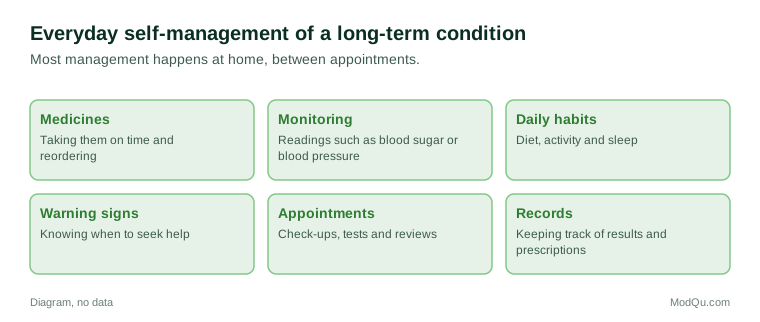
Most of the work of managing a chronic condition is done by the person themselves, between appointments. This is often called self-management. Depending on the condition, it can include:
- taking medicines regularly, sometimes several times a day;
- checking readings, such as blood sugar, blood pressure or peak flow;
- adjusting diet, activity and sleep;
- recognizing warning signs and knowing when to seek help;
- attending check-ups, tests and reviews;
- keeping track of appointments, prescriptions and records.
Example
A man in his fifties with type 2 diabetes checks his blood sugar most mornings, takes two medicines, and sees a nurse every six months. He says the hardest part is not the medicines but remembering to reorder prescriptions and fitting appointments around shift work.
The figure below shows the main parts of daily self-management.
Access to care
People with chronic conditions use health services more than most, and access problems affect them most. Common difficulties include:
- long waits to see a family doctor or specialist;
- seeing a different professional each time and repeating their history;
- poor communication between different services;
- distance to clinics in rural areas;
- the cost of appointments, tests or medicines in some systems;
- limited access to specialist nurses, dietitians, physiotherapists or psychologists.
In many countries, health services are trying to provide more care in the community, through nurse-led clinics, pharmacies and virtual appointments, to reduce hospital visits.
The cost of long-term illness
Even in countries with public health systems, long-term conditions can bring costs:
- prescription charges or co-payments for medicines;
- equipment, such as monitors, test strips or mobility aids;
- travel to appointments and parking;
- special foods or supplements;
- reduced working hours or loss of a job.
Example (hypothetical figures)
A woman with rheumatoid arthritis pays 10 per prescription for three items each month, 25 a month for travel to appointments, and has cut her working week from five days to four, reducing her pay by 400 a month. Her condition costs her household about 455 a month before any other changes.
Work, family and daily life
Chronic conditions affect more than health. People often describe:
- needing time off for flare-ups and appointments;
- worrying about how employers will react;
- fatigue that limits social life and hobbies;
- relying on partners or family for help;
- changes to driving, travel or insurance.
In many countries, employers must make reasonable adjustments for people with long-term conditions or disabilities, such as flexible hours, rest breaks or changes to duties. Awareness of these rights varies.
Mental health and chronic illness
Living with a long-term physical condition is linked with a higher risk of depression and anxiety, and long-term mental health conditions can make physical conditions harder to manage. Many people say they would like their physical and mental health to be considered together, but services are often separate.
Support and information
People with chronic conditions get support from many sources:
- health professionals and specialist nurses;
- patient education programs, often run by health services or charities;
- condition-specific charities and patient organizations;
- online forums and social media groups;
- apps and devices that track readings or remind people to take medicines;
- family, friends and peer support groups.
Example
A young adult newly diagnosed with epilepsy joins an online group run by a patient charity. Other members share tips on telling an employer, travelling and dealing with medicine side effects. She says the group helped her feel less alone, but she checks any medical tips with her specialist nurse.
Technology and remote monitoring
Some health services now offer remote monitoring, where readings from home devices are sent to a care team automatically, and virtual appointments that save travel. People often welcome the convenience but some worry about losing face-to-face contact, the cost of devices, or managing technology when unwell.
Carers and family members
Many people with long-term conditions are supported by a partner, parent, child or friend who helps with medicines, appointments, transport or personal care. These unpaid carers often juggle caring with work and their own health. Some countries offer carers' allowances, respite breaks or carers' assessments, but many carers do not know about them. Surveys on chronic illness often include questions for carers as well as patients, because their experiences affect how well conditions are managed.
What people disagree about
Debates include how much responsibility should rest with patients versus health services, how to fund long-term care as populations age, whether people should pay for prescriptions for long-term conditions, and how much to rely on apps and remote care. There is also discussion about how to support people with several conditions, whose care is often split between specialists.
Questions that businesses want answered include which conditions people live with, how they manage them, how often they use health services, what costs they face, which support they find useful, and what would make managing their condition easier.
Key terms
- Chronic conditionA health condition that lasts a long time and is usually managed rather than cured.
- MultimorbidityLiving with two or more long-term conditions.
- Self-managementThe everyday things a person does to manage their condition.
- Flare-upA period when symptoms get worse.
- Co-paymentA share of the cost of care or medicine paid by the patient.
- Reasonable adjustmentA change at work that helps a person with a condition or disability.
- Remote monitoringSending health readings from home to a care team.
- Patient organizationA group that supports and represents people with a condition.
Full glossary: disease management terms on EditingTests.com.
Chronic conditions and long-term illness vocabulary test
How well do you know the language of this topic? Try 8 quick questions. Your score is shown straight away and is not saved.
What the chronic conditions and long-term illness survey asks
This survey is part of ModQu's Health and Wellness survey. The chronic conditions and long-term illness part takes about five minutes and covers:
- Whether you live with one or more long-term health conditions.
- How you manage your condition day to day.
- How often you use health services and how easy access is.
- What costs your condition brings, including effects on work.
- Which sources of support and information you find most useful.
- What would make managing your condition easier.
After that you can choose to continue with other short parts of the Health and Wellness survey, such as access to family doctors or virtual care and telehealth, or stop.
Ready to take part?
Your answers help show what people really think and do. Results are only ever reported as totals; no one can see your individual answers.
Start the surveyQuestions about this survey
Who can take part?
Adults living with a long-term health condition.
Do I have to give my name?
No. You may be asked for your age group, region and similar details so results can be broken down, but not your name. ModQu never asks for passwords, card numbers or account numbers.
How are the results used?
Answers are combined into totals and percentages and published in ModQu reports. Individual answers are never shown.
Is the vocabulary test part of the survey?
No. It is optional and separate, and your score is not stored.
Does this page give medical advice?
No. It describes common experiences. Speak to a health professional about your own condition.
Are long-term conditions covered as disabilities at work?
In many countries some are, depending on how they affect daily life. Rules vary.