
Share your experience of weight management
Tell us about your weight goals, what you have tried and what helped or did not. Your answers are combined with other people's and reported only as totals.
Start the weight management surveyAbout 5 minutes. No account needed. You can stop at any time.
Why weight is a common health topic
Body weight is linked with many aspects of health, and health services in many countries track measures such as body mass index (BMI) and waist size. At the same time, weight is personal, and people's goals vary: some want to lose weight, some to gain it, some to keep a stable weight, and some to focus on health and fitness rather than the number on the scale.
BMI is widely used because it is simple, but it does not distinguish muscle from fat or account for differences in body shape, age and ethnicity. Health professionals often use it alongside other measures.
The main approaches
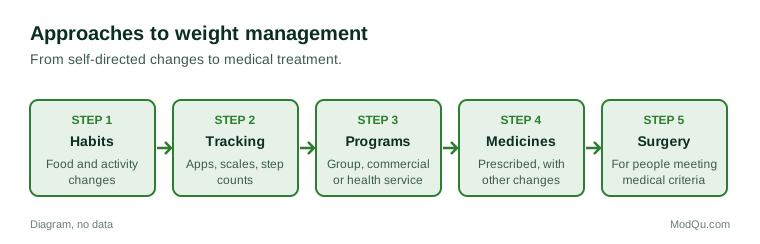
People trying to manage their weight use a range of approaches, often in combination:
- Changing what they eat: smaller portions, fewer sugary drinks and snacks, more vegetables, specific diets.
- Being more active: walking, sport, gym classes, or reducing time spent sitting.
- Tracking: weighing regularly, counting calories or steps, using apps.
- Group and commercial programs: in-person or online programs with meetings, coaching and meal plans.
- Health service programs: referrals to dietitians or structured programs.
- Medicines: prescription medicines that reduce appetite or absorption, used alongside other changes.
- Surgery: procedures that change the stomach or digestive system, for people who meet medical criteria.
The figure below shows these approaches from least to most intensive.
Diets people try
Popular diets change over time. Commonly tried approaches include:
- calorie counting;
- low-carbohydrate diets;
- intermittent fasting, such as eating within a set time window;
- meal replacement shakes and bars;
- plant-based or Mediterranean-style eating;
- diets that cut out particular foods.
Research generally suggests that many diets can lead to weight loss in the short term, and that the main challenge is keeping changes going over time.
Example
A man in his forties tries three diets in two years. Each works for a few months, then he regains the weight. On the fourth attempt he focuses on small changes he can keep, such as cooking at home more and walking to work, and loses weight more slowly but keeps it off.
Medicines and surgery
In recent years, new prescription medicines for weight management have received a lot of attention. They are usually prescribed for people above certain BMI levels or with weight-related health conditions, alongside diet and activity changes. Questions people raise include cost, side effects, supply shortages, what happens when the medicine is stopped, and whether they should be bought online without a prescription, which carries risks of fake products.
Weight-loss surgery is usually considered for people with higher BMI levels when other approaches have not worked. It involves a medical assessment, the operation, and long-term follow-up and changes to eating.
Obstacles people describe
People trying to manage their weight commonly mention:
- lack of time to cook or exercise;
- the cost of healthier foods and gym memberships;
- stress, poor sleep and emotional eating;
- health conditions or medicines that affect weight;
- shift work and irregular hours;
- social events and family eating habits;
- confusing and conflicting advice.
Example (hypothetical figures)
A family compares the cost of a week's evening meals. Ready meals and takeaways cost 95. Cooking simple meals from fresh and frozen ingredients costs 60 but takes about five extra hours a week. The parents both work late twice a week, so they cook in bulk at weekends to fit the time they have.
Weight stigma
Many people with higher body weight report being judged or treated unfairly, including by health professionals, employers and in the media. Weight stigma can discourage people from seeking care and is linked with stress and poorer health. Some health services and campaigns now focus on language that avoids blame and on health behaviours rather than weight alone.
Apps, trackers and online communities
Apps for counting calories, logging food and tracking activity are widely used. Some people find them helpful for awareness and motivation; others find them stressful or obsessive. Online communities offer support and accountability, but also spread misinformation and extreme approaches.
Example
A student uses a calorie app to understand her eating. After a few months she notices she is becoming anxious about every meal. She stops counting and talks to her university health service, which refers her to a dietitian.
Spending on weight management
Spending on weight management includes program fees, apps, meal replacements, gym memberships, special foods, supplements and, increasingly, medicines. Some costs are covered by health systems or insurance for people who meet criteria; many are paid out of pocket. Questions about value for money are common, as many paid products promise more than they deliver.
Weight and workplaces
Employers increasingly offer wellbeing programs that include weight management, such as subsidized gym memberships, healthy canteen options, step challenges or access to coaching. Some employees welcome these; others feel they intrude on private matters or put pressure on people with higher body weight. Programs that are voluntary, confidential and focused on general wellbeing tend to be better received than those focused on weight targets.
What people disagree about
Debates include whether weight should be treated mainly as a medical issue or a personal one, how much responsibility lies with individuals versus food companies and governments, whether new medicines should be widely funded, and how to talk about weight without causing harm. People also disagree about whether to focus on weight loss or on health habits regardless of weight.
Questions that businesses want answered include what weight goals people have, which approaches they have tried, what they spend, which approaches they found helpful, what obstacles they face, and their views on medicines and programs.
Key terms
- Body mass index (BMI)A measure based on weight and height, used to classify weight ranges.
- CalorieA unit of energy in food and drink.
- Intermittent fastingEating within set time windows or on set days.
- Meal replacementA shake or bar used instead of a meal.
- Weight-loss medicineA prescription medicine used to help reduce weight.
- Bariatric surgerySurgery on the stomach or digestive system to help weight loss.
- Weight stigmaNegative attitudes and unfair treatment based on body weight.
- MaintenanceKeeping weight stable after a change.
Full glossary: obesity medicine terms on EditingTests.com.
Weight management vocabulary test
How well do you know the language of this topic? Try 8 quick questions. Your score is shown straight away and is not saved.
What the weight management survey asks
This survey is part of ModQu's Health and Wellness survey. The weight management part takes about five minutes and covers:
- Whether you are trying to lose, gain or keep a stable weight.
- Which approaches you have tried and which helped.
- Whether you have paid for a program, app, medicine or other product.
- What gets in the way of your goals.
- Where you get information and advice about weight.
- Your views on weight-loss medicines and how they should be provided.
After that you can choose to continue with other short parts of the Health and Wellness survey, such as access to family doctors or virtual care and telehealth, or stop.
Ready to take part?
Your answers help show what people really think and do. Results are only ever reported as totals; no one can see your individual answers.
Start the surveyQuestions about this survey
Who can take part?
Adults.
Do I have to give my name?
No. You may be asked for your age group, region and similar details so results can be broken down, but not your name. ModQu never asks for passwords, card numbers or account numbers.
How are the results used?
Answers are combined into totals and percentages and published in ModQu reports. Individual answers are never shown.
Is the vocabulary test part of the survey?
No. It is optional and separate, and your score is not stored.
Does this page recommend a diet?
No. It describes common approaches. Speak to a health professional about your own situation.
Is BMI an accurate measure for everyone?
It is a simple screening measure with known limits, so professionals often use other measures too.