
Share your experience of women's health care
Tell us how easy it is to get care for women's health needs and where you look for information. Your answers are combined with other people's and reported only as totals.
Start the women's health surveyAbout 5 minutes. No account needed. You can stop at any time.
What women's health covers
Women's health is a broad area. It usually includes:
- Menstrual health: periods, period pain, heavy bleeding and conditions such as endometriosis and polycystic ovary syndrome (PCOS).
- Contraception and sexual health.
- Fertility, pregnancy and birth, including miscarriage and postnatal care.
- Menopause and the years leading up to it (perimenopause).
- Screening, such as cervical and breast screening.
- Conditions more common in women, such as osteoporosis, some autoimmune diseases and urinary incontinence.
- Conditions that may show different symptoms in women, such as heart disease.
- Mental health across these life stages, including after birth.
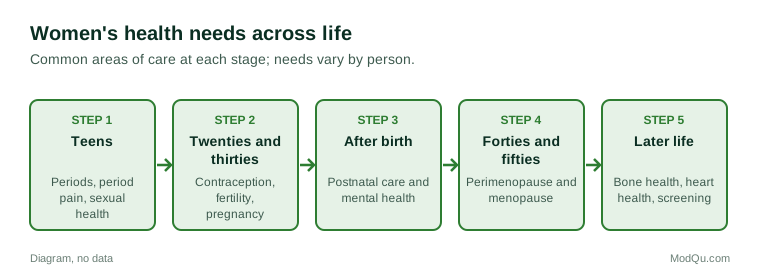
The figure below shows the main life stages and the health needs often linked with each.
Periods and menstrual conditions
Many women experience period pain or heavy bleeding, and some have conditions such as endometriosis that can cause severe pain. Women commonly report that period problems are dismissed as normal, and diagnosis of endometriosis can take several years in many countries. Access to period products is also an issue: "period poverty" describes being unable to afford them, and some governments and schools now provide them free.
Example
A student misses several days of classes each month because of severe pain. For two years she is told it is normal. After keeping a symptom diary and asking for a referral, she is diagnosed with endometriosis and starts treatment. She says the diary helped her be taken seriously.
Contraception and sexual health
Contraception options include pills, implants, injections, intrauterine devices, barrier methods and permanent methods. Access, cost and choice vary greatly by country. Women report wanting clear information about side effects and support to change method. Sexual health services also cover testing and treatment for infections.
Pregnancy, birth and after
Care during pregnancy (antenatal care), birth and the weeks after (postnatal care) is a large part of women's health services. Experiences differ widely depending on the country, health system and individual circumstances. Common concerns include continuity of care, choice of where to give birth, pain relief, support with feeding, and mental health after birth. Miscarriage and pregnancy loss are common but often not discussed, and support varies.
Menopause
Menopause usually happens between the mid-40s and mid-50s, and perimenopause can begin several years earlier. Symptoms vary and can include hot flushes, sleep problems, mood changes, brain fog and joint pain. Many women say they did not recognize symptoms at first, and that information and treatment were hard to get. Awareness has grown in recent years, with more workplaces offering menopause policies and support.
Example (hypothetical figures)
A survey of 500 employees at one firm finds that 120 are women aged 45 to 60. Of these, 70 say menopause symptoms have affected their work, and 25 have considered reducing their hours because of them. The firm introduces flexible working and a menopause support group.
Screening and prevention
Many countries invite women for regular cervical screening and, from a certain age, breast screening. Uptake varies, and reasons for not attending include embarrassment, pain or discomfort, past trauma, difficulty getting appointments, and not receiving or understanding the invitation. Self-sampling kits for some cervical screening are being introduced in several countries to make it easier.
Gaps in research and care
Women's health advocates point to several gaps:
- historically, women were under-represented in some medical research, so evidence for some treatments is weaker for women;
- symptoms of some conditions, such as heart attack, may be less recognized in women;
- women report feeling that their pain is not taken seriously;
- some conditions that mainly affect women receive less research funding;
- care for women from minority groups, disabled women and women in rural areas can be harder to access.
Several countries have introduced national women's health strategies to address these gaps.
Example
A woman in her fifties has nausea and back pain and assumes it is a stomach bug. A friend who is a nurse urges her to seek help. At hospital she is found to be having a heart attack. She later learns that women's heart attack symptoms can differ from those commonly described.
Women's health at work
Health issues such as periods, fertility treatment, pregnancy loss and menopause can affect work. Some employers offer policies such as flexible working, paid leave for fertility treatment or pregnancy loss, and menopause support. Many women still say they feel unable to talk about these issues at work.
Information and apps
Women get information from health professionals, official health websites, friends and family, social media and apps. Period and fertility tracking apps are widely used. Questions about the accuracy of information and the privacy of sensitive data are common.
Older women's health
After menopause, the risk of some conditions rises, including osteoporosis, heart disease and some cancers. Older women are also more likely than men to live alone in later life and to be carers for a partner. Health services for older women focus on bone health, falls prevention, heart health and continued screening where recommended. Older women sometimes report that their symptoms are put down to age rather than investigated.
What people disagree about
Debates include how much women's health should be treated as a separate area, how to improve research on women, how to fund services such as menopause care and fertility treatment, whether period products should be free, and how workplaces should support women's health needs. People also disagree on how much medical and how much social support is needed at life stages such as menopause.
Questions that businesses want answered include how easy women find it to access care for different needs, how they rate the care they receive, where they look for information, how health issues affect their work, and which services they would use.
Key terms
- EndometriosisA condition in which tissue similar to the womb lining grows elsewhere, often causing pain.
- PCOSPolycystic ovary syndrome, a common hormonal condition.
- PerimenopauseThe years leading up to menopause, when symptoms often begin.
- MenopauseThe point when periods have stopped for 12 months.
- Antenatal careHealth care during pregnancy.
- Postnatal careHealth care for mother and baby after birth.
- Cervical screeningA test that checks the cervix for changes that could lead to cancer.
- Period povertyBeing unable to afford period products.
Full glossary: gynecology clinics terms on EditingTests.com.
Women's health vocabulary test
How well do you know the language of this topic? Try 8 quick questions. Your score is shown straight away and is not saved.
What the women's health survey asks
This survey is part of ModQu's Health and Wellness survey. The women's health part takes about five minutes and covers:
- Which women's health needs you have had care for in the last few years.
- How easy it was to get appointments and be taken seriously.
- How you rate the care and information you received.
- Whether you attend screening when invited, and what makes it harder.
- How women's health issues have affected your work, if at all.
- Where you look for information and which sources you trust.
After that you can choose to continue with other short parts of the Health and Wellness survey, such as access to family doctors or virtual care and telehealth, or stop.
Ready to take part?
Your answers help show what people really think and do. Results are only ever reported as totals; no one can see your individual answers.
Start the surveyQuestions about this survey
Who can take part?
Women aged 16 and over.
Do I have to give my name?
No. You may be asked for your age group, region and similar details so results can be broken down, but not your name. ModQu never asks for passwords, card numbers or account numbers.
How are the results used?
Answers are combined into totals and percentages and published in ModQu reports. Individual answers are never shown.
Is the vocabulary test part of the survey?
No. It is optional and separate, and your score is not stored.
Does this page give medical advice?
No. It describes common experiences. Speak to a health professional about your own health.
Why do some symptoms take long to diagnose?
Reasons include symptoms being seen as normal, overlap with other conditions and limited specialist access.