
Share how you use supplements
Tell us which supplements you take, why, where you buy them and how much you trust the claims. Your answers are combined with other people's and reported only as totals.
Start the vitamins and supplements surveyAbout 5 minutes. No account needed. You can stop at any time.
What supplements are
Dietary supplements are products taken by mouth to add nutrients or other substances to the diet. They come as tablets, capsules, gummies, powders, liquids and drinks. The main groups include:
- Vitamins, such as vitamin D, vitamin C and B vitamins.
- Minerals, such as iron, calcium, magnesium and zinc.
- Multivitamins combining several of these.
- Fatty acids, such as fish or algae oils.
- Protein and sports supplements, such as protein powders and creatine.
- Herbal and botanical products, such as turmeric, ginseng or echinacea.
- Probiotics containing live bacteria.
- Specialized products for sleep, joints, skin, hair or energy.
Why people take them
People give many reasons:
- to fill gaps in their diet;
- because a health professional recommended it, for example during pregnancy or for a diagnosed deficiency;
- for general health or "insurance";
- to support exercise or muscle building;
- to help with sleep, stress, joints or digestion;
- to slow the effects of ageing;
- because family, friends or social media recommend them.
Example
A woman who rarely goes outside in winter has a blood test that shows low vitamin D. Her doctor recommends a daily supplement for the winter months. Her colleague takes eight different supplements a day after watching wellness videos, without any test or advice.
Public health bodies in some countries recommend specific supplements for certain groups, such as folic acid before and during early pregnancy, or vitamin D during months with little sunlight. For most other uses, evidence varies a great deal between products.
How supplements are regulated
In most countries, supplements are regulated more like foods than medicines. This usually means:
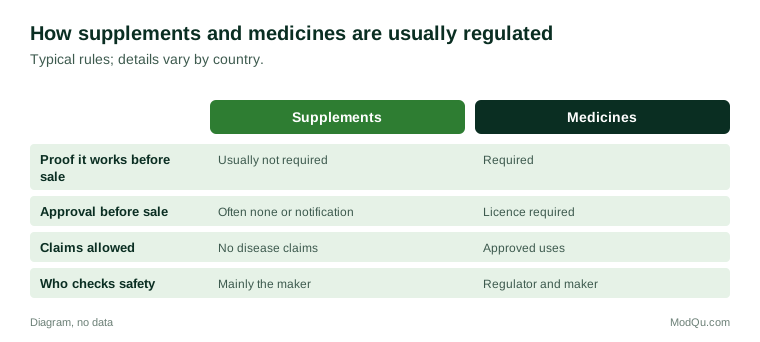
- they do not need to prove they work before going on sale;
- manufacturers are responsible for safety and labelling;
- they may not claim to treat, cure or prevent disease;
- some countries allow approved health claims, such as "calcium is needed for normal bones";
- maximum doses may be set for some nutrients.
Rules differ widely. Some countries require registration or approval of supplements; others have very light rules. Products bought online from another country may not meet local standards.
The figure below compares typical rules for supplements and medicines.
Judging the claims
Supplement marketing often uses words that sound scientific but have no fixed meaning, such as "boost", "support", "detox" or "clinically studied". People trying to judge a product commonly look at:
- whether the claim is an approved health claim or vague wording;
- whether there is good independent evidence for the ingredient;
- the dose compared with recommended amounts;
- independent quality testing or certification;
- whether the seller also sells the product they are reviewing.
Example (hypothetical figures)
A bottle of joint supplements costs 30 for 30 days. The label lists an ingredient at a dose of 200 mg, while the studies the company quotes used 1,500 mg a day. To match the studies, a person would need more than seven tablets a day, costing about 225 a month.
Safety and interactions
Supplements are often seen as natural and safe, but they can cause problems:
- taking too much of some vitamins and minerals, such as vitamin A or iron, can be harmful;
- some herbal products interact with prescription medicines;
- some products, especially for weight loss or bodybuilding, have been found to contain undeclared drugs;
- pregnancy, surgery and some health conditions need extra care.
Health professionals generally suggest telling a doctor or pharmacist about supplements being taken.
Where people buy supplements
Supplements are sold in pharmacies, supermarkets, health food shops, gyms, online marketplaces, direct from brands by subscription, and through multi-level marketing schemes where individuals sell to friends and family. Price, convenience and trust in the seller all affect where people buy.
Example
A runner orders protein powder by subscription from a brand's website because it is cheaper per serving. When they look at the label of a cheaper online product, they find it has less protein per scoop and more added sugar, so they keep their subscription.
Spending and the market
Supplements are a large global market, and spending has grown in many countries. Many people spend a modest amount each month; a smaller group spends a great deal. Personalized supplements, based on questionnaires or tests, and products aimed at specific groups such as women, older people and athletes, are growing parts of the market.
Supplements for children and older adults
Children and older adults are often targeted with specific products. Some groups, such as young children in certain countries, are advised by public health bodies to take particular vitamins. Older adults may be advised about vitamin D or B12 because of changes in absorption or diet. Products for children are often gummies, which some parents worry are mistaken for sweets.
Reading a supplement label
A supplement label usually lists the serving size, the amount of each ingredient per serving, and often the share of a daily reference amount. Other things people check include the form of the nutrient, added sugars or sweeteners in gummies and drinks, allergens, the best-before date, and storage instructions. Words such as "natural", "pure" or "pharmaceutical grade" are generally marketing terms without a legal definition.
What people disagree about
Some see supplements as a sensible way to fill dietary gaps and support health. Others say most people with a varied diet do not need them, that money would be better spent on food, and that marketing exaggerates benefits. There is also debate about whether regulation should be stricter, especially for online sales and social media promotion.
Questions that businesses want answered include who takes supplements, which types, for what reasons, where they buy them, how much they spend, how they judge claims, and whether they tell their doctor.
Key terms
- Dietary supplementA product taken by mouth to add nutrients or other substances to the diet.
- MultivitaminA supplement combining several vitamins and minerals.
- DeficiencyA shortage of a nutrient in the body.
- Health claimA statement that a nutrient or product has a health effect.
- ProbioticA product containing live bacteria intended to benefit health.
- InteractionWhen a supplement changes how a medicine works.
- Third-party testingIndependent checking of a product's contents and quality.
- Upper limitThe highest daily amount of a nutrient unlikely to cause harm.
Full glossary: dietary supplements terms on EditingTests.com.
Vitamins and supplements vocabulary test
How well do you know the language of this topic? Try 8 quick questions. Your score is shown straight away and is not saved.
What the vitamins and supplements survey asks
This survey is part of ModQu's Health and Wellness survey. The vitamins and supplements part takes about five minutes and covers:
- Which vitamins or supplements you take, if any.
- Why you take them and who recommended them.
- Where you buy them and how much you spend a month.
- How you judge whether a product works or is good quality.
- Whether you have told a doctor or pharmacist what you take.
- How much you trust the health claims on labels and in advertising.
After that you can choose to continue with other short parts of the Health and Wellness survey, such as access to family doctors or virtual care and telehealth, or stop.
Ready to take part?
Your answers help show what people really think and do. Results are only ever reported as totals; no one can see your individual answers.
Start the surveyQuestions about this survey
Who can take part?
Adults.
Do I have to give my name?
No. You may be asked for your age group, region and similar details so results can be broken down, but not your name. ModQu never asks for passwords, card numbers or account numbers.
How are the results used?
Answers are combined into totals and percentages and published in ModQu reports. Individual answers are never shown.
Is the vocabulary test part of the survey?
No. It is optional and separate, and your score is not stored.
Does this page say whether I should take supplements?
No. It describes how supplements are used and regulated. Ask a health professional about your own needs.
Are natural supplements always safe?
Not always. Some can cause harm in high doses or interact with medicines.