
Share what schooling costs your family
Tell us what you spent on your child's schooling last year and which costs were largest. Your answers are combined with other people's and reported only as totals.
Start the school fees and education costs surveyAbout 5 minutes. No account needed. You can stop at any time.
Free schooling and what it does not cover
Most countries provide free public primary education, and many extend it through secondary school. The right to free primary education is part of the Universal Declaration of Human Rights and the United Nations Convention on the Rights of the Child. In practice, "free" often means no tuition fee. Families may still pay for a wide range of items and activities.
In some countries, public schools also charge official fees or ask for "voluntary" contributions toward running costs. In others, families pay informal charges for exams, extra lessons or school maintenance. Rules on what schools may charge differ widely, even between regions of the same country.
What families pay for
Common education costs include:
- Tuition fees at private, religious, international or some public schools.
- Registration, admission and exam fees.
- Uniforms and shoes, including sports kit.
- Books, stationery and supplies, sometimes from a set list.
- Devices and internet access, such as a laptop or tablet.
- Transport: school buses, public transport or fuel.
- Meals: school lunches or food to take.
- Trips and activities: excursions, camps, sports, music and clubs.
- Extra lessons and tutoring.
- Boarding costs where children live at school.
Example (hypothetical figures)
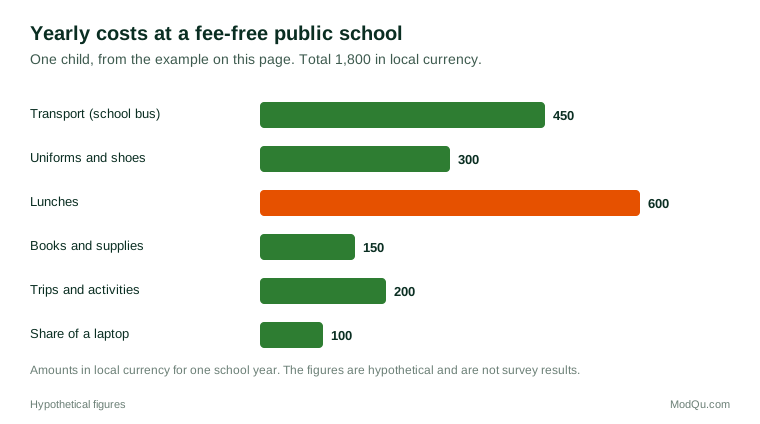
A family with one child at a public school pays no tuition. Over a year they spend, in local currency, 450 on the school bus, 300 on uniforms and shoes, 600 on lunches, 150 on books and supplies, 200 on two trips and a sports club, and 100 toward a shared laptop. The total is 1,800 for a school described as free.
Public and private schools
The type of school is the biggest factor in what families pay.
- Public or state schools are funded by government. Fees are usually low or none, though other costs apply.
- Private independent schools charge tuition, which can range from modest to very high.
- Low-fee private schools are common in parts of South Asia and Africa, where families pay small fees for schools they see as better than local public options.
- Religious and community schools may be fully or partly publicly funded, or charge fees.
- International schools often follow another country's curriculum and charge high fees.
- Boarding schools add accommodation and meals.
Families choose private schools for many reasons: academic results, smaller classes, religion, language of teaching, discipline, facilities, or a lack of places or quality in local public schools. Others choose public schools on principle or because private fees are out of reach.
Example
Parents in a fast-growing city find that the nearest public school has very large classes. They move their daughter to a low-fee private school nearby. The fee is a stretch, so they stop paying for her older brother's weekend football club to cover it.
Hidden and rising costs
Parents often say the costs that surprise them are not the fees but the extras: requests for supplies, money for class events, specific branded uniform items, and charges for trips, exams or technology. Costs rise as children move through school, with older students needing more devices, materials and exam fees. Costs also tend to arrive at once, at the start of the school year.
Families with several children feel the impact most. Some schools offer sibling discounts, second-hand uniform sales or help funds, but practice varies.
How families manage costs
Households use a range of strategies:
- budgeting through the year for the start of term;
- buying second-hand uniforms and books, or passing them down;
- choosing a school based on cost and travel;
- applying for bursaries, scholarships or fee reductions;
- using public support, such as school meal programs, grants for uniforms or transport passes;
- borrowing, including from family, savings groups or lenders;
- taking on extra work.
Some governments provide cash transfers to families on condition that children attend school, which helps cover costs. Others provide free meals, books or transport.
Example
A single parent of three receives a public grant toward school uniforms. They also join a school swap scheme where families trade outgrown uniforms. The grant and the swaps cover most uniform costs, but the parent still borrows from a relative to pay for a residential school trip.
What people disagree about
Education costs are a frequent subject of public debate. Points of disagreement include:
- whether schools should be allowed to charge for trips, materials and activities;
- whether governments should fund private or religious schools;
- whether uniforms, especially branded ones, add unnecessary cost;
- how much parents should be expected to contribute to public schools;
- whether costs keep poorer children out of some activities and schools.
Questions that schools, education departments and suppliers want answered include how much families spend per child, which costs are largest, whether costs have changed, and whether cost affects which school families choose.
Costs at different stages
Costs change as children move through school. In the early years, the main costs are often uniforms, supplies and transport. In the middle years, after-school activities, trips and devices become larger. In the final years, exam fees, tutoring, course materials, laptops and university applications can add up quickly. Families often say the first year at a new school, when everything must be bought at once, is the most expensive. Planning for these points is one reason surveys ask about costs by the age of the child.
Costs also differ between rural and urban families. Rural families may pay more for transport or boarding because schools are far away, while urban families may pay more for fees, meals and activities.
Key terms
- Tuition feeA charge for teaching at a school, college or university.
- Public schoolA school funded by government, usually free to attend.
- Private schoolA school funded mainly by fees and private sources.
- BursaryMoney given to help pay school or college costs, usually based on need.
- ScholarshipAn award to help pay for education, often based on merit.
- Low-fee private schoolA private school charging small fees, common in some lower-income countries.
- Conditional cash transferPublic payments made to families on condition that children attend school.
- Sibling discountA reduced fee for a second or later child at the same school.
Full glossary: public finance terms on EditingTests.com.
School fees and education costs vocabulary test
How well do you know the language of this topic? Try 8 quick questions. Your score is shown straight away and is not saved.
What the school fees and education costs survey asks
This survey is part of ModQu's Education and Learning survey. The school fees and education costs part takes about five minutes and covers:
- What type of school your children attend.
- How much you spent on schooling for each child last year.
- Which cost was largest: fees, uniforms, transport, meals, devices or activities.
- Whether costs have risen, and how you have coped.
- Whether you received any help, such as a bursary, grant or free meals.
- Whether cost affected your choice of school.
After that you can choose to continue with other short parts of the Education and Learning survey, such as choosing a college or university or online learning, or stop.
Ready to take part?
Your answers help show what people really think and do. Results are only ever reported as totals; no one can see your individual answers.
Start the surveyQuestions about this survey
Who can take part?
Parents of school-age children.
Do I have to give my name?
No. You may be asked for your age group, region and similar details so results can be broken down, but not your name. ModQu never asks for passwords, card numbers or account numbers.
How are the results used?
Answers are combined into totals and percentages and published in ModQu reports. Individual answers are never shown.
Is the vocabulary test part of the survey?
No. It is optional and separate, and your score is not stored.
Do I need exact amounts?
No. Estimates are fine, and many questions use ranges. You can skip any question about money.
Should I count tutoring?
The survey asks about tutoring separately, so you can show it apart from school costs.
Can families with children in different schools take part?
Yes. You can answer for each child or for the household as a whole, depending on the question.