
Share your experience of childcare
Tell us what childcare you use, what you pay and how it has affected your work hours. Your answers are combined with other people's and reported only as totals.
Start the childcare surveyAbout 5 minutes. No account needed. You can stop at any time.
What childcare covers
Childcare means the care of children by someone other than their parents, usually while parents work, study or look for work. This page focuses on children under six, before they start full-day school, although school-age children also need care before and after school and in the summer.
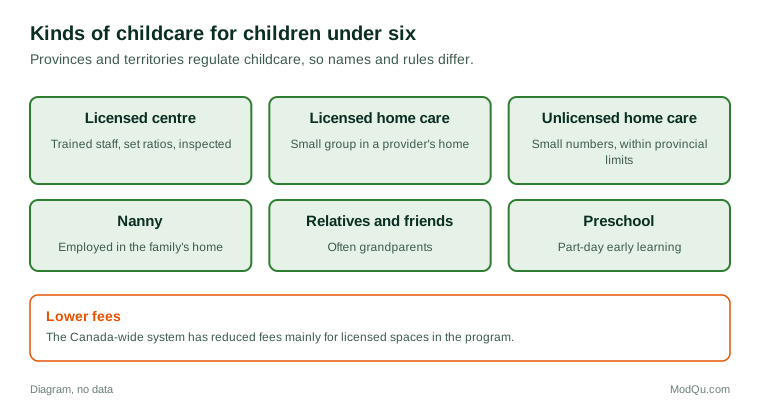
In Canada, provinces and territories regulate childcare, so names and rules differ. The main kinds are:
- Licensed childcare centres, often called daycares, run by non-profit groups, municipalities, schools or private operators, with trained staff and set ratios of staff to children.
- Licensed home childcare, in which a provider cares for a small group of children in their own home, often supervised by an agency.
- Unlicensed home care, where a provider cares for a small number of children, within limits set by provincial law, without a licence.
- Nannies, employed in the family's home, sometimes living in, sometimes shared between two families.
- Relatives and friends, such as grandparents caring for children.
- Preschool and nursery programs, part-day programs often focused on early learning.
- Before- and after-school programs for children in kindergarten and school.
In Québec, the province has run a network of low-fee childcare since the late 1990s, including early childhood centres, known by the French acronym CPE.
How families choose
Families weigh several things when choosing childcare:
- Availability: whether a space is open when they need it.
- Cost.
- Location: near home, work or an older child's school.
- Hours: whether the care covers work schedules, including early starts, late finishes and shift work.
- Quality: staff training, ratios, the program, cleanliness and safety.
- Trust: how comfortable parents feel with the caregivers.
- Values, language and culture: for example French-language care or care that reflects a family's culture.
- Flexibility: part-time spaces, sick days and holidays.
In practice, many families take whatever space they can find and then move when something better opens up.
Example
A couple put their names on waitlists at five centres while expecting their first child. When parental leave ends a year later, only one has a space, 25 minutes in the opposite direction from both workplaces. They take it, and the child's grandparent covers two afternoons a week so the parents can work longer hours on those days.
What childcare costs
Childcare costs vary widely by province, city, type of care and the child's age. Infant care usually costs most, because it needs more staff per child.
In 2021 the federal government began signing agreements with every province and territory to create the Canada-wide Early Learning and Child Care system. The goal set out in the agreements was to reduce average fees for licensed childcare for children under six, with a target of $10 a day on average by 2026, and to create more licensed spaces. Provinces have cut fees in stages, and progress has varied. Not every space is included: some private and unlicensed care is outside the program.
Families may also receive help through:
- provincial fee subsidies for lower-income families;
- the Canada Child Benefit, a monthly tax-free payment for families with children under 18, based on income;
- the childcare expense deduction on income tax for eligible costs;
- employer-provided childcare or support in some workplaces.
Example (hypothetical figures)
A family pays $1,100 a month for a licensed infant space. After their province's fee reduction, the fee falls to $15 a day. For 21 days a month, that is $315 a month, a saving of $785 a month or $9,420 a year. A neighbour uses an unlicensed home provider who is not part of the program, and still pays $1,000 a month.
Questions that businesses and governments want answered here include what families pay, how fee reductions have changed their costs, and how many families still pay full fees.
Waitlists and finding a space
Many parents say finding childcare is harder than paying for it. As fees have fallen in some provinces, demand for licensed spaces has risen faster than new spaces have opened, and waitlists have grown in many communities.
Common problems include:
- long waitlists, sometimes joined before a child is born;
- few infant spaces;
- few spaces in rural areas and some neighbourhoods, sometimes called childcare deserts;
- little care outside standard weekday hours;
- few spaces for children with disabilities or extra support needs;
- shortages of trained early childhood educators (ECEs), partly linked to wages, which limit how many spaces centres can open.
Effects on parents' work
Childcare is closely linked to whether and how much parents work, especially mothers. Common effects families describe include:
- delaying a return to work after parental leave;
- one parent working part-time or leaving work;
- changing jobs to get hours that match childcare;
- turning down promotions or extra shifts;
- relying on family members to cover gaps;
- working different shifts from a partner so one parent is always home.
Researchers often point to Québec's low-fee system as having been followed by a rise in the share of mothers of young children in paid work, and this is part of the case made for the national system. How large the effect is elsewhere is still being studied.
Example
A single parent works as a personal support worker on rotating shifts. The nearest licensed centre opens at 7:00 a.m. and closes at 6:00 p.m., which does not cover early or evening shifts. They arrange care with a neighbour for early shifts and ask their employer for day shifts only, which means fewer hours and less pay.
Quality and early learning
Childcare is also early education. Research has linked high-quality early learning to children's later development, especially for children from disadvantaged backgrounds. Quality is shaped by:
- staff training and how long staff stay;
- the ratio of staff to children and group sizes;
- the program, including play-based learning;
- warm, stable relationships between caregivers and children;
- safe, well-equipped spaces.
Provinces set minimum standards for licensed care, including staff qualifications, ratios and safety. Parents can usually look up licensing and inspection records for licensed providers through their province.
What people disagree about
Childcare is the subject of strong debate:
- Who should provide it? Some favour public and non-profit care; others want private operators fully included in fee reductions.
- Who should benefit? Some argue public money should go to licensed centres; others want support for parents who use relatives, nannies or stay home.
- Fees versus spaces: some say cutting fees before there are enough spaces creates long waitlists; others say lower fees were overdue.
- Wages for early childhood educators, and how to attract and keep staff.
- Flexibility: how to serve parents with shift work and irregular hours.
Key terms
- Licensed childcareCare that meets provincial standards and is inspected.
- Early childhood educatorA trained professional who works with young children in care and learning settings.
- RatioThe number of children for each staff member.
- Fee subsidyGovernment help with childcare fees, usually based on income.
- WaitlistA list of families waiting for a childcare space.
- Childcare desertAn area with too few childcare spaces for the children who live there.
- Canada Child BenefitA monthly tax-free federal payment to eligible families with children under 18.
- Before- and after-school careCare for school-age children outside school hours.
Full glossary: childcare services terms on EditingTests.com.
Childcare vocabulary test
How well do you know the language of this topic? Try 8 quick questions. Your score is shown straight away and is not saved.
What the childcare survey asks
This survey is part of ModQu's Education and Learning survey. The childcare part takes about five minutes and covers:
- What childcare you use for your youngest child under six.
- How much you pay per month, and whether fees have changed.
- How long it took to find a space, and how many waitlists you joined.
- How satisfied you are with the care.
- How childcare has affected your work hours or your partner's.
- What would most improve childcare for your family.
After that you can choose to continue with other short parts of the Education and Learning survey, such as choosing a college or university or online learning, or stop.
Ready to take part?
Your answers help show what people really think and do. Results are only ever reported as totals; no one can see your individual answers.
Start the surveyQuestions about this survey
Who can take part?
Parents of children under six.
Do I have to give my name?
No. You may be asked for your age group, region and similar details so results can be broken down, but not your name. ModQu never asks for passwords, card numbers or account numbers.
How are the results used?
Answers are combined into totals and percentages and published in ModQu reports. Individual answers are never shown.
Is the vocabulary test part of the survey?
No. It is optional and separate, and your score is not stored.
I care for my children at home. Can I take part?
Yes. The survey asks why families choose care at home and whether they would use other care if it were available.