
Share your experience of learning a language
Tell us whether you are learning a language, which method you use and why you are learning it. Your answers are combined with other people's and reported only as totals.
Start the learning languages surveyAbout 5 minutes. No account needed. You can stop at any time.
Language learning in Canada
Canada has two official languages, English and French, and many other languages are spoken at home. Statistics Canada's census records the languages people speak, including Indigenous languages and the many languages brought by immigrants.
That shapes language learning in several ways:
- English-speaking Canadians learn French at school, in immersion programs and as adults, often for work in bilingual jobs or the federal public service.
- French-speaking Canadians learn English, and many are bilingual.
- Newcomers learn English or French, or both, to settle, work and become citizens. Citizenship applicants in a set age range must show adequate knowledge of English or French.
- Families pass on heritage languages to children, and adults learn the language of their parents or grandparents.
- Indigenous communities and learners are working to revitalize Indigenous languages, supported by the Indigenous Languages Act passed in 2019.
- People learn languages such as Spanish, Mandarin, Japanese, Korean, Arabic and others for travel, work, culture and personal interest.
Why adults learn
Adults usually have a clear reason for learning, and it shapes which method they choose and how long they keep going. Common reasons include:
- Work: bilingual job requirements, customers who speak another language, or work abroad.
- Settling in a new country: daily life, work, school and citizenship.
- Family: a partner's family, children in immersion or heritage-language programs, or reconnecting with family roots.
- Travel: preparing for a trip, or a plan to live abroad.
- Culture: films, music, literature, games and food.
- Brain health and personal challenge: keeping the mind active, especially in later life.
- Study: a course requirement or study abroad.
Example
A federal public servant needs to reach a set level in French for a promotion. They take government-funded classes two mornings a week, use an app for vocabulary on the bus and join a conversation group at lunch. They pass the oral test on their second attempt, about a year after starting.
Methods people use
There are many ways to learn a language, and most successful learners combine several.
- Language apps: short lessons on a phone, often with games, streaks and reminders. Popular for vocabulary and getting started, and easy to fit into a day.
- Classes: in person or online, through school boards, community centres, colleges, universities, cultural institutes and private schools. They offer structure, a teacher and other learners.
- Private tutors: one-to-one lessons, in person or by video, often found through online tutoring marketplaces.
- Conversation exchanges: meeting a speaker of the target language who wants to practise yours, sometimes called a language exchange or tandem.
- Self-study: textbooks, workbooks, audio courses and podcasts.
- Media: watching films and series, listening to music and radio, reading news and books.
- Immersion: living or studying where the language is spoken, or attending an intensive program in which only the target language is used. In Canada, the federal government funds summer French and English immersion bursaries for students through a program called Explore.
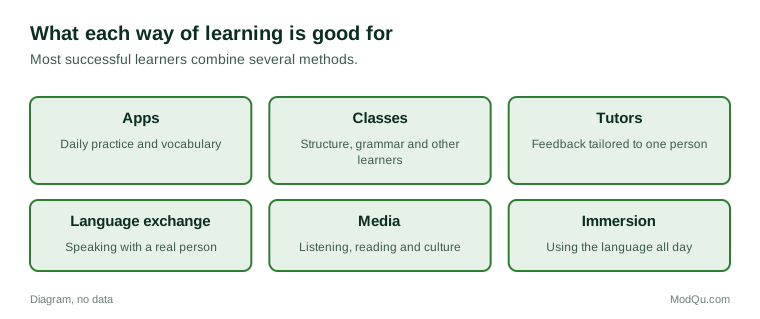
People often describe the different methods as good for different things. Apps are good for daily practice and vocabulary; classes and tutors for structure, grammar and feedback; conversation and immersion for speaking and listening.
Example
A learner uses a language app every day for a year and builds a large vocabulary but finds they freeze when a server in a restaurant speaks to them. They join an online conversation group twice a week, and after two months they say they can hold a basic conversation, though they still use the app for vocabulary.
How progress is measured
Language ability is often described using frameworks of levels:
- The Common European Framework of Reference for Languages (CEFR) describes six levels from A1 (beginner) to C2 (mastery), and is used widely around the world.
- The Canadian Language Benchmarks (CLB) for English and the Niveaux de compétence linguistique canadiens (NCLC) for French describe 12 levels, used for immigration, settlement and work in Canada.
- The federal public service uses its own levels for second-language evaluation.
Abilities are usually measured in four skills: listening, speaking, reading and writing. Many learners are stronger in some skills than others; for example, they may read well but struggle to follow fast speech.
Formal tests are used for immigration, citizenship, university entry and jobs. Apps and courses use their own progress measures, which may not match these frameworks.
Time, cost and commitment
How long it takes to learn a language depends on the learner's first language, the language being learned, how much time they spend, the methods they use and their goal. Languages closely related to a learner's first language are usually easier to learn than distant ones.
Costs vary from nothing, using free apps, libraries and media, to thousands of dollars for intensive courses or immersion abroad.
Example (hypothetical figures)
A learner compares three ways to spend a year. A premium app subscription costs $100 a year. A weekly evening class costs $220 per 10-week term, and three terms a year cost $660. A tutor at $35 an hour, once a week for 40 weeks, costs $1,400. They choose the app plus one term of classes, for $320, and add the tutor later if they need help with speaking.
Common obstacles
Adult language learners often mention the same obstacles:
- Time: hard to find with work and family.
- Motivation: early progress is fast, then slows, and many learners stop.
- Speaking anxiety: fear of making mistakes or not being understood.
- Few chances to practise, especially for less common languages in some areas.
- Plateaus: feeling stuck at an intermediate level.
- Cost of classes, tutors and travel.
- Losing skills without regular use.
Things learners say help include setting a clear goal, practising a little every day, speaking early even with mistakes, finding a conversation partner, using media they enjoy, and joining a class or group for accountability.
Questions that businesses and schools want answered here include which languages people are learning, which apps and methods they use and pay for, and what keeps them going.
What people disagree about
There are lively debates about language learning. Can adults learn a language as well as children? Research suggests children who start young often reach a more native-like accent, while adults can learn grammar and vocabulary efficiently, and many reach high levels. Can apps alone make someone fluent, or are they a starting point? Should French be required more widely in Canadian schools? And how should governments support Indigenous language revitalization and newcomer language training?
Key terms
- FluencyThe ability to use a language smoothly and easily.
- ImmersionLearning a language by using it in daily life or in a program where only that language is used.
- CEFRA framework describing language ability in six levels, from A1 to C2.
- Canadian Language BenchmarksA Canadian scale of English language ability with 12 levels.
- Heritage languageA language spoken in a person's family or community, other than the main language around them.
- Language exchangeMeeting a speaker of another language to practise each other's languages.
- PlateauA period when a learner feels their progress has stopped.
- Target languageThe language being learned.
Full glossary: online learning platforms terms on EditingTests.com.
Learning languages vocabulary test
How well do you know the language of this topic? Try 8 quick questions. Your score is shown straight away and is not saved.
What the learning languages survey asks
This survey is part of ModQu's Education and Learning survey. The learning languages part takes about five minutes and covers:
- Whether you are learning a language now, or have in the past few years.
- Which language, and why you are learning it.
- Which apps, classes or other methods you use.
- How much time and money you spend on it.
- How you judge your progress, and what level you hope to reach.
- What has helped or got in the way.
After that you can choose to continue with other short parts of the Education and Learning survey, such as choosing a college or university or online learning, or stop.
Ready to take part?
Your answers help show what people really think and do. Results are only ever reported as totals; no one can see your individual answers.
Start the surveyQuestions about this survey
Who can take part?
Adults.
Do I have to give my name?
No. You may be asked for your age group, region and similar details so results can be broken down, but not your name. ModQu never asks for passwords, card numbers or account numbers.
How are the results used?
Answers are combined into totals and percentages and published in ModQu reports. Individual answers are never shown.
Is the vocabulary test part of the survey?
No. It is optional and separate, and your score is not stored.
I am a fluent speaker helping others learn. Can I take part?
The survey is for learners, but you can take part if you are also learning a language yourself.