
Share your experience of student life
Tell us how you pay for your studies, whether you work while studying and what your biggest expense is. Your answers are combined with other people's and reported only as totals.
Start the student life and costs surveyAbout 5 minutes. No account needed. You can stop at any time.
Who students are
Post-secondary students in Canada are a varied group. They include:
- recent high school graduates in their first degree or diploma;
- mature students returning after work or family;
- part-time students who work full-time;
- graduate students in master's and doctoral programs;
- international students studying on a study permit;
- students with children or other caregiving duties;
- Indigenous students, students with disabilities and first-generation students, who may face particular costs and barriers.
Their costs and pressures differ a lot. A student living with their parents near campus has a very different budget from an international student renting a room in a large city, or a parent studying part-time.
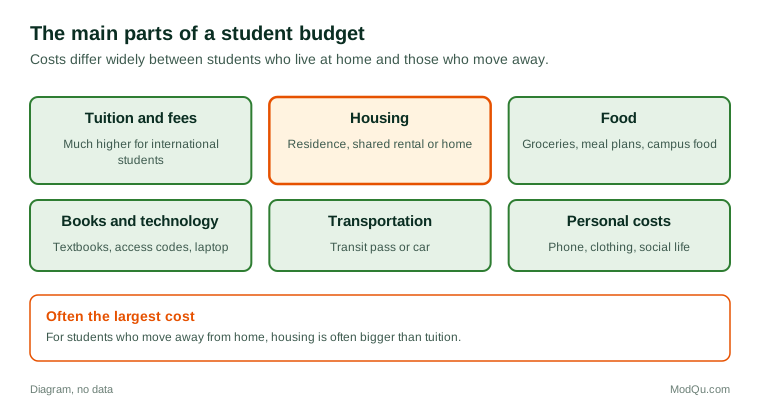
The main costs
Students commonly describe these as their main expenses:
- Tuition and fees: varies by province, institution and program, and is much higher for international students. Fees for professional programs such as medicine, law and dentistry are often higher.
- Housing: residence, a shared rental, living at home, or living with a partner. For students who move away from home, housing is often the largest cost.
- Food: groceries, meal plans and eating on campus.
- Books, supplies and technology: textbooks, access codes for online course materials, laptops and software.
- Transportation: transit passes, which are included in student fees at many schools, or car costs.
- Phone and internet.
- Health costs: many schools include a student health and dental plan in fees, with an option to opt out for students with other coverage.
- Personal and social costs: clothing, entertainment, clubs, travel home.
Example (hypothetical figures)
A student renting a room in a shared house near campus budgets for an eight-month academic year. Rent is $850 a month ($6,800), groceries and food $400 a month ($3,200), phone $50 a month ($400), books and supplies $900, and personal costs $150 a month ($1,200). Tuition and fees are $8,200. The total for the year is $20,700.
How students pay
Most students combine several sources:
- Family support, including Registered Education Savings Plans (RESPs) and help with rent or living at home.
- Work: summer jobs, part-time jobs during term, co-op placements and internships.
- Government student aid: the Canada Student Financial Assistance Program and provincial and territorial programs provide loans and grants based on financial need. Québec runs its own program.
- Scholarships, bursaries and awards from schools, governments, employers and community groups.
- Personal savings.
- Lines of credit and credit cards, which some students use to fill gaps, sometimes at high interest.
- Graduate funding: many graduate students receive teaching or research assistantships and stipends.
Students who rely mainly on loans often worry about repayment after graduation. Government student loans in Canada have repayment assistance for graduates with low income.
Working while studying
Many students work during the school year as well as in summer. Common jobs include retail, food service, tutoring, campus jobs in libraries and offices, research assistant positions, and gig work.
Working can help students pay their way, gain experience and build a résumé. It can also take time from studying, sleep and social life, and long hours have been linked in research to lower grades for some students. Students describe trying to balance hours, class schedules and exam periods.
International students' work rights are set by Immigration, Refugees and Citizenship Canada (IRCC). The rules on how many hours they may work off campus during term have changed in recent years, so international students check the current rules.
Example
A second-year student works 20 hours a week at a grocery store, mostly evenings and weekends. During exams they ask for fewer shifts, which their manager allows, but it means a smaller paycheque in the months when rent is also due. They say the job pays their rent but they often study late after shifts.
Housing
Housing has become one of the biggest worries for students in many Canadian cities. Common issues include:
- shortages of residence spaces, with waitlists for first-year and upper-year students;
- high rents near campus;
- crowded or poor-quality rentals;
- long commutes from cheaper areas;
- leases that do not match the eight-month academic year;
- scams targeting students looking for housing online, especially international students arriving from abroad.
Some students live at home longer to save money, which may mean a longer commute and less involvement in campus life.
Food costs and food insecurity
Rising food prices have made groceries a larger part of students' budgets. Food insecurity, meaning not having reliable access to enough affordable, nutritious food, is a concern on many campuses. Many schools and student unions run food banks, low-cost meal programs and community gardens. Students describe skipping meals, buying cheaper and less healthy food, and relying on campus food banks near the end of the month.
Example
An international student's rent rises after their first year, and the cost of groceries goes up at the same time. By March they are using the campus food bank every two weeks. They say they had budgeted for tuition and rent before arriving, but not for how fast costs would rise.
Mental health, wellbeing and campus life
Students often report stress, anxiety and pressure linked to studies, money, work, housing and the future. The transition to post-secondary education, moving away from home, and exams add to this.
Most colleges and universities offer counselling services, peer support, wellness programs and accessibility services for students with disabilities or mental health conditions. Students often say these services are valuable but describe waitlists, limited sessions and not knowing what is available. Many student health plans include some coverage for counselling outside campus.
This page describes these issues; students who are struggling can contact their school's counselling service, a health professional or a crisis line.
Student life is not only about money and pressure. Many students value:
- friendships and social life;
- clubs, societies, sports and student government;
- volunteering and community involvement;
- cultural and faith groups;
- events, performances and campus traditions;
- support networks for Indigenous students, international students, LGBTQ2S+ students and others.
Students who work many hours or commute long distances often say they miss out on these. Questions that schools and businesses want answered here include how students pay for their studies, how many hours they work, what their biggest expenses are, and which campus services they use and value.
What people disagree about
There are debates about student costs. Should tuition be lower, frozen, or free? Who should pay for post-secondary education: students, families or governments? How should international student fees be set, given that many institutions rely on them? Should governments do more to build student housing? And how much paid work should students be encouraged to do while studying?
Key terms
- TuitionThe fee charged for instruction in a program.
- Student aidGovernment loans and grants to help students pay for education, based on need.
- BursaryA non-repayable award based mainly on financial need.
- AssistantshipPaid work, often teaching or research, offered to graduate students.
- Food insecurityNot having reliable access to enough affordable, nutritious food.
- Study permitA document that allows an international student to study in Canada.
- Student health planHealth and dental coverage for students, often included in fees.
- Repayment assistanceHelp for graduates with low income to repay government student loans.
Full glossary: university administration terms on EditingTests.com.
Student life and costs vocabulary test
How well do you know the language of this topic? Try 8 quick questions. Your score is shown straight away and is not saved.
What the student life and costs survey asks
This survey is part of ModQu's Education and Learning survey. The student life and costs part takes about five minutes and covers:
- How you pay for your studies and living costs.
- Whether you work while studying, and how many hours a week.
- What your biggest expenses are.
- Where you live while studying, and how much it costs.
- How money, work and studies affect your stress and wellbeing.
- Which campus services you use, and which you value most.
After that you can choose to continue with other short parts of the Education and Learning survey, such as choosing a college or university or online learning, or stop.
Ready to take part?
Your answers help show what people really think and do. Results are only ever reported as totals; no one can see your individual answers.
Start the surveyQuestions about this survey
Who can take part?
Current college and university students.
Do I have to give my name?
No. You may be asked for your age group, region and similar details so results can be broken down, but not your name. ModQu never asks for passwords, card numbers or account numbers.
How are the results used?
Answers are combined into totals and percentages and published in ModQu reports. Individual answers are never shown.
Is the vocabulary test part of the survey?
No. It is optional and separate, and your score is not stored.
I am a part-time or graduate student. Can I take part?
Yes. Anyone currently enrolled at a college or university can take part, full-time or part-time, undergraduate or graduate.