
Share how you chose where to study
Tell us which factors mattered most, where you found information and how you feel about the cost. Your answers are combined with other people's and reported only as totals.
Start the choosing a college or university surveyAbout 5 minutes. No account needed. You can stop at any time.
The kinds of post-secondary education
In Canada, education after high school is often called post-secondary education. Provinces and territories are responsible for it, so the systems differ, but the main kinds of institution are similar across the country:
- Universities, which offer bachelor's, master's and doctoral degrees, and professional programs such as law, medicine and engineering.
- Colleges, which offer diplomas, certificates and applied programs, often linked to particular careers, and in many provinces also some applied degrees. In Québec, students go to CEGEP after high school, which leads either to university or to a technical career.
- Polytechnics and institutes of technology, which focus on applied and technical education, including degrees.
- Trade schools and apprenticeship programs, which train people for skilled trades.
- Private career colleges, which offer short, job-focused programs and are regulated by provinces.
- Indigenous institutes, which offer programs grounded in Indigenous knowledge and communities.
In the United States, "college" is often used for any undergraduate institution, including universities. In Canada, college and university usually mean different things.
How students decide
Students and their families weigh many factors. The most commonly mentioned include:
- Program: whether the school offers the program the student wants, and its reputation in that field.
- Career prospects: co-op placements, internships, graduate employment and links with employers.
- Cost: tuition, fees, housing and living costs.
- Location: distance from home, whether the student can live at home, and the city or town itself.
- Admission chances: grade requirements and competition for places.
- Reputation and rankings, though many students give these less weight than program and cost.
- Campus life: size, residences, clubs, sports and atmosphere.
- Support services: academic advising, mental health support, accessibility services and support for Indigenous, international or first-generation students.
- Scholarships and financial aid offered.
- Language: English, French or bilingual programs.
The weight of each factor differs a lot between students. For some, cost and living at home settle the question. For others, a specific program or a co-op option outweighs everything else.
Example
A student accepted at three universities is drawn to the one with the strongest reputation in their field, five hours from home. A second offers a co-op version of the same program in their home city, where they could live with family. After adding up residence and travel costs and comparing co-op earnings, they choose the second school and plan to apply for graduate study elsewhere later.
Where students find information
Students use a mix of sources when choosing:
- school websites and program pages;
- campus tours, open houses and virtual tours;
- high school guidance counsellors;
- parents, siblings and relatives, especially those who attended the school;
- friends and current students;
- social media and videos posted by students and schools;
- rankings and guides published by magazines and newspapers;
- provincial application centres, such as Ontario's application centres for universities and colleges;
- government information on programs and graduate outcomes.
Students often say they trust current students and people they know more than official marketing. Students who are the first in their family to attend post-secondary education, often called first-generation students, may have fewer family members to ask and rely more on counsellors and school information.
Questions that schools and businesses want answered here include which sources students trust most, when in high school they start looking, and which factors decide their final choice.
Applying and admissions
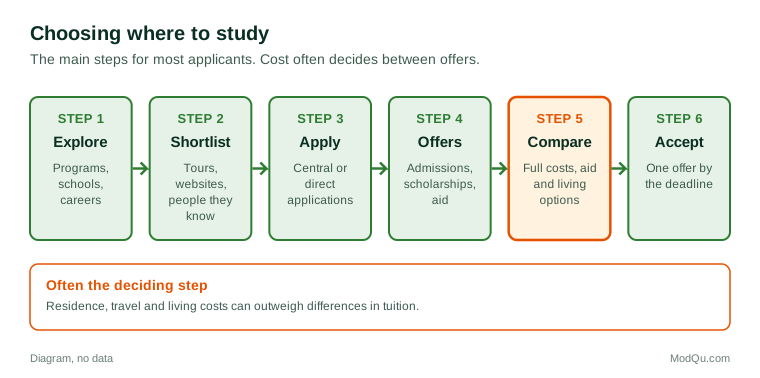
The application process varies by province and school. In some provinces, students apply through a central application centre; in others, directly to each school. Admission is usually based on high school grades in required courses, and some programs also ask for portfolios, auditions, interviews, essays or tests.
Students often apply to several schools, receive offers at different times, and must accept one by a set date. Some programs, such as nursing, engineering and some health sciences, are highly competitive. Mature students and people returning to education may be admitted on the basis of experience or upgrading courses.
Costs and how people pay
The cost of post-secondary education is made up of:
- tuition, which varies by province, institution and program, and is usually much higher for international students;
- ancillary fees for services such as health plans, transit passes, athletics and student unions;
- books and supplies, including computers and software;
- housing, whether in residence, renting off campus or living at home;
- food, transportation and personal costs.
People pay through a mix of family savings, part-time and summer work, scholarships and bursaries, and government student aid. In Canada, the federal and provincial governments run student financial assistance programs that provide loans and grants based on need. Registered Education Savings Plans (RESPs) let families save for a child's education, with federal grants such as the Canada Education Savings Grant added to contributions.
Example (hypothetical figures)
A student estimates one year at a university in another city: $7,500 in tuition and fees, $1,200 for books and supplies, $9,000 for a residence room and meal plan, and $1,800 for travel home and personal costs, for $19,500 in total. They have $6,000 from an RESP, a $2,000 entrance scholarship and $3,500 in summer savings, for $11,500. The remaining $8,000 would need to come from student aid, part-time work or family.
Worries about debt
Student debt is a common concern. Students worry about how much they will owe, how long it will take to repay, and whether their program will lead to a job that makes the debt manageable. Parents worry about how much they can help and about their child taking on debt.
Government student loans in Canada have repayment assistance programs for graduates with low income, and the rules on interest have changed in recent years. Private loans and lines of credit, often used for professional programs, carry their own terms.
Some students choose a less expensive school, live at home, study part-time while working, or start at a college and transfer to a university, partly to limit debt.
Example
A student wants to become a physiotherapist, which requires a university degree followed by a master's program. Worried about debt, they spend two years at a local college in a university transfer program while living at home, then transfer to a university to complete the degree. They say the plan saved money but meant leaving friends who went straight to university.
Changing patterns and what people disagree about
How people choose and attend post-secondary education is changing. Online and hybrid programs are more common. More students take micro-credentials and short programs alongside or instead of degrees. International student numbers grew rapidly in Canada, and the federal government introduced caps on study permits from 2024, which has affected colleges and universities. Many institutions face budget pressures.
People disagree about several questions. Is a university degree still worth the cost compared with a college diploma or a trade? Should tuition be lower, or free, and who should pay? How much should rankings matter? And should students choose a program based on interest or on expected earnings?
Key terms
- Post-secondary educationEducation after high school, at a college, university or trade school.
- CEGEPA Québec college that students attend after high school.
- TuitionThe fee charged for instruction in a program.
- Ancillary feesFees for services such as health plans, transit and athletics.
- BursaryA non-repayable award based mainly on financial need.
- ScholarshipA non-repayable award based mainly on merit, such as grades.
- RESPA Registered Education Savings Plan, used to save for a child's education.
- Co-op programA program that alternates study terms with paid work terms.
Full glossary: higher education terms on EditingTests.com.
Choosing a college or university vocabulary test
How well do you know the language of this topic? Try 8 quick questions. Your score is shown straight away and is not saved.
What the choosing a college or university survey asks
This survey is part of ModQu's Education and Learning survey. The choosing a college or university part takes about five minutes and covers:
- Which school and program you chose, or are choosing, and what kind it is.
- Which factors mattered most in your choice.
- Where you found information and which sources you trusted most.
- How you are paying, or plan to pay, for your studies.
- How worried you are about student debt.
- Looking back, whether you would choose the same way again.
After that you can choose to continue with other short parts of the Education and Learning survey, such as online learning or parents and schools, or stop.
Ready to take part?
Your answers help show what people really think and do. Results are only ever reported as totals; no one can see your individual answers.
Start the surveyQuestions about this survey
Who can take part?
Students and recent applicants, and their parents.
Do I have to give my name?
No. You may be asked for your age group, region and similar details so results can be broken down, but not your name. ModQu never asks for passwords, card numbers or account numbers.
How are the results used?
Answers are combined into totals and percentages and published in ModQu reports. Individual answers are never shown.
Is the vocabulary test part of the survey?
No. It is optional and separate, and your score is not stored.
I am a parent, not a student. Can I take part?
Yes. Parents of students and applicants can take part and answer about the choice from their point of view.