
Share your views on your child's school
Tell us how satisfied you are with your child's school, whether you pay for tutoring and how much screen time school involves. Your answers are combined with other people's and reported only as totals.
Start the parents and schools surveyAbout 5 minutes. No account needed. You can stop at any time.
How schooling is organized in Canada
In Canada, education from kindergarten to the end of high school is the responsibility of each province and territory. Each sets its own curriculum, school year and rules, and most run public schools through local school boards or school districts. There is no national education department.
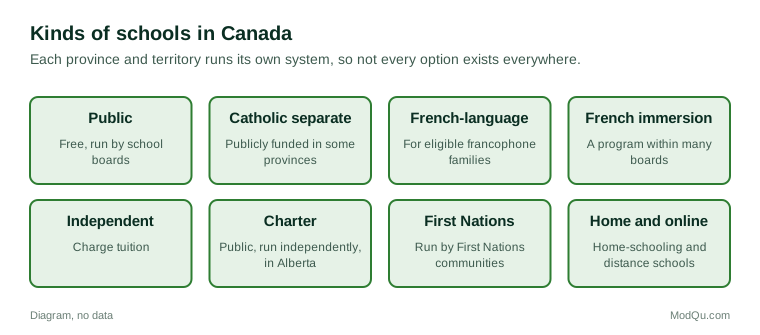
The main kinds of school are:
- Public schools, funded by government and free to attend, run by school boards.
- Catholic separate schools, publicly funded in some provinces, including Ontario, Alberta and Saskatchewan.
- French-language schools for children of eligible French-speaking parents outside Québec, and English-language schools in Québec for eligible children, under minority language education rights in the Charter of Rights and Freedoms.
- French immersion programs, in which English-speaking students learn many subjects in French.
- Independent or private schools, which charge tuition, and in some provinces receive partial public funding.
- Charter schools, publicly funded but run independently, found in Alberta.
- First Nations schools, operated by First Nations communities.
- Online and distance schools, offered by many boards and provinces.
- Home-schooling, permitted in every province with differing rules on registration and reporting.
How parents choose a school
Many families do not actively choose: their child attends the local public school assigned by their address. Others make a deliberate choice, and the choice of school can even affect where families decide to live.
Factors parents often weigh include:
- closeness to home and transport;
- the school's reputation and what other parents say;
- class sizes;
- programs such as French immersion, arts, sports, gifted programs or the International Baccalaureate;
- support for children with special needs or learning disabilities;
- school values, including religious education;
- safety and how bullying is handled;
- before- and after-school care;
- cost, for independent schools.
Example
A family moving to a new city looks at homes in two neighbourhoods. One is cheaper but its school has no French immersion. The other costs more, and its school offers immersion and an after-school program. They buy in the second neighbourhood, saying the school was the deciding factor.
What parents judge a school on
When parents rate their child's school, they tend to think about:
- teaching quality and how well teachers know their child;
- communication, including how often and how clearly the school keeps parents informed;
- their child's progress, as shown in report cards and parent-teacher meetings;
- wellbeing and safety, including bullying and mental health support;
- special education, such as individual education plans and educational assistants;
- facilities and resources, such as libraries, technology and playgrounds;
- extracurricular activities.
Parents' views of their own child's school are often more positive than their views of schools in general. This pattern, seen in many surveys, may reflect direct experience versus news coverage.
Some provinces publish results of standardized assessments, such as tests in reading, writing and mathematics at certain grades. How much weight these results deserve when judging a school is debated.
Homework
Homework is one of the most debated topics among parents. Some want more homework to build skills and habits; others feel it adds stress and takes time from play, sleep and family life. Views often vary with the child's age, the type of homework and how much help parents can give.
Common concerns include the amount of homework, whether it is meaningful or busywork, the need for a computer or internet at home, and the pressure on parents who do not have time, or the knowledge, to help. Many school boards have homework policies that set guidelines by grade.
Example
A parent of a Grade 4 child finds that homework takes about 20 minutes most nights. A parent of a Grade 9 student at the same board says their teenager spends two hours on some nights. Both are satisfied overall, but the second parent worries about the effect on sleep and part-time work.
Tutoring and paying for extra help
Many families pay for tutoring or extra learning outside school. Reasons include:
- catching up after falling behind;
- preparing for tests or entry to a competitive program;
- support for a learning disability;
- learning a second language, such as French;
- keeping up skills over the summer;
- enrichment for students who are ahead.
Options include private tutors, tutoring centres, online tutoring, peer tutoring, and free help through some schools, libraries and community groups.
Example (hypothetical figures)
A parent pays a tutor $45 an hour for one hour a week to help their child with mathematics during the 38-week school year. That costs $1,710 a year. A tutoring centre near them charges a monthly fee of $240 for two sessions a week over 10 months, or $2,400 a year, but in a small group rather than one to one.
Access to tutoring is uneven. Families with more income can pay for more help, which some people worry widens gaps between students.
Technology and screen time in class
Technology is now part of most classrooms, through laptops or tablets, online learning platforms, digital textbooks and apps. Parents often have mixed feelings about it.
Some value technology for preparing children for future work, giving access to information and supporting students with disabilities. Others worry about too much screen time, distraction, online safety and the effect of devices on attention and handwriting.
Cell phones are a related issue. Several provinces, including Ontario, Québec, British Columbia and others, have introduced rules restricting student phone use during class time. Parents differ on how strict these rules should be, with some wanting to be able to reach their child during the day.
Parent involvement and what people disagree about
Parents take part in school life in many ways: volunteering, joining a school council or parent advisory committee, helping with homework, attending meetings and events, and fundraising. Involvement varies with work schedules, language, comfort with the school system and parents' own school experiences.
Schools and parents disagree on several issues. How much say should parents have over what is taught? How large should classes be? Should schools focus more on basic skills or on wider learning such as the arts, physical education and wellbeing? How should funding be shared among public, Catholic, independent and other schools? And how should schools balance technology with other ways of learning?
Questions that businesses and education bodies want answered here include how satisfied parents are, what they spend on tutoring and extra learning, and their views on technology in class.
Key terms
- School boardA local body that runs public schools in an area.
- CurriculumThe set of subjects and learning goals set by the province.
- French immersionA program in which English-speaking students learn many subjects in French.
- Individual education planA written plan for a student who needs special education support.
- Standardized assessmentA test given to all students at a grade level in the same way.
- Report cardA school's formal record of a student's progress.
- Independent schoolA school not run by a public school board, usually charging tuition.
- Educational assistantA staff member who supports students, often those with special needs.
Full glossary: private schools terms on EditingTests.com.
Parents and schools vocabulary test
How well do you know the language of this topic? Try 8 quick questions. Your score is shown straight away and is not saved.
What the parents and schools survey asks
This survey is part of ModQu's Education and Learning survey. The parents and schools part takes about five minutes and covers:
- What kind of school your child attends, and how you chose it.
- How satisfied you are with the school, teaching and communication.
- How you feel about the amount and type of homework.
- Whether you pay for tutoring or extra learning, and how much.
- How much screen time school involves, and how you feel about it.
- How involved you are in school life.
After that you can choose to continue with other short parts of the Education and Learning survey, such as choosing a college or university or online learning, or stop.
Ready to take part?
Your answers help show what people really think and do. Results are only ever reported as totals; no one can see your individual answers.
Start the surveyQuestions about this survey
Who can take part?
Parents of school-age children.
Do I have to give my name?
No. You may be asked for your age group, region and similar details so results can be broken down, but not your name. ModQu never asks for passwords, card numbers or account numbers.
How are the results used?
Answers are combined into totals and percentages and published in ModQu reports. Individual answers are never shown.
Is the vocabulary test part of the survey?
No. It is optional and separate, and your score is not stored.
I have children at different schools. How do I answer?
You can answer about the child you know most about, or the survey may ask you to choose one child for the detailed questions.