
Inquiry · Inquiry in education and learning
Inquiry-Based Learning: Theory and Evidence
Inquiry-based learning asks learners to investigate questions rather than simply receive answers. This article explains its theoretical roots, the phases of an inquiry cycle, and what decades of research say about when it works, when it does not and why guidance makes the difference.
Inquiry-based learning (IBL) is an approach to teaching in which learners build knowledge by investigating questions, much as researchers do, rather than by receiving information that has already been organised for them. It has been promoted by education reformers for more than a century and is written into science curricula across the world. It has also been the subject of one of the most heated debates in educational research, between those who see it as the best way to develop understanding and those who argue that it leaves novices floundering. The evidence that has accumulated over the past few decades allows a fairly clear answer to the question of when inquiry-based learning works. This article explains the theory behind it, the forms it takes and what the research shows.
Theoretical roots
The idea that learning should be a process of inquiry owes most to John Dewey. In How We Think, Dewey (1910) argued that genuine thinking begins with a felt difficulty, proceeds through the formulation of the problem and the suggestion of possible solutions, and ends with testing those solutions in experience. He believed that schools should organise learning around such problems, so that children would acquire both knowledge and the habits of reflective thought. Dewey (1938) later developed this into a general theory of inquiry as the process by which an unsettled situation is transformed into a settled one.
In the 1960s two further influences shaped the movement. Jerome Bruner (1961) argued for discovery learning: knowledge that learners discover for themselves, he claimed, is better understood, better remembered and more likely to transfer to new situations, and the act of discovery develops a capacity for problem solving. Joseph Schwab (1960), a biologist and educator, argued that science should be taught as it is practised, as a process of inquiry in which knowledge is provisional and revisable, rather than as a body of settled facts. Schwab described a range of approaches, from inquiry in which the teacher provides the question and method to inquiry in which students formulate both, a distinction that still structures discussions today.
Lev Vygotsky's (1978) work provided a different kind of support. Vygotsky emphasised that learning happens first in social interaction, often with the help of a more knowledgeable person, before it is internalised. His idea of a zone of proximal development, the range of tasks a learner can accomplish with help but not alone, suggests that inquiry is most productive when it stretches learners just beyond what they can do independently and when support is available. Wood et al. (1976) introduced the term scaffolding for such support.
By the 1990s these ideas had entered policy. In the United States, the National Research Council (1996) made inquiry a central element of its national science education standards, and a subsequent report (National Research Council, 2000) described the essential features of classroom inquiry: learners engage with scientifically oriented questions, give priority to evidence, formulate explanations from evidence, connect them to scientific knowledge and communicate and justify them.
The inquiry cycle
Inquiry-based learning is usually organised as a cycle of phases. Pedaste et al. (2015) reviewed 32 articles describing such cycles and synthesised them into a common framework, shown in Figure 1.
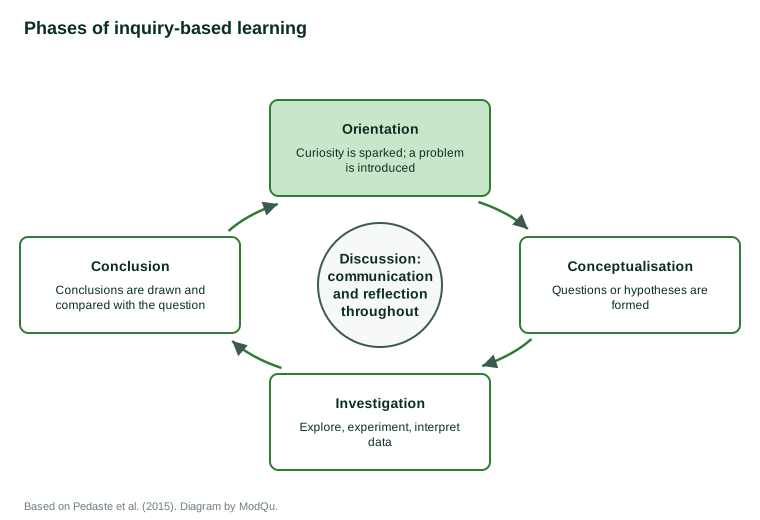
In the orientation phase, learners' curiosity is stimulated and a problem is introduced. In conceptualisation, they formulate questions or hypotheses. In investigation, they explore, experiment and interpret data. In the conclusion phase, they draw conclusions and compare them with their questions or hypotheses. Throughout, a discussion phase involves communicating with others and reflecting on the process. Pedaste et al. emphasise that real inquiry rarely follows the phases in a fixed order; learners often loop back to revise a question or redesign an investigation.
Forms of inquiry
Inquiry-based learning is not a single method. It is helpful to describe its forms by asking who supplies the question, the method and the answer (Banchi & Bell, 2008). In structured inquiry, the teacher provides the question and the procedure, and learners work out the answer. In guided inquiry, the teacher provides the question and learners design the method. In open inquiry, learners pose the question as well. Problem-based learning, project-based learning and many laboratory and fieldwork activities can all be understood as forms of inquiry that vary along these lines.
The distinction matters because, as the research shows, the amount and type of guidance is one of the strongest influences on what learners gain.
The debate
In 2006 Paul Kirschner, John Sweller and Richard Clark published an influential critique titled "Why minimal guidance during instruction does not work" (Kirschner et al., 2006). Drawing on cognitive load theory, they argued that working memory is severely limited when people deal with new information, and that unguided problem solving consumes working memory in searching for solutions, leaving little capacity for learning (Sweller, 1988). Novices, they argued, learn more from explicit instruction and worked examples than from discovering principles for themselves. Expertise depends on knowledge stored in long-term memory, and that knowledge is built most efficiently by direct teaching.
Earlier evidence supported this view. Richard Mayer (2004) reviewed research on discovery learning across several decades and concluded that pure discovery, without guidance, consistently produced weaker learning than guided approaches. David Klahr and Milena Nigam (2004) taught children the control of variables strategy, the principle that a fair experiment changes only one thing at a time. Children who received direct instruction were far more likely to master the strategy than children who explored on their own, and those who mastered it by either route were equally able to apply it in evaluating others' experiments. Chen and Klahr (1999) had earlier found that explicit instruction in the strategy, combined with practice, produced learning that transferred to new contexts.
Defenders of inquiry replied that the critics were attacking a form of inquiry that few educators advocate. Hmelo-Silver et al. (2007) argued that well-designed problem-based and inquiry learning involve extensive scaffolding, including structured processes, expert facilitation and carefully chosen problems, and that these approaches produce good outcomes on measures of reasoning, application and long-term retention. The disagreement, they suggested, was less about whether learners need guidance than about what kind of guidance and when.
What the meta-analyses show
Several large syntheses of research have since clarified the picture.
Louis Alfieri and colleagues (2011) analysed 164 studies comparing discovery-based instruction with other approaches. They found that unassisted discovery was less effective than explicit instruction. But enhanced discovery, in which learners received guidance, feedback, worked examples or prompts to explain their reasoning, was more effective than other forms of instruction, including explicit teaching.
Erin Furtak and colleagues (2012) focused on experimental and quasi-experimental studies of inquiry-based science teaching. They found a positive overall effect, and an effect that was larger when the inquiry was teacher-led than when it was student-led. Inquiry focused on the epistemic aspects of science, such as how evidence is used to support claims, had particularly strong effects.
Daphne Minner and colleagues (2010) synthesised 138 studies of inquiry-based science instruction and found that a majority reported positive effects on students' understanding of content, with the strongest effects when instruction emphasised students' active thinking and responsibility for learning.
Ard Lazonder and Ruth Harmsen (2016) analysed 72 studies and found that guidance had a substantial positive effect on learning outcomes in inquiry learning. More specific forms of guidance, such as scaffolds and explanations, had larger effects than general prompts, and younger learners benefited most from specific guidance.
Large-scale surveys have added a cautionary note. Analysing data from the 2015 Programme for International Student Assessment, the OECD (2016) found that students who reported more frequent inquiry-based science teaching tended to score lower on the science assessment, while teacher-directed instruction was associated with higher scores. Such correlations cannot establish causes, and much depends on how inquiry is carried out in practice, but they are a reminder that inquiry is not automatically beneficial.
What inquiry develops besides content knowledge
Much of the debate has focused on how well inquiry teaches content, as measured by tests. But advocates have always claimed that inquiry develops other things as well, and these deserve separate attention.
The first is epistemic understanding: knowing how knowledge in a field is produced, tested and revised. Students who only receive conclusions may learn what scientists believe without learning why, or how those beliefs could change. Furtak et al. (2012) found that inquiry activities focused on these epistemic aspects, such as using evidence to support claims and evaluating competing explanations, had some of the largest effects in their analysis. Schwab (1960) made the same argument half a century earlier, warning that teaching science as a "rhetoric of conclusions" misrepresents what science is.
The second is investigative skill: the ability to pose a researchable question, design a fair test, collect and interpret data and draw justified conclusions. These skills do not develop automatically, as Kuhn et al. (2000) found, but they cannot develop at all without opportunities to practise them.
The third is engagement. Minner et al. (2010) noted that many studies reported increases in students' interest and motivation when they were actively involved in investigation. Engagement is not an end in itself, but it affects how much effort learners invest and whether they continue with a subject.
Common pitfalls
Classroom research has also documented ways in which inquiry goes wrong in practice. One is "hands-on, minds-off" activity, in which learners are busy with materials and procedures but are not thinking about the ideas the activity was meant to develop. Another is the "cookbook" laboratory, in which learners follow step-by-step instructions to a known result and call it inquiry, although they make no decisions and test no ideas. A third is the opposite: tasks so open that learners cannot make progress and spend their time on unproductive trial and error. A fourth, perhaps the most common, is the absence of consolidation. Learners carry out an investigation, but nobody helps them connect what they found to the underlying ideas, so the activity leaves little lasting knowledge.
Each of these pitfalls corresponds to a lesson from the research. Inquiry needs a clear conceptual goal, genuine decisions for learners to make, enough support to make progress and a phase of explanation and reflection that ties the investigation to what it was meant to teach.
A classroom example
Consider a hypothetical lesson on what affects how fast a pendulum swings. In a cookbook version, students are told to measure the period of a pendulum with three different lengths and record the results in a table. In a well-designed inquiry version, the teacher first shows two pendulums swinging at different rates and asks the class what might explain the difference. Students suggest the length of the string, the weight of the bob and how far it is pulled back. The teacher then asks each group to choose one factor and design a fair test, prompting them to think about which variables to keep constant, a skill that Chen and Klahr (1999) showed benefits from explicit teaching. Groups run their tests, share results and discover that only length matters, which surprises many of them. The teacher then explains the relationship and asks students to use it to predict the swing of a pendulum they have not yet measured. The lesson takes longer than the cookbook version, but students leave with a better understanding of pendulums and of how to test an idea.
Making sense of the evidence
These findings can be reconciled. Inquiry-based learning works when it is well guided and less well when it is not. Three factors appear especially important.
Prior knowledge. Novices benefit from more structure, because they lack the knowledge to search a problem efficiently and to recognise which results matter. As learners gain expertise, the same structure can become unnecessary or even counterproductive, a pattern known as the expertise reversal effect.
The type of guidance. Effective guidance targets the parts of inquiry that novices find hardest: forming testable questions, designing fair investigations, interpreting data and connecting conclusions to evidence. Deanna Kuhn and colleagues (2000) found that young students often failed to draw valid conclusions from their own investigations, and that sustained practice with support was needed to develop the reasoning skills inquiry requires.
The role of the teacher. Dobber et al. (2017) reviewed research on the teacher's role in inquiry-based education and found that teachers need to manage several roles at once: designing inquiry tasks, guiding students' reasoning, managing group work and helping students reflect. Inquiry is demanding for teachers as well as learners, and its success depends heavily on teachers' skill.
There is also evidence that the order of exploration and instruction matters. Manu Kapur (2008) found that students who first attempted complex problems on their own, and failed, and then received instruction, learned more deeply than students who received instruction first. A meta-analysis by Sinha and Kapur (2021) found that this productive failure approach produced better conceptual understanding and transfer than instruction-first approaches, provided the initial problem-solving was carefully designed and followed by instruction that built on students' attempts. Exploration and explicit teaching are not alternatives; they can be sequenced to support each other.
Inquiry at scale
Can inquiry-based curricula work across whole school systems? Some evidence suggests they can, when well supported. Geier et al. (2008) studied middle school students in Detroit who took part in inquiry-based science units developed with extensive teacher support and materials. These students achieved higher pass rates on state science tests than comparable students, and the gains were cumulative, increasing with the number of units students had completed. Blanchard et al. (2010) compared guided inquiry laboratory instruction with traditional verification laboratories in schools and found that guided inquiry produced greater gains in students' understanding, especially at the secondary level.
John Hattie's (2009) synthesis of meta-analyses on influences on achievement found a moderate average effect for inquiry-based teaching, smaller than for some more explicit approaches but substantial enough to matter, and with large variation depending on implementation.
Lessons for practice
For teachers, trainers and anyone designing learning, the evidence suggests several principles:
- Use inquiry to develop understanding and reasoning, not to transmit large amounts of new information quickly. Inquiry is especially effective for deep understanding, application and the development of investigative skills.
- Provide guidance, and target it at the hard parts. Help learners formulate questions, design investigations and interpret evidence. Guidance does not mean giving the answer.
- Adjust guidance to the learner. Start with more structure for novices and fade it as competence grows.
- Combine exploration with explicit instruction. Short periods of exploration before instruction can prepare learners to understand it more deeply.
- Make reasoning visible. Ask learners to explain how their conclusions follow from their evidence, and discuss the process as well as the results.
- Support teachers. Inquiry-based learning places heavy demands on teachers' knowledge and skill, and curricula that provide materials and professional development produce better results.
Beyond the classroom
These lessons apply wherever people need to learn how to investigate. Organisations that develop researchers and analysts face the same choices as schools. New staff who are simply handed an open problem may flounder; those who are only ever given instructions may never learn to frame their own questions. A sequence that begins with well-defined questions and clear methods, moves to questions where staff must design the method, and ends with staff framing their own questions, mirrors the progression from structured to open inquiry that the research supports.
Conclusion
Inquiry-based learning has deep theoretical roots and a substantial evidence base. The central lesson of that evidence is that inquiry and guidance are not opposites. Unguided discovery is generally ineffective, especially for novices. Well-designed inquiry, with guidance targeted at the hardest parts of the process and adjusted to the learner, can produce deeper understanding, better reasoning and more durable learning than conventional instruction. The goal of inquiry-based learning, learners who can ask and answer their own questions, is best reached by a path that begins with considerable support and gradually hands over responsibility.
References
Alfieri, L., Brooks, P. J., Aldrich, N. J., & Tenenbaum, H. R. (2011). Does discovery-based instruction enhance learning? Journal of Educational Psychology, 103(1), 1–18. https://doi.org/10.1037/a0021017
Banchi, H., & Bell, R. (2008). The many levels of inquiry. Science and Children, 46(2), 26–29.
Blanchard, M. R., Southerland, S. A., Osborne, J. W., Sampson, V. D., Annetta, L. A., & Granger, E. M. (2010). Is inquiry possible in light of accountability? A quantitative comparison of the relative effectiveness of guided inquiry and verification laboratory instruction. Science Education, 94(4), 577–616. https://doi.org/10.1002/sce.20390
Bruner, J. S. (1961). The act of discovery. Harvard Educational Review, 31(1), 21–32.
Chen, Z., & Klahr, D. (1999). All other things being equal: Acquisition and transfer of the control of variables strategy. Child Development, 70(5), 1098–1120. https://doi.org/10.1111/1467-8624.00081
Dewey, J. (1910). How we think. D. C. Heath.
Dewey, J. (1938). Logic: The theory of inquiry. Henry Holt.
Dobber, M., Zwart, R., Tanis, M., & van Oers, B. (2017). Literature review: The role of the teacher in inquiry-based education. Educational Research Review, 22, 194–214. https://doi.org/10.1016/j.edurev.2017.09.002
Furtak, E. M., Seidel, T., Iverson, H., & Briggs, D. C. (2012). Experimental and quasi-experimental studies of inquiry-based science teaching: A meta-analysis. Review of Educational Research, 82(3), 300–329. https://doi.org/10.3102/0034654312457206
Geier, R., Blumenfeld, P. C., Marx, R. W., Krajcik, J. S., Fishman, B., Soloway, E., & Clay-Chambers, J. (2008). Standardized test outcomes for students engaged in inquiry-based science curricula in the context of urban reform. Journal of Research in Science Teaching, 45(8), 922–939. https://doi.org/10.1002/tea.20248
Hattie, J. (2009). Visible learning: A synthesis of over 800 meta-analyses relating to achievement. Routledge.
Hmelo-Silver, C. E., Duncan, R. G., & Chinn, C. A. (2007). Scaffolding and achievement in problem-based and inquiry learning: A response to Kirschner, Sweller, and Clark (2006). Educational Psychologist, 42(2), 99–107. https://doi.org/10.1080/00461520701263368
Kapur, M. (2008). Productive failure. Cognition and Instruction, 26(3), 379–424. https://doi.org/10.1080/07370000802212669
Kirschner, P. A., Sweller, J., & Clark, R. E. (2006). Why minimal guidance during instruction does not work: An analysis of the failure of constructivist, discovery, problem-based, experiential, and inquiry-based teaching. Educational Psychologist, 41(2), 75–86. https://doi.org/10.1207/s15326985ep4102_1
Klahr, D., & Nigam, M. (2004). The equivalence of learning paths in early science instruction: Effects of direct instruction and discovery learning. Psychological Science, 15(10), 661–667. https://doi.org/10.1111/j.0956-7976.2004.00737.x
Kuhn, D., Black, J., Keselman, A., & Kaplan, D. (2000). The development of cognitive skills to support inquiry learning. Cognition and Instruction, 18(4), 495–523. https://doi.org/10.1207/S1532690XCI1804_3
Lazonder, A. W., & Harmsen, R. (2016). Meta-analysis of inquiry-based learning: Effects of guidance. Review of Educational Research, 86(3), 681–718. https://doi.org/10.3102/0034654315627366
Mayer, R. E. (2004). Should there be a three-strikes rule against pure discovery learning? The case for guided methods of instruction. American Psychologist, 59(1), 14–19. https://doi.org/10.1037/0003-066X.59.1.14
Minner, D. D., Levy, A. J., & Century, J. (2010). Inquiry-based science instruction—what is it and does it matter? Results from a research synthesis years 1984 to 2002. Journal of Research in Science Teaching, 47(4), 474–496. https://doi.org/10.1002/tea.20347
National Research Council. (1996). National science education standards. National Academy Press. https://doi.org/10.17226/4962
National Research Council. (2000). Inquiry and the national science education standards: A guide for teaching and learning. National Academy Press. https://doi.org/10.17226/9596
OECD. (2016). PISA 2015 results (Volume II): Policies and practices for successful schools. OECD Publishing. https://doi.org/10.1787/9789264267510-en
Pedaste, M., Mäeots, M., Siiman, L. A., de Jong, T., van Riesen, S. A. N., Kamp, E. T., Manoli, C. C., Zacharia, Z. C., & Tsourlidaki, E. (2015). Phases of inquiry-based learning: Definitions and the inquiry cycle. Educational Research Review, 14, 47–61. https://doi.org/10.1016/j.edurev.2015.02.003
Schwab, J. J. (1960). Inquiry, the science teacher, and the educator. The School Review, 68(2), 176–195. https://doi.org/10.1086/442536
Sinha, T., & Kapur, M. (2021). When problem solving followed by instruction works: Evidence for productive failure. Review of Educational Research, 91(5), 761–798. https://doi.org/10.3102/00346543211019105
Sweller, J. (1988). Cognitive load during problem solving: Effects on learning. Cognitive Science, 12(2), 257–285. https://doi.org/10.1207/s15516709cog1202_4
Vygotsky, L. S. (1978). Mind in society: The development of higher psychological processes (M. Cole, V. John-Steiner, S. Scribner, & E. Souberman, Eds.). Harvard University Press.
Wood, D., Bruner, J. S., & Ross, G. (1976). The role of tutoring in problem solving. Journal of Child Psychology and Psychiatry, 17(2), 89–100. https://doi.org/10.1111/j.1469-7610.1976.tb00381.x