
Inquiry · Inquiry in education and learning
Metacognition: Thinking About One's Own Thinking
Metacognition is thinking about one's own thinking: knowing what you know, monitoring how well you understand and adjusting your approach. This article explains the concept, the research on how accurately people judge their own knowledge, and how metacognition can be strengthened for learning and inquiry.
When a student reads a chapter and decides they understand it well enough to stop, they are making a metacognitive judgement. So is a researcher who decides that an analysis is reliable enough to report, or a manager who decides they know enough about a market to make a decision. Metacognition, usually described as thinking about one's own thinking, governs these judgements. It determines when people seek more information and when they stop, which strategies they choose and how they respond to difficulty. The research shows that metacognition is often inaccurate, that inaccuracy has real costs and that it can be improved.
What metacognition is
The developmental psychologist John Flavell (1979) introduced the term and distinguished two main components. Metacognitive knowledge is what people know about cognition: about themselves as thinkers (for example, "I remember things better when I write them down"), about tasks ("this problem is harder than it looks") and about strategies ("summarising helps me understand"). Metacognitive experiences are the feelings and judgements that arise during thinking, such as the feeling of knowing an answer or the sense that something does not make sense.
Later researchers emphasised the regulatory side. Schraw and Moshman (1995) distinguished knowledge of cognition, including knowing what strategies exist and when to use them, from regulation of cognition, which includes planning, monitoring and evaluating one's own thinking. Schraw and Dennison (1994) developed a widely used questionnaire measuring both components.
Thomas Nelson and Louis Narens (1990) proposed an influential model, shown in Figure 1. It distinguishes an object level, where thinking about the task takes place, from a meta level, which contains a model of what is going on at the object level. Information flows up from the object level to the meta level through monitoring, as when a person judges how well they have learned something. Instructions flow down through control, as when a person decides to keep studying, change strategy or stop.
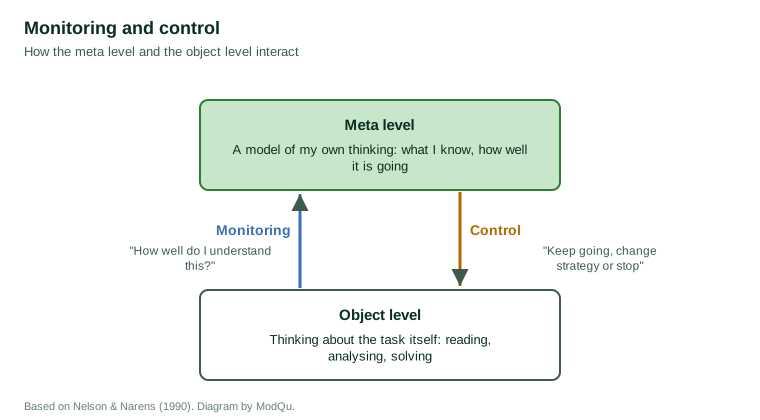
The model makes a simple but important point. Control decisions can only be as good as the monitoring they are based on. A student who wrongly believes they have mastered a topic will stop studying too early. A researcher who wrongly believes their findings are robust will not check them.
How accurate is self-monitoring?
Unfortunately, monitoring is often inaccurate. People's judgements of how well they have learned something are influenced by cues that are not reliable indicators of learning. Asher Koriat (1997) showed that people base these judgements on cues such as how familiar the material feels and how easily it comes to mind during study, which can be misleading. Material that has just been read feels familiar, for example, but may not be remembered a week later.
Robert Bjork, John Dunlosky and Nate Kornell (2013) reviewed research on such illusions of competence. Students tend to prefer study methods that feel effective, such as rereading and studying one topic at a time, over methods that are more effective but feel harder, such as testing themselves and mixing topics. Kornell and Bjork (2008) found that people who studied the paintings of several artists mixed together learned to identify each artist's style better than those who studied each artist's paintings in a block, yet most participants believed that blocked study had been more effective. The feeling of fluency misled them about their own learning.
Inaccurate monitoring has consequences. Dunlosky and Rawson (2012) found that students who were overconfident about how well they had learned definitions stopped studying them sooner and performed worse on later tests. Overconfidence produced underachievement.
Overconfidence and its sources
Overconfidence is one of the most robust findings in research on judgement. Moore and Healy (2008) distinguished three forms: overestimation of one's own performance, overplacement of oneself relative to others and overprecision, excessive certainty about the accuracy of one's beliefs. Overprecision is especially relevant to inquiry, because it leads people to treat uncertain conclusions as settled.
Justin Kruger and David Dunning (1999) found that people who performed worst on tests of reasoning, grammar and humour overestimated their performance the most. They argued that the skills needed to perform well are the same skills needed to recognise good performance, so that people who lack them are doubly disadvantaged. Ehrlinger et al. (2008) confirmed this pattern in real-world settings and found that it was not simply explained by a lack of effort or incentive. The effect has been debated, partly because some of it reflects statistical artefacts, but the broader finding that poor performers have limited insight into their performance has held up.
Monitoring that relies on the wrong cues
A useful way to think about metacognitive errors is that people monitor their thinking using cues that are easy to observe but only loosely related to what matters. Several such cues are common in research and analysis.
Fluency is the ease with which information is processed. A clearly written report, a familiar chart or an argument that flows smoothly feels convincing, even when the evidence behind it is weak. Effort can mislead in the opposite direction: an analysis that took weeks feels more reliable than one that took an afternoon, although the time spent says little about whether the method was sound. Agreement among colleagues is another cue. When everyone in a meeting nods, it feels as if a conclusion has been tested, when it may only have been repeated. And coherence, the sense that a story hangs together, can make a single explanation feel certain when several others would fit the same facts.
Recognising these cues does not remove their influence, but it allows people to check them. A team that notices it is persuaded by a well-designed slide can ask what the slide would look like if the result had gone the other way. An analyst who feels confident because the work was hard can ask what a sceptical reviewer would question first.
A hypothetical example
An analyst at a hypothetical retailer builds a model to forecast demand for the coming season. The model fits past data well, the code runs without errors and the forecasts look sensible. The analyst feels confident, and the meta level signals that the work is done.
A habit of metacognitive checking changes the outcome. Before reporting, the analyst writes down how accurate they expect the forecasts to be and then tests the model on the most recent season, which it was not built on. The errors are twice as large as expected. Looking more closely, the analyst realises that the model has learned patterns specific to a period of unusual promotions. The original confidence was based on fluency and effort, not on a test of predictive accuracy. The analyst revises the model, reports a wider range of uncertainty and adds a routine check comparing each season's forecasts with what actually happened. The final forecast is less impressive-looking but more trustworthy, and the organisation learns to treat confidence as something to be checked rather than assumed.
Metacognition and learning
Metacognitive skill is an important predictor of learning. Veenman et al. (2006) reviewed studies showing that metacognitive skills predict learning outcomes, and that they contribute independently of intelligence. Barry Zimmerman (2002) described self-regulated learners as those who plan their learning, set goals, monitor their progress and adjust their strategies, and showed that these behaviours distinguish more and less successful students.
Dunlosky et al. (2013) evaluated ten common learning techniques for their effectiveness. Two stood out: practice testing, in which learners test themselves, and distributed practice, in which study is spread over time. Both have a metacognitive benefit as well as a direct one. Testing reveals what one does not know, correcting the illusion of competence produced by rereading.
Can metacognition be taught?
The evidence suggests it can. Dignath and Büttner (2008) conducted a meta-analysis of interventions to improve self-regulated learning among primary and secondary students and found substantial positive effects on academic achievement, with larger effects when interventions taught metacognitive strategies explicitly and explained why they were useful. Guidance from the Education Endowment Foundation (Quigley et al., 2018), based on a review of the evidence, recommends explicitly teaching students metacognitive strategies for planning, monitoring and evaluating their learning, modelling one's own thinking aloud, and setting tasks that are challenging enough to require these strategies.
Metacognition in inquiry
For anyone who generates knowledge, metacognition is a professional skill. The most accurate forecasters in long-running forecasting tournaments were distinguished not only by knowledge but by their habit of monitoring and updating their beliefs, assigning precise probabilities, and reviewing what they got wrong (Mellers et al., 2015; Tetlock & Gardner, 2015). Donald Schön (1983) showed that skilled professionals "reflect in action", noticing when a situation does not fit their expectations and rethinking their approach.
Some practical habits strengthen metacognition in research and analysis:
- Predict, then check. Before looking at results, write down what you expect. Comparing expectations with results reveals the limits of your understanding.
- Test yourself. Instead of rereading a report, try to state its main findings from memory, then check.
- State confidence explicitly. Attach a probability or confidence level to conclusions, and track how often those levels are justified.
- Explain it to someone else. Difficulty explaining something reveals gaps that silent reading conceals.
- Seek feedback. Outside reviewers can detect errors that the author's monitoring misses.
- Review completed work. Asking what went well, what did not and why builds metacognitive knowledge for next time.
Conclusion
Metacognition is the capacity to monitor and control one's own thinking. It determines when people seek more information, which strategies they use and when they stop. Because self-monitoring is often inaccurate, and because inaccurate monitoring leads to poor decisions about learning and inquiry, strengthening metacognition is one of the most valuable things a learner or researcher can do. The evidence shows that it can be taught, through explicit strategies, practice testing, feedback and the habit of checking one's expectations against reality.
References
Bjork, R. A., Dunlosky, J., & Kornell, N. (2013). Self-regulated learning: Beliefs, techniques, and illusions. Annual Review of Psychology, 64, 417–444. https://doi.org/10.1146/annurev-psych-113011-143823
Dignath, C., & Büttner, G. (2008). Components of fostering self-regulated learning among students. A meta-analysis on intervention studies at primary and secondary school level. Metacognition and Learning, 3(3), 231–264. https://doi.org/10.1007/s11409-008-9029-x
Dunlosky, J., & Rawson, K. A. (2012). Overconfidence produces underachievement: Inaccurate self evaluations undermine students' learning and retention. Learning and Instruction, 22(4), 271–280. https://doi.org/10.1016/j.learninstruc.2011.08.003
Dunlosky, J., Rawson, K. A., Marsh, E. J., Nathan, M. J., & Willingham, D. T. (2013). Improving students' learning with effective learning techniques: Promising directions from cognitive and educational psychology. Psychological Science in the Public Interest, 14(1), 4–58. https://doi.org/10.1177/1529100612453266
Ehrlinger, J., Johnson, K., Banner, M., Dunning, D., & Kruger, J. (2008). Why the unskilled are unaware: Further explorations of (absent) self-insight among the incompetent. Organizational Behavior and Human Decision Processes, 105(1), 98–121. https://doi.org/10.1016/j.obhdp.2007.05.002
Flavell, J. H. (1979). Metacognition and cognitive monitoring: A new area of cognitive–developmental inquiry. American Psychologist, 34(10), 906–911. https://doi.org/10.1037/0003-066X.34.10.906
Koriat, A. (1997). Monitoring one's own knowledge during study: A cue-utilization approach to judgments of learning. Journal of Experimental Psychology: General, 126(4), 349–370. https://doi.org/10.1037/0096-3445.126.4.349
Kornell, N., & Bjork, R. A. (2008). Learning concepts and categories: Is spacing the "enemy of induction"? Psychological Science, 19(6), 585–592. https://doi.org/10.1111/j.1467-9280.2008.02127.x
Kruger, J., & Dunning, D. (1999). Unskilled and unaware of it: How difficulties in recognizing one's own incompetence lead to inflated self-assessments. Journal of Personality and Social Psychology, 77(6), 1121–1134. https://doi.org/10.1037/0022-3514.77.6.1121
Mellers, B., Stone, E., Atanasov, P., Rohrbaugh, N., Metz, S. E., Ungar, L., Bishop, M. M., Horowitz, M., Merkle, E., & Tetlock, P. (2015). The psychology of intelligence analysis: Drivers of prediction accuracy in world politics. Journal of Experimental Psychology: Applied, 21(1), 1–14. https://doi.org/10.1037/xap0000040
Moore, D. A., & Healy, P. J. (2008). The trouble with overconfidence. Psychological Review, 115(2), 502–517. https://doi.org/10.1037/0033-295X.115.2.502
Nelson, T. O., & Narens, L. (1990). Metamemory: A theoretical framework and new findings. Psychology of Learning and Motivation, 26, 125–173. https://doi.org/10.1016/S0079-7421(08)60053-5
Quigley, A., Muijs, D., & Stringer, E. (2018). Metacognition and self-regulated learning: Guidance report. Education Endowment Foundation.
Schraw, G., & Dennison, R. S. (1994). Assessing metacognitive awareness. Contemporary Educational Psychology, 19(4), 460–475. https://doi.org/10.1006/ceps.1994.1033
Schraw, G., & Moshman, D. (1995). Metacognitive theories. Educational Psychology Review, 7(4), 351–371. https://doi.org/10.1007/BF02212307
Schön, D. A. (1983). The reflective practitioner: How professionals think in action. Basic Books.
Tetlock, P. E., & Gardner, D. (2015). Superforecasting: The art and science of prediction. Crown.
Veenman, M. V. J., Van Hout-Wolters, B. H. A. M., & Afflerbach, P. (2006). Metacognition and learning: Conceptual and methodological considerations. Metacognition and Learning, 1(1), 3–14. https://doi.org/10.1007/s11409-006-6893-0
Zimmerman, B. J. (2002). Becoming a self-regulated learner: An overview. Theory Into Practice, 41(2), 64–70. https://doi.org/10.1207/s15430421tip4102_2