
Inquiry · Inquiry in education and learning
The Role of Productive Failure and Iteration in Inquiry-Driven Knowledge
Failure is usually treated as something to avoid in learning and research. A growing body of evidence shows that well-designed failure, followed by feedback and another attempt, can produce deeper knowledge than getting things right first time. This article explains productive failure, desirable difficulties and the role of iteration in generating knowledge.
Most systems of education and work are designed to minimise failure. Lessons are sequenced so that students can succeed at each step; projects are planned to avoid mistakes; errors are corrected quickly and quietly. Yet some of the most interesting findings in the science of learning suggest that this instinct is sometimes wrong. Struggling with a problem before being taught how to solve it, making errors and then correcting them, and making repeated attempts that each fall short can lead to deeper and more durable knowledge than smooth success. In research and organisations, the same principle underlies iterative methods in which ideas are tested, found wanting and improved. This article explains what the evidence shows about learning from failure, when failure is productive and when it is not, and how iteration drives the generation of knowledge.
Productive failure
The term productive failure was introduced by Manu Kapur (2008). In his original studies, secondary school students in Singapore worked on complex mathematics and physics problems. Some groups were given well-structured problems with guidance; others were given ill-structured problems without guidance. The second groups mostly failed to solve their problems. But when both groups were later tested on well-structured and ill-structured problems, the students who had struggled performed better, particularly on the ill-structured problems that required transfer.
Kapur then refined the design into a two-phase approach. In the first phase, students try to solve a challenging problem that requires a concept they have not yet been taught, such as a measure of statistical variability. They generate multiple solutions, most of which are incomplete or wrong. In the second phase, the teacher teaches the canonical concept, comparing and contrasting it with the students' attempts. Kapur (2014) compared this approach with direct instruction followed by problem solving and found that students in the productive failure condition performed as well on procedural questions and better on questions requiring conceptual understanding and transfer.
A meta-analysis by Tanmay Sinha and Manu Kapur (2021) synthesised 53 studies comparing problem solving followed by instruction with instruction followed by problem solving. Problem solving first produced better conceptual understanding and transfer, with the advantage largest when the problem-solving phase was designed according to productive failure principles. For procedural knowledge, there was no clear difference.
Why failure can help
Several mechanisms seem to explain productive failure. Katharina Loibl, Ido Roll and Nikol Rummel (2017) reviewed the research and identified three. First, attempting a problem activates prior knowledge, bringing to mind what learners already know that might be relevant. Second, it makes learners aware of the gaps in their knowledge: having tried and failed, they know what they do not know. Third, generating solutions helps learners notice the critical features of the problem, so that when the canonical solution is presented they understand why it is designed as it is. Loibl et al. found that these benefits depend on the instruction that follows building on students' failed attempts, by comparing them with the correct solution.
Daniel Schwartz and John Bransford (1998) had earlier proposed that there is "a time for telling". Explanations are more useful when learners have first developed differentiated knowledge of a domain, for example by analysing contrasting cases, because they then have something to which the explanation can be connected. Schwartz and Martin (2004) found that students who first tried to invent their own ways of measuring variability, before being taught the standard method, were better prepared to learn from later instruction and to apply what they learned to new problems. They described this as preparation for future learning.
Desirable difficulties
Productive failure is related to a broader idea from cognitive psychology. Robert Bjork (1994) introduced the term desirable difficulties for conditions of learning that make performance during training harder but improve long-term retention and transfer. Examples include spacing study over time rather than cramming, mixing different types of problem rather than practising one at a time, and testing oneself rather than rereading. These conditions feel less effective while learning, because performance is lower, but they produce better learning.
Errors are part of this picture. Kornell et al. (2009) found that attempting to answer a question before being told the answer improved later memory for the answer, even when the attempt was wrong. Janet Metcalfe (2017), reviewing research on learning from errors, concluded that making errors and receiving corrective feedback generally enhances learning, provided that the feedback is given. Butterfield and Metcalfe (2001) found a striking pattern: errors made with high confidence were more likely to be corrected on a later test than errors made with low confidence, a hypercorrection effect. Surprise at being wrong seems to focus attention on the correct answer.
When failure is not productive
Not all failure is productive. Kapur (2016) distinguished four possibilities, shown in Figure 1.
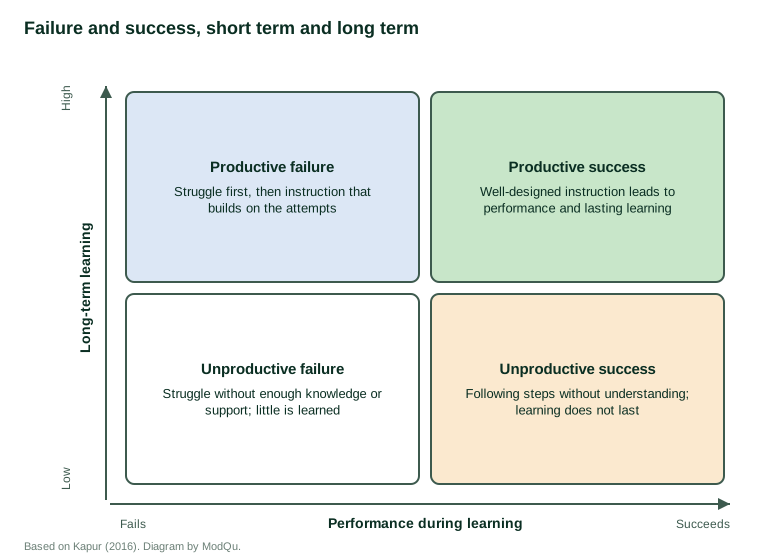
Productive success occurs when well-designed instruction leads both to good performance and to lasting learning. Unproductive success occurs when people perform well in the short term, for example by following a procedure, without understanding it, so that learning does not last or transfer. Unproductive failure occurs when people struggle without the knowledge or support needed to make progress, and learn little. Productive failure occurs when initial failure prepares people to learn deeply from subsequent instruction.
The difference between productive and unproductive failure lies in design. Productive failure requires a problem that is challenging but accessible, one that learners can engage with using what they already know, even if they cannot solve it. It requires an environment where failure is safe. And it requires subsequent instruction or feedback that builds on the attempts. Without these conditions, failure simply wastes time and can damage motivation.
The emotional side of failure
Failure is not only a cognitive event. It is also an emotional one, and how people interpret it affects whether they learn from it. Carol Dweck (2006) argued that people who see ability as something that can grow, a growth mindset, are more likely to treat failure as information and persist after setbacks, while those who see ability as fixed are more likely to treat failure as a verdict on themselves and avoid challenges. The idea has been very influential in education, but the evidence for interventions designed to change mindsets is more modest than early claims suggested. A meta-analysis by Sisk et al. (2018) found that the relationship between mindset and academic achievement was weak overall, and that mindset interventions had small average effects, larger for students from disadvantaged backgrounds or at risk of failing.
The broader point survives the debate about mindsets. Whether failure is productive depends partly on how it is framed and received. A student who is told that a struggle is expected and useful, or an employee whose manager responds to a failed experiment by asking what was learned, is more likely to engage with the failure than to hide it. Keith and Frese (2008) found that part of the benefit of error management training came from instructions that framed errors positively and helped trainees control their frustration. Designing for productive failure therefore means designing the emotional setting as well as the task.
Designing for productive failure
For teachers, trainers and research leaders who want to use failure productively, the research suggests a sequence. Start with a problem that people can engage with using what they already know but cannot fully solve. Tell them in advance that struggling is expected. Ask them to generate several approaches rather than one. Then provide instruction or feedback that explicitly compares their attempts with a stronger solution, showing what each attempt captured and what it missed. Finally, give them a new problem on which to apply what they have learned. Each step matters: without the comparison, the struggle teaches little; without the new problem, the learning may not transfer.
Learning from failure at work
The same principles apply in organisations. Keith and Frese (2008) conducted a meta-analysis of error management training, in which trainees are encouraged to make errors while learning a task, such as using new software, and are taught to see errors as useful information. Compared with training designed to avoid errors, error management training produced better performance, particularly on tasks that required transferring skills to new situations.
Organisations as a whole can also learn from failure, but often do not. Sim Sitkin (1992) argued that organisations learn more from small, early failures than from successes, because failures draw attention, prompt search for causes and challenge complacency. He recommended a strategy of small losses: deliberately taking on projects where failure is likely to be informative and its costs are limited. Cannon and Edmondson (2005) found that organisations rarely learn systematically from failure, because failures are often not identified, are analysed superficially or are not used to change practice. They argued that organisations need to make it safe to report failures, analyse them carefully and deliberately experiment. Amy Edmondson (2011) distinguished preventable failures in routine work, which should be minimised, from intelligent failures in the frontier of knowledge, which are an essential part of discovery and should be encouraged. Psychological safety, the belief that one will not be punished for admitting mistakes, is a precondition for both (Edmondson, 1999).
Iteration as a method of inquiry
Iteration, making repeated attempts in which each is informed by the results of the last, is the method that turns failure into knowledge. It is central to science, engineering, design and management.
In the philosophy of science, Karl Popper (1963) argued that knowledge grows through conjectures and refutations: bold hypotheses are proposed and then tested; those that fail are replaced by better ones. Science, on this view, is iterative failure. In quality management, W. Edwards Deming (1986) promoted a cycle of plan, do, study and act, in which improvements are tried on a small scale, their results studied and the lessons applied to the next cycle.
In engineering and software development, iteration replaced earlier methods that tried to specify everything in advance. Barry Boehm (1988) proposed a spiral model in which software is developed through repeated cycles of planning, risk analysis, building and evaluation, with each cycle reducing uncertainty. In product development, Stefan Thomke (2003) showed that firms that ran many quick, cheap experiments, and expected most of them to fail, innovated faster than firms that ran few expensive ones. Eric Ries (2011) popularised a similar approach for new businesses, centred on building a minimal version of a product, measuring how customers respond and learning whether to persevere or change direction.
Design research has added evidence about how to iterate well. Dow et al. (2010) asked participants to design web advertisements. Those who created several designs in parallel, and received feedback on all of them before refining one, produced better final designs, explored more diverse ideas and felt more confident than those who refined a single design through the same number of iterations. Parallel attempts reduced the tendency to fixate on a first idea.
Conditions for productive iteration
Across these fields, iteration produces knowledge when certain conditions are met:
- Attempts are cheap. Small, quick experiments allow many iterations; large, expensive ones discourage them.
- Feedback is fast and informative. Each attempt must yield information about why it succeeded or failed. Hattie and Timperley (2007) found that feedback is most useful when it addresses where the learner is going, how they are progressing and what to do next.
- Failure is safe. People must be able to report and discuss failures without fear.
- Results are compared with expectations. Writing down what one expects before each attempt makes it possible to learn from the gap.
- Lessons are carried forward. Each iteration should change something based on the last, rather than repeating it.
- Iteration eventually converges. Exploration must at some point give way to consolidation, through instruction, synthesis or a decision.
A hypothetical example
A research team is designing a new customer survey. In a traditional approach, the team would spend weeks drafting the perfect questionnaire and then field it once. In an iterative approach, the team drafts a rough version in a day, tests it with five customers using cognitive interviews and finds that three questions are misunderstood and one important topic is missing. It revises the survey, tests it with another five customers, finds smaller problems and revises again. After three short rounds, the team fields a survey that works, having learned in the process how customers think about the topic. Each round "failed" in that it revealed problems, but each failure was cheap, informative and quickly acted on.
Conclusion
Failure is not always the opposite of learning. When it is designed to be productive, through challenging but accessible problems, a safe environment and instruction or feedback that builds on the attempts, it can produce deeper understanding and better transfer than early success. Iteration is the method that makes failure productive in research and organisations: repeated, cheap attempts, each informed by the last, gradually converge on knowledge that a single, careful attempt might never reach. The practical lesson is not to seek failure for its own sake, but to design inquiry so that when failure comes, as it will, it teaches something.
References
Bjork, R. A. (1994). Memory and metamemory considerations in the training of human beings. In J. Metcalfe & A. P. Shimamura (Eds.), Metacognition: Knowing about knowing (pp. 185–205). MIT Press.
Boehm, B. W. (1988). A spiral model of software development and enhancement. Computer, 21(5), 61–72. https://doi.org/10.1109/2.59
Butterfield, B., & Metcalfe, J. (2001). Errors committed with high confidence are hypercorrected. Journal of Experimental Psychology: Learning, Memory, and Cognition, 27(6), 1491–1494. https://doi.org/10.1037/0278-7393.27.6.1491
Cannon, M. D., & Edmondson, A. C. (2005). Failing to learn and learning to fail (intelligently): How great organizations put failure to work to innovate and improve. Long Range Planning, 38(3), 299–319. https://doi.org/10.1016/j.lrp.2005.04.005
Deming, W. E. (1986). Out of the crisis. MIT Center for Advanced Engineering Study.
Dow, S. P., Glassco, A., Kass, J., Schwarz, M., Schwartz, D. L., & Klemmer, S. R. (2010). Parallel prototyping leads to better design results, more divergence, and increased self-efficacy. ACM Transactions on Computer-Human Interaction, 17(4), Article 18. https://doi.org/10.1145/1879831.1879836
Dweck, C. S. (2006). Mindset: The new psychology of success. Random House.
Edmondson, A. (1999). Psychological safety and learning behavior in work teams. Administrative Science Quarterly, 44(2), 350–383. https://doi.org/10.2307/2666999
Edmondson, A. C. (2011). Strategies for learning from failure. Harvard Business Review, 89(4), 48–55.
Hattie, J., & Timperley, H. (2007). The power of feedback. Review of Educational Research, 77(1), 81–112. https://doi.org/10.3102/003465430298487
Kapur, M. (2008). Productive failure. Cognition and Instruction, 26(3), 379–424. https://doi.org/10.1080/07370000802212669
Kapur, M. (2014). Productive failure in learning math. Cognitive Science, 38(5), 1008–1022. https://doi.org/10.1111/cogs.12107
Kapur, M. (2016). Examining productive failure, productive success, unproductive failure, and unproductive success in learning. Educational Psychologist, 51(2), 289–299. https://doi.org/10.1080/00461520.2016.1155457
Keith, N., & Frese, M. (2008). Effectiveness of error management training: A meta-analysis. Journal of Applied Psychology, 93(1), 59–69. https://doi.org/10.1037/0021-9010.93.1.59
Kornell, N., Hays, M. J., & Bjork, R. A. (2009). Unsuccessful retrieval attempts enhance subsequent learning. Journal of Experimental Psychology: Learning, Memory, and Cognition, 35(4), 989–998. https://doi.org/10.1037/a0015729
Loibl, K., Roll, I., & Rummel, N. (2017). Towards a theory of when and how problem solving followed by instruction supports learning. Educational Psychology Review, 29(4), 693–715. https://doi.org/10.1007/s10648-016-9379-x
Metcalfe, J. (2017). Learning from errors. Annual Review of Psychology, 68, 465–489. https://doi.org/10.1146/annurev-psych-010416-044022
Popper, K. R. (1963). Conjectures and refutations: The growth of scientific knowledge. Routledge & Kegan Paul.
Ries, E. (2011). The lean startup: How today's entrepreneurs use continuous innovation to create radically successful businesses. Crown Business.
Schwartz, D. L., & Bransford, J. D. (1998). A time for telling. Cognition and Instruction, 16(4), 475–522. https://doi.org/10.1207/s1532690xci1604_4
Schwartz, D. L., & Martin, T. (2004). Inventing to prepare for future learning: The hidden efficiency of encouraging original student production in statistics instruction. Cognition and Instruction, 22(2), 129–184. https://doi.org/10.1207/s1532690xci2202_1
Sinha, T., & Kapur, M. (2021). When problem solving followed by instruction works: Evidence for productive failure. Review of Educational Research, 91(5), 761–798. https://doi.org/10.3102/00346543211019105
Sisk, V. F., Burgoyne, A. P., Sun, J., Butler, J. L., & Macnamara, B. N. (2018). To what extent and under which circumstances are growth mind-sets important to academic achievement? Two meta-analyses. Psychological Science, 29(4), 549–571. https://doi.org/10.1177/0956797617739704
Sitkin, S. B. (1992). Learning through failure: The strategy of small losses. Research in Organizational Behavior, 14, 231–266.
Thomke, S. H. (2003). Experimentation matters: Unlocking the potential of new technologies for innovation. Harvard Business School Press.