
Inquiry · Inquiry in education and learning
Cultivating Inquiry Dispositions: Mindsets, Habits, and Skills
Skill in inquiry is not enough; people must also be inclined to use it and alert to when it is needed. This article explains inquiry dispositions as a combination of mindsets, habits and skills, reviews the research on how they develop, and sets out practical ways to cultivate them in classrooms and organisations.
Many people can reason well when told to. Fewer do so when nobody asks. A manager who would spot the flaw in a colleague's argument on a training course may accept the same flaw in a meeting. A student who can design a fair experiment in a science test may not think to question a claim in an advertisement. The gap between what people can do and what they actually do is the territory of dispositions: the tendencies that determine whether abilities are used. For inquiry, dispositions may matter as much as skills. This article explains what inquiry dispositions are, how they are made up of mindsets, habits and skills, and what research suggests about cultivating them.
Ability is not enough
David Perkins, Eileen Jay and Shari Tishman (1993) proposed a dispositional theory of thinking that has shaped much later work. They argued that good thinking requires three things. Ability is the capacity to carry out a kind of thinking, such as considering alternatives. Inclination is the motivation or tendency to do so. Sensitivity is alertness to occasions that call for it. All three are needed. A person with ability but no sensitivity will not notice when careful thought is required; a person with sensitivity but no inclination will notice but not bother.
Perkins et al. (2000) tested this theory in a series of studies. Students read short stories containing situations that called for particular kinds of thinking, such as seeking alternative explanations or examining the other side of an argument. When the opportunity was pointed out to them, most students could carry out the thinking competently. When it was not, many did not notice the opportunity at all. Sensitivity, not ability, was the main bottleneck. This finding has a striking implication: much teaching of thinking focuses on skills, but the larger problem may be that people do not recognise when to use the skills they have.
Intellectual virtues
Philosophers have approached the same issue through the idea of intellectual virtues: character traits that make someone a good thinker and inquirer. Linda Zagzebski (1996) argued that knowledge arises from acts of intellectual virtue, such as open-mindedness, intellectual courage, thoroughness and attentiveness, in the way that good actions arise from moral virtues. Roberts and Wood (2007) described a range of such virtues, including love of knowledge, firmness, humility, autonomy, generosity and practical wisdom, and emphasised that they are acquired through practice and shaped by communities.
Jason Baehr (2011) focused specifically on the virtues of an inquiring mind. He argued that the intellectual virtues are, at root, the traits of a good inquirer: curiosity in initiating inquiry, attentiveness and carefulness in carrying it out, open-mindedness and intellectual courage in following evidence where it leads, and tenacity in persisting when it is hard. Baehr's account links character directly to the practice of inquiry.
Three components: mindsets, habits and skills
One useful way to organise the research is to treat an inquiry disposition as a combination of three overlapping components, as Figure 1 shows.
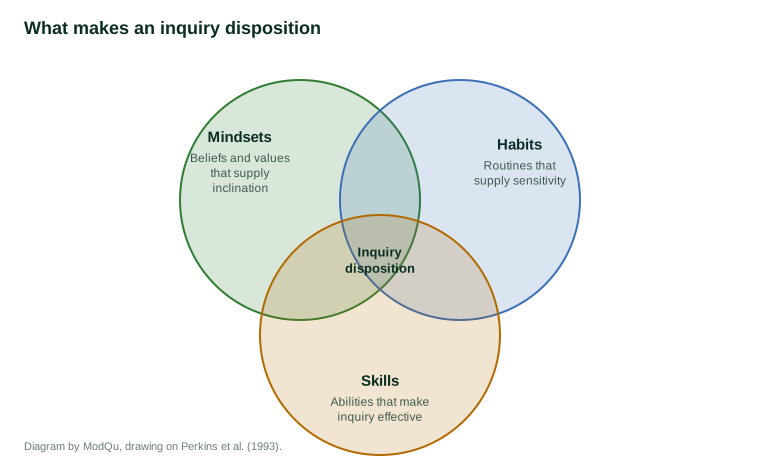
Mindsets are beliefs and values about knowledge, ability and inquiry. They supply inclination: they determine whether inquiry seems worthwhile and whether difficulty is welcome. Habits are patterns of behaviour that run with little conscious effort. They supply sensitivity: a habit of asking "how do we know?" fires automatically when a claim is made. Skills are the abilities to inquire well: framing questions, designing investigations, evaluating evidence. They make inquiry effective when it happens.
The overlaps matter as much as the components. Skills without the right mindset produce a person who can inquire but sees no reason to, or uses the skills only to defend existing views. A mindset without skills produces enthusiasm that leads nowhere: questions are asked but not answered well. Habits without skills produce routine questioning that becomes ritual, such as asking "what are the risks?" at every meeting without ever analysing the answer. Only when all three are present does inquiry happen reliably, at the right moments and to good effect.
Mindsets
Beliefs about knowledge
People's beliefs about the nature of knowledge shape whether they inquire. Deanna Kuhn (1999) described how understanding of knowledge develops. People who believe that knowledge is simply right or wrong, and that authorities have the answers, see little point in inquiring for themselves. People who believe that all views are equally valid see little point in weighing evidence. Only those who believe that knowledge is uncertain but that some claims are better supported than others have a reason to inquire carefully. Cultivating inquiry therefore involves helping people understand how knowledge is built and tested.
Beliefs about ability
Carol Dweck (2006) argued that people who believe ability can be developed are more likely to take on challenges and persist after setbacks. Inquiry is full of setbacks, so this belief should support it. The evidence for interventions that change such beliefs is, however, mixed. Sisk et al. (2018) found that mindset interventions had small average effects on achievement, with larger effects for students at risk of failing. Beliefs about ability matter, but changing them is not a simple fix.
Open-mindedness and humility
Two further mindsets are closely related to inquiry. Actively open-minded thinking is the tendency to seek out evidence against one's own beliefs and to weigh it fairly. Stanovich and West (1997) found that people high in this trait evaluated arguments more independently of their prior opinions. Jonathan Baron (2019) found that people who scored higher on a measure of actively open-minded thinking were less likely to hold beliefs resistant to evidence. Intellectual humility, the recognition that one's views might be wrong, is associated with more careful evaluation of evidence and greater openness to opposing views (Leary et al., 2017).
Tolerance of uncertainty
Inquiry requires living with not knowing. Kashdan et al. (2018) found that stress tolerance, the ability to accept the discomfort of uncertainty and novelty, was a distinct dimension of curiosity and was associated with greater willingness to explore. People who find uncertainty intolerable tend to close questions too quickly.
Valuing inquiry
Finally, people must value inquiry. Ryan and Deci (2000) showed that intrinsic motivation, doing something because it is interesting or satisfying, is supported when people feel autonomous, competent and connected to others, and undermined by excessive control and external pressure. Hidi and Renninger (2006) showed that interest develops through repeated engagement supported by others. Inquiry dispositions are unlikely to develop in environments where questions are treated as interruptions and only answers are rewarded.
Habits
Habits make inquiry automatic. Arthur Costa and Bena Kallick (2008) identified sixteen habits of mind that characterise effective thinkers, including persisting, thinking flexibly, questioning and posing problems, applying past knowledge to new situations, gathering data through all senses, striving for accuracy and remaining open to continuous learning. Their argument is that these are not skills to be used on demand but dispositions to be practised until they become characteristic ways of behaving.
Psychological research on habits explains how this happens. Wendy Wood and David Neal (2007) described habits as associations between contexts and responses that are learned through repetition and then triggered by the context, with little need for conscious intention. Lally et al. (2010) studied people forming new everyday habits and found that the behaviours became more automatic with repetition, with a median of about 66 days to reach a plateau, though with great variation between people and behaviours.
These findings suggest how inquiry habits can be built. A habit of asking "what is the evidence?" whenever a claim is made in a meeting, or "what would change my mind?" before a decision, needs a consistent context and repeated practice. Peter Gollwitzer (1999) found that implementation intentions, specific plans of the form "when situation X arises, I will do Y", make it much more likely that people act on their intentions. "When someone presents a forecast, I will ask how accurate past forecasts have been" is an implementation intention for an inquiry habit.
Skills
Skills are the most familiar component and the most often taught. They include formulating clear and answerable questions, designing investigations that can distinguish between explanations, gathering and evaluating evidence, reasoning from evidence to conclusions and communicating findings with appropriate confidence. Diane Halpern (1998) argued that skills must be taught explicitly and practised across contexts if they are to transfer, and that teaching should include learning to recognise when a skill applies, which connects skills to sensitivity. Meta-analyses of critical thinking instruction find that explicit teaching combined with application in subjects is most effective (Abrami et al., 2008).
Skills also feed back into the other components. Albert Bandura (1977) showed that self-efficacy, the belief that one can succeed at a task, strongly influences whether people attempt it and how long they persist. People who are skilled at inquiry are more likely to believe they can inquire successfully, and so more likely to try.
How dispositions are cultivated
Because dispositions involve values and habits as well as skills, they cannot be taught by instruction alone. Tishman et al. (1993) argued that dispositions are best developed through enculturation: immersion in a culture in which good thinking is modelled, valued and practised. They identified four mechanisms. Models are people, such as teachers or leaders, who display the dispositions. Explanation makes the dispositions and their value explicit. Interaction engages learners in using them with others. Feedback helps learners see how well they are doing.
Ron Ritchhart (2002) studied teachers who were notably successful in developing students' thinking and found that they created a culture of thinking through their expectations, language, use of time, modelling, routines, opportunities, interactions and physical environment. Ritchhart et al. (2011) developed thinking routines, short and repeatable structures that make thinking visible and build habits. One example, "See, Think, Wonder", asks learners to describe what they observe, what they think is going on and what it makes them wonder. Another, "Claim, Support, Question", asks them to make a claim, identify support for it and raise a question about it. Because the routines are used repeatedly, they become habits.
Psychological safety is also essential. Amy Edmondson (1999) found that teams learn when members feel safe to ask questions, admit errors and challenge ideas. In environments where asking a question risks looking ignorant, inquiry dispositions will not develop however well they are taught.
Inquiry dispositions in organisations
The same principles apply to adults at work. An organisation that wants its people to inquire must do more than send them on a course. Leaders must model inquiry, asking genuine questions and admitting what they do not know. The value of inquiry must be explicit, for example by recognising good questions as well as good answers. Routines can build habits: a standard question at the start of a project ("what decision will this inform?"), a regular review of past forecasts, a template that requires alternative explanations to be considered. Feedback must reward the process of inquiry, not only results that confirm expectations. And people must feel safe to raise doubts.
Obstacles to inquiry dispositions
Several features of ordinary environments work against inquiry dispositions, and cultivating them often means removing obstacles as much as adding practices.
Time pressure is the most common. Inquiry takes time, and in a busy classroom or office the first plausible answer is often accepted because there is no time to look for a better one. Building inquiry into routines, so that it does not depend on finding spare time, is one response.
Incentives for answers are another. When people are rewarded for delivering answers quickly and confidently, and penalised for saying "I don't know yet", they learn to close questions early. Assessment and performance systems that recognise good questions and honest uncertainty reduce this pressure.
Expertise can also be an obstacle. Abraham Luchins (1942) gave people a series of water-jar problems that could all be solved by the same complicated method. When a problem appeared that could be solved by a much simpler method, most people continued to use the complicated one, and some failed to solve problems that required a different approach altogether. Familiar methods become mental sets that block fresh thinking. Experts are especially vulnerable, because they have more well-practised methods to fall back on. Deliberately asking "is there another way to look at this?" counteracts the effect.
Status differences discourage inquiry from those with less power. Junior staff may see problems that senior staff miss but hesitate to raise them. Leaders who invite questions explicitly, and respond well when they come, make inquiry possible for everyone, not only those confident enough to risk it.
Routines for teams
Thinking routines can be adapted for adult teams. Some examples:
- See, think, wonder at the start of a review: what do the data show, what do we think explains it, what does it make us wonder?
- Claim, support, question for any recommendation: what is being claimed, what supports it, what question remains?
- Predict, then check: before results are revealed, each team member writes down what they expect.
- The second explanation: no conclusion is accepted until at least one alternative explanation has been stated and considered.
- What would change our minds? asked before any significant decision.
Used consistently, routines like these turn inquiry from an occasional effort into a habit, which is where dispositions take root.
A hypothetical example
A hypothetical analytics team notices that its reports are accurate but rarely challenge the assumptions of the managers who commission them. Training in analytical methods has not helped, because the analysts have the skills already. The team leader concludes that the problem is dispositional and introduces several changes. Every project brief now includes the question "what would surprise us?", answered before data collection begins. Each analyst keeps a short log of predictions and checks them at the end of each project. Team meetings begin with five minutes of "see, think, wonder" on a chart from current work. The team leader makes a point of asking genuine questions and of saying "I don't know" when that is true. And the annual review now asks each analyst to describe a time when their work changed someone's mind.
After a year, the team's reports include more alternative explanations and more explicit statements of uncertainty, and managers begin to commission work earlier, when questions are still open. The analysts' skills did not change. What changed was their sensitivity to opportunities for inquiry and their inclination to pursue them.
Can dispositions be measured?
Dispositions are harder to measure than skills, because a test signals that careful thinking is expected, while everyday life usually does not. Questionnaires measure self-reported tendencies, such as actively open-minded thinking or intellectual humility, but are vulnerable to people describing themselves as they would like to be. Perkins et al. (2000) measured sensitivity by embedding unannounced opportunities for thinking in tasks and seeing whether people noticed them. Facione (2000) developed a measure of critical thinking dispositions and found that disposition and skill were related but distinct. In practice, observing what people do in real work, such as how often they ask for evidence or consider alternatives, may be the most valid measure.
Conclusion
Inquiry depends not only on knowing how to inquire but on being inclined to do so and noticing when it is needed. These dispositions combine mindsets about knowledge, ability and uncertainty; habits that make inquiry automatic in familiar situations; and skills that make it effective. They develop through enculturation: through models, explicit explanation, practice with others, routines that build habits and feedback that values the process of inquiry. Classrooms and organisations that want people who generate knowledge must cultivate all three components, and the environment in which they can grow.
References
Abrami, P. C., Bernard, R. M., Borokhovski, E., Wade, A., Surkes, M. A., Tamim, R., & Zhang, D. (2008). Instructional interventions affecting critical thinking skills and dispositions: A stage 1 meta-analysis. Review of Educational Research, 78(4), 1102–1134. https://doi.org/10.3102/0034654308326084
Baehr, J. (2011). The inquiring mind: On intellectual virtues and virtue epistemology. Oxford University Press. https://doi.org/10.1093/acprof:oso/9780199604074.001.0001
Bandura, A. (1977). Self-efficacy: Toward a unifying theory of behavioral change. Psychological Review, 84(2), 191–215. https://doi.org/10.1037/0033-295X.84.2.191
Baron, J. (2019). Actively open-minded thinking in politics. Cognition, 188, 8–18. https://doi.org/10.1016/j.cognition.2018.10.004
Costa, A. L., & Kallick, B. (Eds.). (2008). Learning and leading with habits of mind: 16 essential characteristics for success. ASCD.
Dweck, C. S. (2006). Mindset: The new psychology of success. Random House.
Edmondson, A. (1999). Psychological safety and learning behavior in work teams. Administrative Science Quarterly, 44(2), 350–383. https://doi.org/10.2307/2666999
Facione, P. A. (2000). The disposition toward critical thinking: Its character, measurement, and relationship to critical thinking skill. Informal Logic, 20(1), 61–84. https://doi.org/10.22329/il.v20i1.2254
Gollwitzer, P. M. (1999). Implementation intentions: Strong effects of simple plans. American Psychologist, 54(7), 493–503. https://doi.org/10.1037/0003-066X.54.7.493
Halpern, D. F. (1998). Teaching critical thinking for transfer across domains: Disposition, skills, structure training, and metacognitive monitoring. American Psychologist, 53(4), 449–455. https://doi.org/10.1037/0003-066X.53.4.449
Hidi, S., & Renninger, K. A. (2006). The four-phase model of interest development. Educational Psychologist, 41(2), 111–127. https://doi.org/10.1207/s15326985ep4102_4
Kashdan, T. B., Stiksma, M. C., Disabato, D. J., McKnight, P. E., Bekier, J., Kaji, J., & Lazarus, R. (2018). The five-dimensional curiosity scale: Capturing the bandwidth of curiosity and identifying four unique subgroups of curious people. Journal of Research in Personality, 73, 130–149. https://doi.org/10.1016/j.jrp.2017.11.011
Kuhn, D. (1999). A developmental model of critical thinking. Educational Researcher, 28(2), 16–46. https://doi.org/10.3102/0013189X028002016
Lally, P., van Jaarsveld, C. H. M., Potts, H. W. W., & Wardle, J. (2010). How are habits formed: Modelling habit formation in the real world. European Journal of Social Psychology, 40(6), 998–1009. https://doi.org/10.1002/ejsp.674
Leary, M. R., Diebels, K. J., Davisson, E. K., Jongman-Sereno, K. P., Isherwood, J. C., Raimi, K. T., Deffler, S. A., & Hoyle, R. H. (2017). Cognitive and interpersonal features of intellectual humility. Personality and Social Psychology Bulletin, 43(6), 793–813. https://doi.org/10.1177/0146167217697695
Luchins, A. S. (1942). Mechanization in problem solving: The effect of Einstellung. Psychological Monographs, 54(6), i–95. https://doi.org/10.1037/h0093502
Perkins, D. N., Jay, E., & Tishman, S. (1993). Beyond abilities: A dispositional theory of thinking. Merrill-Palmer Quarterly, 39(1), 1–21.
Perkins, D., Tishman, S., Ritchhart, R., Donis, K., & Andrade, A. (2000). Intelligence in the wild: A dispositional view of intellectual traits. Educational Psychology Review, 12(3), 269–293. https://doi.org/10.1023/A:1009031605464
Ritchhart, R. (2002). Intellectual character: What it is, why it matters, and how to get it. Jossey-Bass.
Ritchhart, R., Church, M., & Morrison, K. (2011). Making thinking visible: How to promote engagement, understanding, and independence for all learners. Jossey-Bass.
Roberts, R. C., & Wood, W. J. (2007). Intellectual virtues: An essay in regulative epistemology. Oxford University Press. https://doi.org/10.1093/acprof:oso/9780199283675.001.0001
Ryan, R. M., & Deci, E. L. (2000). Self-determination theory and the facilitation of intrinsic motivation, social development, and well-being. American Psychologist, 55(1), 68–78. https://doi.org/10.1037/0003-066X.55.1.68
Sisk, V. F., Burgoyne, A. P., Sun, J., Butler, J. L., & Macnamara, B. N. (2018). To what extent and under which circumstances are growth mind-sets important to academic achievement? Two meta-analyses. Psychological Science, 29(4), 549–571. https://doi.org/10.1177/0956797617739704
Stanovich, K. E., & West, R. F. (1997). Reasoning independently of prior belief and individual differences in actively open-minded thinking. Journal of Educational Psychology, 89(2), 342–357. https://doi.org/10.1037/0022-0663.89.2.342
Tishman, S., Jay, E., & Perkins, D. N. (1993). Teaching thinking dispositions: From transmission to enculturation. Theory Into Practice, 32(3), 147–153. https://doi.org/10.1080/00405849309543590
Wood, W., & Neal, D. T. (2007). A new look at habits and the habit–goal interface. Psychological Review, 114(4), 843–863. https://doi.org/10.1037/0033-295X.114.4.843
Zagzebski, L. T. (1996). Virtues of the mind: An inquiry into the nature of virtue and the ethical foundations of knowledge. Cambridge University Press. https://doi.org/10.1017/CBO9781139174763