
Inquiry · Inquiry in education and learning
The Role of Play and Experimentation in Inquiry Processes
Play and experimentation are among the oldest ways of finding things out. This article explains how play supports inquiry in children and adults, what research shows about exploratory play, guided play and the cost of too much instruction, and how organisations use playful experimentation to generate knowledge.
Play is often contrasted with serious work, and experimentation with idle tinkering. Yet the research on how children learn, and on how organisations innovate, suggests that play and experimentation are among the most powerful methods of inquiry available. When children play with a new toy, they are often running experiments, testing what happens if they push this or pull that. When designers sketch dozens of rough prototypes, or when online businesses test hundreds of small variations of a web page, they are playing with possibilities in order to learn. This article examines the role of play and experimentation in inquiry, drawing on developmental psychology, education research and studies of innovation.
What play is
Play is notoriously hard to define. Brian Sutton-Smith (1997) catalogued the many different ways in which play has been understood, from progress and development to fantasy, identity and frivolity, and concluded that play is fundamentally ambiguous. Johan Huizinga (1949) described play as a free activity, standing outside ordinary life, with its own boundaries of time and space and its own rules, pursued for its own sake. Anthony Pellegrini (2009) reviewed research on the forms and functions of play across species and argued that play allows young animals and humans to try out behaviours in a setting where mistakes are cheap.
This last feature, low cost of failure, links play to inquiry. Jerome Bruner (1972) argued that one of the main functions of the long human childhood is to allow play, in which the consequences of actions are reduced so that children can explore combinations of behaviour they would never risk in earnest. Lev Vygotsky (1967) saw play as a leading source of development in young children, in which they act "a head taller" than themselves, following rules and taking roles that stretch their capacities.
Exploratory play as experimentation
Much recent research has shown that children's exploratory play is directed at learning in ways that resemble scientific inquiry. Alison Gopnik (2012) reviewed evidence that young children form and test causal hypotheses, learn from patterns of evidence and choose actions that will be informative.
Schulz and Bonawitz (2007) showed preschoolers a box with two levers. When the demonstration made clear what each lever did, children were happy to move on to a new toy. When the evidence was confounded, because both levers had been pushed at once, children preferred to keep playing with the box, and their play helped to resolve the ambiguity. Cook et al. (2011) went further. They showed children that some beads made a toy play music and others did not. When the evidence was ambiguous about which beads worked, children spontaneously tested beads one at a time, in ways that isolated the relevant variable, even though nobody had told them to. Their play was, in effect, a well-designed experiment.
Even infants direct their exploration towards learning. Aimee Stahl and Lisa Feigenson (2015) showed eleven-month-old infants objects that either behaved as expected or violated expectations, for example by appearing to pass through a solid wall. Infants learned more about objects that had behaved surprisingly, and explored them in ways that tested the specific violation they had seen: they banged objects that had seemed to pass through walls, and dropped objects that had seemed to hover in mid-air. Surprise directed play towards the question it raised.
The double edge of instruction
If play is a form of inquiry, then instruction can sometimes get in its way. Bonawitz et al. (2011) gave preschoolers a toy with several hidden functions. When an adult demonstrated one function in a teaching manner, children tended to repeat that function and explored less, discovering fewer of the other functions. When the adult revealed the same function accidentally, or did not demonstrate at all, children explored more broadly and found more functions. Children reasonably assumed that a teacher would show them everything worth knowing, so they stopped looking. The authors called this "the double-edged sword of pedagogy": instruction is efficient for transmitting what the teacher knows, but can limit discovery of what the teacher has not shown.
Free play, guided play and direct instruction
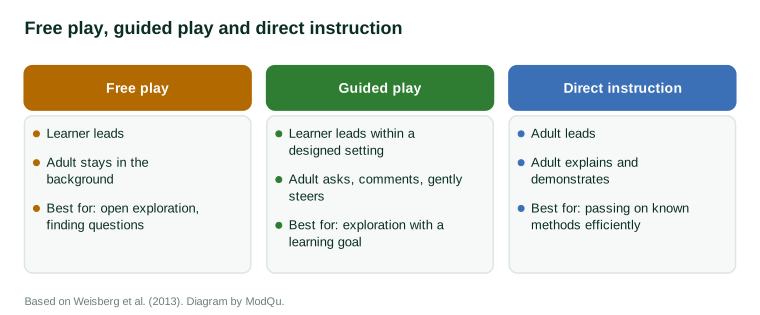
This does not mean that children should simply be left to play. The research on education points to guided play as a middle way. Weisberg et al. (2013) described guided play as play in which adults set up the environment and support children's exploration, for example by asking questions, commenting and gently steering, while leaving children in control of their activity. Figure 1 contrasts it with free play and direct instruction.
The evidence for guided play is encouraging. Skene et al. (2022) conducted a meta-analysis of studies comparing guided play with free play and with direct instruction. Guided play had a greater positive effect than direct instruction on some mathematics outcomes, such as early mathematical skills and shape knowledge, and a greater effect than free play on spatial skills, with no clear differences on other outcomes. The evidence is still limited, but it suggests that combining children's agency with adult support can be more effective than either alone.
The evidence on pretend play is more cautious. Lillard et al. (2013) reviewed decades of research on claims that pretend play causes improvements in creativity, reasoning, language and social skills, and concluded that the evidence was weaker than often claimed. Many studies were small, had methodological problems or could not distinguish the effects of play from the effects of adult involvement. Play may be valuable, but its benefits should not be overstated.
Play, exploration and age
Gopnik et al. (2017) compared children, adolescents and adults and found that younger people were more willing to consider unusual hypotheses and explore, while adults were more efficient at applying what they already knew. Gopnik has suggested that childhood is a period specialised for exploration, a kind of "research and development" phase of human life, while adulthood is specialised for exploitation. Adults can still play and explore, but they must often make a deliberate effort to do so, because their expertise pulls them towards familiar solutions.
Exploration and exploitation in organisations
James March (1991) described a fundamental tension in organisational learning between exploration, the search for new possibilities through variation, experimentation and play, and exploitation, the refinement and use of existing knowledge. Exploitation produces reliable, short-term returns; exploration produces uncertain, longer-term ones. March argued that organisations tend to drive out exploration in favour of exploitation, because its returns are more certain and more immediate, and that this can leave them unable to adapt when circumstances change.
Charalampos Mainemelis and Sarah Ronson (2006) argued that play has a distinctive role in organisational creativity. It loosens the constraints of ordinary work, encourages people to try unusual combinations and makes failure less threatening. Michael Schrage (2000) described how innovative firms use prototypes, models and simulations as forms of "serious play", in which people learn by building and testing rough versions of ideas rather than by planning in detail.
Experimentation as structured play
Experimentation is in some ways play with rules. Ronald Fisher (1935) laid the foundations of modern experimental design, including randomisation, which allows a causal effect to be distinguished from coincidence. Modern organisations apply these principles at scale. Stefan Thomke (2003) showed that firms that run many cheap, fast experiments, expecting most to fail, innovate more effectively than firms that run a few expensive ones. Online businesses run thousands of controlled experiments each year, testing variations in design, wording and features on randomly assigned groups of users. Kohavi et al. (2020) describe how such experiments regularly overturn the confident predictions of experts, and argue that the humility to test ideas rather than assume them is the main benefit.
Design research shows how playful experimentation can be structured for better results. Dow et al. (2010) found that designers who created several prototypes in parallel and received feedback on all of them produced better and more varied final designs than those who iterated on a single prototype. Producing several options reduced attachment to any one and encouraged exploration.
Play in adult research practice
Adults rarely call what they do at work "play", but many productive research practices have a playful character. Analysts who explore a new data set by plotting it in many different ways, without a fixed hypothesis, are playing with the data in the sense that matters here: trying things cheaply to see what turns up. Designers who sketch a dozen rough concepts in an hour are playing with possibilities. Teams that run a quick simulation or a role-play of a customer interaction before committing to a plan are using play to test ideas in a setting where mistakes cost little.
Such practices are easily squeezed out. Deadlines favour going straight to the analysis that was planned; formal reviews favour polished work over rough sketches; and exploratory work is hard to justify in a project plan because its results cannot be predicted. Some organisations protect it deliberately, for example by giving analysts a "sandbox" copy of data where they can explore freely without affecting production systems, by scheduling short exploratory sessions at the start of projects, or by asking for several rough options before any single one is developed.
The lesson from the research on children applies here too. Exploration is most productive when there is something surprising or ambiguous to explore, when people control their own activity and when someone helps capture what is found. An analyst's sandbox is more useful when it comes with a question that genuinely puzzles the team and a short session afterwards to discuss what the exploration revealed.
Conditions for productive play
The research suggests that play and experimentation produce knowledge under certain conditions:
- Low cost of failure. People explore more freely when mistakes are cheap and safe.
- Something to be curious about. Surprising, ambiguous or confusing situations draw exploration towards questions worth answering.
- Agency. People explore more when they control their own activity rather than following instructions.
- Light-touch guidance. Questions, prompts and a well-designed environment can direct play towards learning without taking it over.
- Time. Exploration needs room. Schedules that leave no time for trying things out push people towards exploitation.
- A way to capture what is learned. Play produces knowledge only if insights are noticed, recorded and tested.
Mihaly Csikszentmihalyi (1990) found that people experience flow, a state of deep, enjoyable absorption, when the challenge of an activity matches their skills. Playful inquiry at the edge of one's ability can be intrinsically rewarding, which helps sustain it.
A hypothetical example
A research team at a hypothetical consumer goods company is asked to find new uses for a cleaning product. Rather than starting with a survey, the team sets aside two afternoons for structured play. Small groups are given the product, a range of household items and a simple instruction: try things and note anything surprising. One group finds that the product removes a particular kind of stain from fabric unusually well. The team then moves from play to experiment, testing the effect systematically on different fabrics and stains, and finally to a survey to find out how many customers face that problem. The playful phase found the question; the experimental phase answered it.
Conclusion
Play and experimentation are not opposites of serious inquiry but forms of it. Children's exploratory play is directed at learning and often follows the logic of a well-designed experiment. Instruction can make learning efficient but can also cut exploration short, and guided play offers a way to combine the strengths of both. In organisations, exploration and playful experimentation are essential for discovering what is not yet known, and they need protected time, safety and structure to thrive. Whether in a nursery or a research laboratory, some of the best questions are found by trying things to see what happens.
References
Bonawitz, E., Shafto, P., Gweon, H., Goodman, N. D., Spelke, E., & Schulz, L. (2011). The double-edged sword of pedagogy: Instruction limits spontaneous exploration and discovery. Cognition, 120(3), 322–330. https://doi.org/10.1016/j.cognition.2010.10.001
Bruner, J. S. (1972). Nature and uses of immaturity. American Psychologist, 27(8), 687–708. https://doi.org/10.1037/h0033144
Cook, C., Goodman, N. D., & Schulz, L. E. (2011). Where science starts: Spontaneous experiments in preschoolers' exploratory play. Cognition, 120(3), 341–349. https://doi.org/10.1016/j.cognition.2011.03.003
Csikszentmihalyi, M. (1990). Flow: The psychology of optimal experience. Harper & Row.
Dow, S. P., Glassco, A., Kass, J., Schwarz, M., Schwartz, D. L., & Klemmer, S. R. (2010). Parallel prototyping leads to better design results, more divergence, and increased self-efficacy. ACM Transactions on Computer-Human Interaction, 17(4), Article 18. https://doi.org/10.1145/1879831.1879836
Fisher, R. A. (1935). The design of experiments. Oliver and Boyd.
Gopnik, A. (2012). Scientific thinking in young children: Theoretical advances, empirical research, and policy implications. Science, 337(6102), 1623–1627. https://doi.org/10.1126/science.1223416
Gopnik, A., O'Grady, S., Lucas, C. G., Griffiths, T. L., Wente, A., Bridgers, S., Aboody, R., Fung, H., & Dahl, R. E. (2017). Changes in cognitive flexibility and hypothesis search across human life history from childhood to adolescence to adulthood. Proceedings of the National Academy of Sciences, 114(30), 7892–7899. https://doi.org/10.1073/pnas.1700811114
Huizinga, J. (1949). Homo ludens: A study of the play-element in culture. Routledge & Kegan Paul.
Kohavi, R., Tang, D., & Xu, Y. (2020). Trustworthy online controlled experiments: A practical guide to A/B testing. Cambridge University Press. https://doi.org/10.1017/9781108653985
Lillard, A. S., Lerner, M. D., Hopkins, E. J., Dore, R. A., Smith, E. D., & Palmquist, C. M. (2013). The impact of pretend play on children's development: A review of the evidence. Psychological Bulletin, 139(1), 1–34. https://doi.org/10.1037/a0029321
Mainemelis, C., & Ronson, S. (2006). Ideas are born in fields of play: Towards a theory of play and creativity in organizational settings. Research in Organizational Behavior, 27, 81–131. https://doi.org/10.1016/S0191-3085(06)27003-5
March, J. G. (1991). Exploration and exploitation in organizational learning. Organization Science, 2(1), 71–87. https://doi.org/10.1287/orsc.2.1.71
Pellegrini, A. D. (2009). The role of play in human development. Oxford University Press.
Schrage, M. (2000). Serious play: How the world's best companies simulate to innovate. Harvard Business School Press.
Schulz, L. E., & Bonawitz, E. B. (2007). Serious fun: Preschoolers engage in more exploratory play when evidence is confounded. Developmental Psychology, 43(4), 1045–1050. https://doi.org/10.1037/0012-1649.43.4.1045
Skene, K., O'Farrelly, C. M., Byrne, E. M., Kirby, N., Stevens, E. C., & Ramchandani, P. G. (2022). Can guidance during play enhance children's learning and development in educational contexts? A systematic review and meta-analysis. Child Development, 93(4), 1162–1180. https://doi.org/10.1111/cdev.13730
Stahl, A. E., & Feigenson, L. (2015). Observing the unexpected enhances infants' learning and exploration. Science, 348(6230), 91–94. https://doi.org/10.1126/science.aaa3799
Sutton-Smith, B. (1997). The ambiguity of play. Harvard University Press.
Thomke, S. H. (2003). Experimentation matters: Unlocking the potential of new technologies for innovation. Harvard Business School Press.
Vygotsky, L. S. (1967). Play and its role in the mental development of the child. Soviet Psychology, 5(3), 6–18. https://doi.org/10.2753/RPO1061-040505036
Weisberg, D. S., Hirsh-Pasek, K., & Golinkoff, R. M. (2013). Guided play: Where curricular goals meet a playful pedagogy. Mind, Brain, and Education, 7(2), 104–112. https://doi.org/10.1111/mbe.12015