
Inquiry · Inquiry in education and learning
Bloom's Taxonomy and Levels of Questioning
Bloom's taxonomy sorts thinking into levels, from remembering facts to creating something new, and is widely used to plan questions. This article explains the original and revised taxonomies, what research says about higher- and lower-level questions, and how to use the framework sensibly.
Few frameworks in education are as widely known as Bloom's taxonomy. Teachers use it to plan lessons, trainers to write learning objectives and researchers to classify questions. Its appeal is that it offers a simple way to think about the kind of thinking a question demands. It is also often misunderstood, especially when it is treated as a ladder that learners must climb one rung at a time, or as a rule that "higher" questions are always better. This article explains what the taxonomy says, what the evidence shows and how it can be used to ask better questions.
The original and revised taxonomies
In 1956 a committee of university examiners led by Benjamin Bloom published a classification of educational objectives in the cognitive domain (Bloom, 1956). It described six levels, arranged from simple to complex: knowledge, comprehension, application, analysis, synthesis and evaluation. The committee's aim was practical: to give examiners a common language for describing what tests measured, so that they could share test items and compare results.
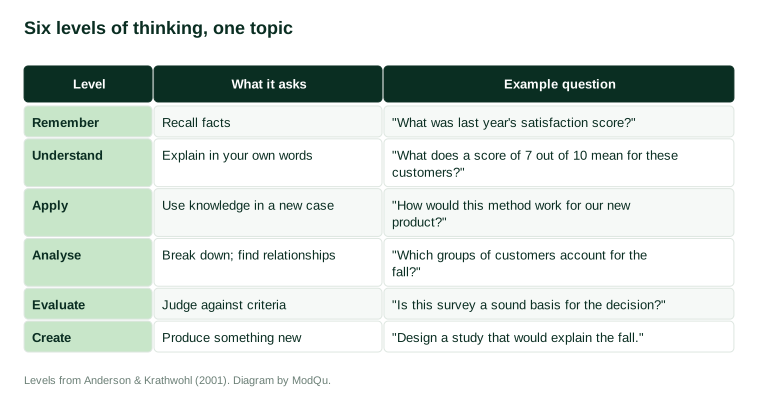
In 2001 a group led by Lorin Anderson and David Krathwohl published a revision (Anderson & Krathwohl, 2001). The revised version renamed the levels as verbs, describing what learners do: remember, understand, apply, analyse, evaluate and create. It swapped the top two levels, placing creating above evaluating. And it added a second dimension, the type of knowledge involved, distinguishing factual, conceptual, procedural and metacognitive knowledge (Krathwohl, 2002). Figure 1 sets out the six levels of the revised version with example questions.
Using the taxonomy to plan questions
The taxonomy is most useful as a check on the range of questions in a lesson, test, interview or research plan. Studies of classroom questioning have repeatedly found that most teachers' questions ask students to recall facts. Meredith Gall (1970), reviewing research going back to the early twentieth century, found that about 60% of teachers' questions required recall, around 20% were procedural and only about 20% required students to think. Graesser and Person (1994) found a similar imbalance in the questions students ask: most were shallow requests for facts, and deep questions about causes and consequences were rare.
The taxonomy makes this imbalance visible and suggests alternatives. A teacher who notices that every question in a lesson begins with "what is" or "name the" can add questions that ask students to explain, compare, judge or design. The same check works on a test or an assessment. If every item can be answered by recalling a fact, the test cannot show whether students understand or can use what they have learned, however difficult the facts are.
Do higher-level questions improve learning?
The research on this point is more mixed than the popularity of the taxonomy might suggest. Philip Winne (1979) reviewed experiments in which teachers were trained to ask more higher-level questions and found no consistent effect on student achievement. Redfield and Rousseau (1981), re-analysing similar studies with meta-analytic methods, found a positive effect of higher-level questions. Samson et al. (1987) found a small positive effect overall, and concluded that the effect was modest and varied across studies. A reasonable summary is that higher-level questions can help, but that simply asking more of them is not enough; they must be well chosen, and students need the knowledge to answer them.
That last point matters. Pooja Agarwal (2019) tested whether students needed to learn facts before they could answer higher-order questions, as the ladder interpretation of the taxonomy implies. She found that practice with higher-order questions improved performance on higher-order tests more than fact practice did, and that mixing both kinds of questions worked well. Fact knowledge was not a prerequisite that had to be completed first; but practice at the higher levels was needed to perform well at those levels.
Criticisms and cautions
Several cautions apply. First, the levels are not a strict hierarchy. Edward Furst (1981) pointed out that real thinking rarely moves neatly from one level to the next, and that the categories overlap. Evaluating an argument, for example, often requires understanding and analysis at the same time. Second, the level of a question depends on what the learner already knows. A question that requires analysis for a beginner may be simple recall for an expert who has seen the answer before. Third, the taxonomy says nothing about the quality of answers. Biggs and Collis (1982) proposed the SOLO taxonomy as a complement, classifying responses by how well they integrate relevant ideas rather than by the type of thinking the question demands.
Using it in research and work
The taxonomy is also a useful check outside the classroom. A research brief that contains only "what" and "how many" questions sits at the lower levels and will describe without explaining. Adding questions that ask why, how the findings compare with expectations and what should be done makes the brief more likely to produce insight. In interviews, moving from questions that ask people to recall events to questions that ask them to explain, compare and evaluate draws out richer accounts.
Conclusion
Bloom's taxonomy is best used as a reminder that questions differ in the thinking they demand, and that a good set of questions covers the full range. It is not a ladder, and higher questions are not automatically better. But a person who checks their questions against the taxonomy will rarely end up asking only for facts.
References
Agarwal, P. K. (2019). Retrieval practice & Bloom's taxonomy: Do students need fact knowledge before higher order learning? Journal of Educational Psychology, 111(2), 189–209. https://doi.org/10.1037/edu0000282
Anderson, L. W., & Krathwohl, D. R. (Eds.). (2001). A taxonomy for learning, teaching, and assessing: A revision of Bloom's taxonomy of educational objectives. Longman.
Biggs, J. B., & Collis, K. F. (1982). Evaluating the quality of learning: The SOLO taxonomy. Academic Press.
Bloom, B. S. (Ed.). (1956). Taxonomy of educational objectives: The classification of educational goals. Handbook I: Cognitive domain. Longmans, Green.
Furst, E. J. (1981). Bloom's taxonomy of educational objectives for the cognitive domain: Philosophical and educational issues. Review of Educational Research, 51(4), 441–453. https://doi.org/10.3102/00346543051004441
Gall, M. D. (1970). The use of questions in teaching. Review of Educational Research, 40(5), 707–721. https://doi.org/10.3102/00346543040005707
Graesser, A. C., & Person, N. K. (1994). Question asking during tutoring. American Educational Research Journal, 31(1), 104–137. https://doi.org/10.3102/00028312031001104
Krathwohl, D. R. (2002). A revision of Bloom's taxonomy: An overview. Theory Into Practice, 41(4), 212–218. https://doi.org/10.1207/s15430421tip4104_2
Redfield, D. L., & Rousseau, E. W. (1981). A meta-analysis of experimental research on teacher questioning behavior. Review of Educational Research, 51(2), 237–245. https://doi.org/10.3102/00346543051002237
Samson, G. E., Strykowski, B., Weinstein, T., & Walberg, H. J. (1987). The effects of teacher questioning levels on student achievement: A quantitative synthesis. The Journal of Educational Research, 80(5), 290–295. https://doi.org/10.1080/00220671.1987.10885769
Winne, P. H. (1979). Experiments relating teachers' use of higher cognitive questions to student achievement. Review of Educational Research, 49(1), 13–49. https://doi.org/10.3102/00346543049001013