
Share your experience of online learning
Tell us which online courses you have taken, whether you finished and what the certificate was worth. Your answers are combined with other people's and reported only as totals.
Start the online learning surveyAbout 5 minutes. No account needed. You can stop at any time.
What online learning includes
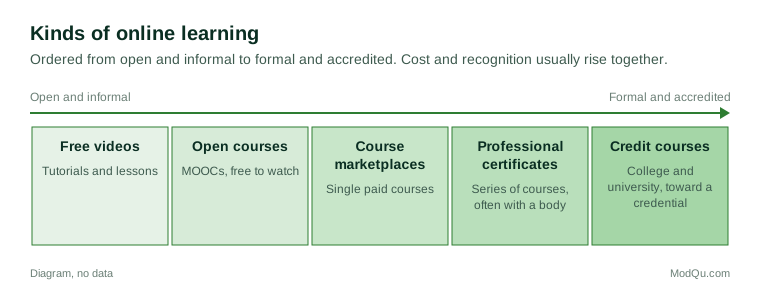
Online learning covers any course or program delivered mainly over the internet. It takes many forms:
- Free video tutorials and lessons on video sites and educational websites.
- Massive open online courses (MOOCs), open to anyone, often free to watch with a fee for a certificate. Many are created with universities.
- Online course marketplaces, where instructors sell individual courses on topics such as programming, design, business or crafts.
- Professional certificate programs, often a series of courses, sometimes created with companies or professional bodies.
- College and university courses and degrees delivered online or in a hybrid format, which carry academic credit.
- Employer training platforms, used by organizations to train staff.
- Language learning apps and other skill-building apps.
- Live online classes, such as tutoring, coding bootcamps and fitness or music lessons over video.
Online learning existed long before the COVID-19 pandemic, especially in distance education. The pandemic moved most schools and universities online for a time, which made online learning familiar to many more people.
Formats and how they work
Online courses differ in how they are delivered:
- Asynchronous courses let learners work through videos, readings and quizzes at their own pace, at any time.
- Synchronous courses meet live at set times over video, like a virtual classroom.
- Cohort-based courses group learners who start and finish together, often with deadlines, discussion and peer feedback.
- Self-paced courses have no set schedule.
- Hybrid or blended courses mix online and in-person learning.
Many courses use a learning management system (LMS), a platform that holds course materials, assignments, grades and discussion boards.
Why people learn online
People choose online learning for several reasons:
- Flexibility: fitting study around work, family and other commitments.
- Access: taking courses not available locally, especially in rural and remote areas.
- Cost: many courses are cheaper or free, and there are no travel or housing costs.
- Career goals: learning a new skill, earning a certificate, preparing for a promotion or a career change.
- Personal interest: hobbies, languages, history or science for their own sake.
- Pace: being able to go faster, slower, or repeat lessons.
Some people prefer online learning; others find it harder to stay motivated without classmates, teachers and set class times.
Example
A parent working full-time wants to move into bookkeeping. They cannot attend evening classes because of childcare, so they enrol in an online certificate program from a college. They study for an hour after the children are asleep and on weekend mornings, and complete the program in 14 months.
Completion and why courses go unfinished
Many people who start online courses do not finish them. Completion is especially low for free, open, self-paced courses, where anyone can sign up with a click. It tends to be higher in paid courses, cohort-based courses and programs that carry academic credit or lead to a credential the learner needs.
Some of the reasons are simple. Many people sign up out of curiosity, watch a few lessons, and get what they wanted, so "not finishing" is not always a failure. Others intend to finish but stop because of:
- lack of time, especially around work and family;
- loss of motivation without deadlines or classmates;
- content that is too hard, too easy or not what they expected;
- technical problems or poor internet;
- not seeing the value of the certificate.
Things that tend to help completion include deadlines, live sessions, feedback from instructors, study groups, and a clear goal such as a job requirement.
Example
A learner signs up for four free courses in one month: data analysis, photography, Spanish and history. They finish the data analysis course because they need it for a job application, watch half of the photography course, try two Spanish lessons, and never open the history course. Asked later, they say they got something useful from three of the four.
Costs and value for money
Online courses range from free to thousands of dollars. Common pricing models include:
- free courses, sometimes supported by advertising or by charging for certificates;
- pay per course;
- subscriptions giving access to many courses for a monthly or yearly fee;
- program fees for certificate programs and bootcamps;
- tuition for credit courses and degrees, often similar to in-person tuition.
Whether a course is good value depends on what the learner needs. A free course may be all that is needed to learn a spreadsheet skill. A recognized credential may be worth a higher price if it leads to a job.
Example (hypothetical figures)
A learner compares two ways to learn data analysis. A subscription costs $50 a month, and they expect to need six months, for $300, with a certificate of completion. A college online certificate costs $2,400 for four courses over eight months, with instructor feedback and academic credit. They choose the college program because employers in their area list it in job postings, which works out to $2,100 more for that recognition and support.
Certificates and what employers think
Online learners often hope a certificate will help their career. How much it helps varies:
- Academic credit and degrees from accredited institutions are generally recognized in the same way as in-person programs, although some employers still ask how a degree was earned.
- Professional certifications set by industry bodies are often well recognized in their field.
- Certificates of completion from open courses show initiative and specific learning, but on their own may carry less weight with some employers than experience or recognized credentials.
- Portfolios and projects built during a course often matter more than the certificate itself, especially in fields such as design, programming and writing.
Questions that businesses and schools want answered here include which platforms people use, what they are willing to pay, and how much learners and employers value online certificates.
Quality, trust and what people disagree about
Quality varies widely. Some courses are designed by experienced teachers and instructional designers; others are made quickly and contain errors. Learners often rely on reviews, the reputation of the institution or instructor, and free previews.
There are open debates. Is online learning as effective as in-person learning, and for whom? Do online courses widen access, or do they mainly serve people who are already well educated? How should schools prevent cheating in online exams without invading privacy? And how should employers judge short online credentials compared with degrees?
People with poor internet access, older devices, or less experience using technology can find online learning harder, so access to devices and broadband, especially in rural, remote and northern communities in Canada, is part of the discussion.
Key terms
- MOOCA massive open online course, open to anyone and often free to watch.
- Asynchronous learningLearning at one's own pace without live sessions.
- Synchronous learningLearning in live sessions at set times.
- Cohort-based courseA course in which a group of learners start and finish together.
- Learning management systemA platform that holds course materials, assignments and grades.
- Certificate of completionA document showing that a learner finished a course.
- AccreditationOfficial recognition that an institution or program meets quality standards.
- BootcampA short, intensive training program, often in technology skills.
Full glossary: online learning platforms terms on EditingTests.com.
Online learning vocabulary test
How well do you know the language of this topic? Try 8 quick questions. Your score is shown straight away and is not saved.
What the online learning survey asks
This survey is part of ModQu's Education and Learning survey. The online learning part takes about five minutes and covers:
- Which kinds of online courses and platforms you have used.
- Why you took your most recent online course.
- Whether you finished it, and if not, why not.
- What you paid, and whether it was good value.
- Whether you earned a certificate, and whether an employer would value it.
- How online learning compares with in-person learning for you.
After that you can choose to continue with other short parts of the Education and Learning survey, such as choosing a college or university or parents and schools, or stop.
Ready to take part?
Your answers help show what people really think and do. Results are only ever reported as totals; no one can see your individual answers.
Start the surveyQuestions about this survey
Who can take part?
Adults who took an online course.
Do I have to give my name?
No. You may be asked for your age group, region and similar details so results can be broken down, but not your name. ModQu never asks for passwords, card numbers or account numbers.
How are the results used?
Answers are combined into totals and percentages and published in ModQu reports. Individual answers are never shown.
Is the vocabulary test part of the survey?
No. It is optional and separate, and your score is not stored.
Do free videos count as online learning?
Yes. The survey covers everything from free tutorials to full online degrees.