
Surveys · Types and applications
Diary Studies and Experience Sampling Methods
Diary studies and experience sampling ask people to report on their activities, feelings and behaviour at or near the moment they occur, rather than recalling them later. This article explains the main designs, why real-time reports can be more accurate, the problems of burden and compliance, and how such data are analysed.
Most surveys ask people to look back. How many times did you visit a doctor last year? How satisfied have you been with your job over the past month? How stressed do you generally feel? Answering such questions requires people to remember, summarise and judge their experiences, and each of these steps introduces error. Diary studies and experience sampling take a different approach. They ask people to report what they are doing, feeling or experiencing at the time, or soon after, often many times over days or weeks. The aim, in a well-known phrase, is to capture "life as it is lived" (Bolger et al., 2003).
These methods are used in market research, time use statistics, psychology, health research and the study of work. This article explains how they work, what they offer and what they demand of participants and researchers.
Kinds of diary and experience sampling design
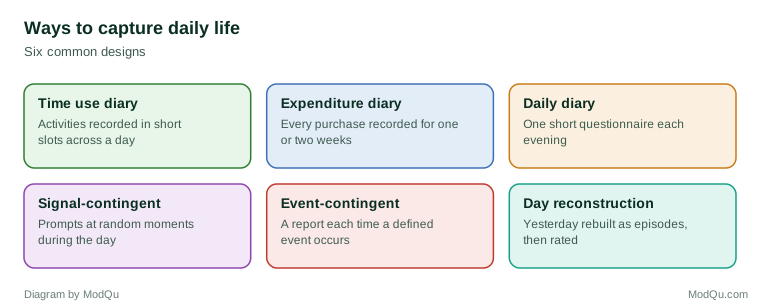
Figure 1 summarises the main designs.
Time use and expenditure diaries
Official statistics have used diaries for decades. Time use diaries ask people to record what they were doing in each period of a day, often in ten-minute slots, along with where they were and who they were with. They show how time is divided between paid work, unpaid housework and care, travel, leisure and sleep, and how these patterns change over time (Gershuny, 2000). Juster et al. (2003) found that diaries gave more accurate estimates of time use than questions asking people to estimate how much time they usually spend on each activity.
Expenditure diaries ask households to record every purchase over a period, usually one or two weeks. They provide detailed information on spending that respondents could not recall from memory, and are used to set the weights of consumer price indices. Sudman and Ferber (1971) showed that the design of such diaries, including how long they are kept and how often interviewers visit, affects how completely purchases are recorded.
Daily diaries
Daily diary studies ask people to complete a short questionnaire once a day, typically in the evening, for one or several weeks. They are widely used in psychology and organisational research to study how daily events, such as conflicts or workload, relate to mood, sleep and behaviour on the same and following days (Bolger & Laurenceau, 2013). Sonnentag (2003), for example, used daily surveys to show that employees who recovered well from work in the evening were more engaged and proactive the next day.
Experience sampling and ecological momentary assessment
The experience sampling method asks participants to report their experience at random moments during the day. Originally, participants carried pagers that signalled them several times a day to complete a short paper questionnaire about what they were doing and how they felt (Larson & Csikszentmihalyi, 1983; Csikszentmihalyi & Larson, 1987; Hektner et al., 2007). In health research, a similar approach was developed under the name ecological momentary assessment (Stone & Shiffman, 1994; Shiffman et al., 2008). Today both are usually carried out with smartphone apps.
Experience sampling designs differ in what triggers a report:
- Signal-contingent designs prompt participants at random or fixed times.
- Interval-contingent designs ask for reports at regular intervals, such as every three hours.
- Event-contingent designs ask participants to report whenever a particular event occurs, such as smoking a cigarette, having a social interaction or experiencing a headache.
The day reconstruction method
Experience sampling is demanding, because it interrupts people's daily lives. Kahneman et al. (2004) developed the day reconstruction method as a less intrusive alternative. Participants first reconstruct the previous day as a series of episodes, like scenes in a film, and then answer questions about each episode, such as what they were doing, who they were with and how they felt. Because the reports are made the next day and anchored to specific episodes, they are thought to be close to real-time reports while requiring only one session.
Why real-time reports matter
Memory and summarising
Retrospective questions require people to retrieve relevant experiences from memory and summarise them. Both steps are fallible. People forget minor events, place events in the wrong period and fill gaps with what usually happens. When asked how they generally feel, people rely partly on beliefs about themselves rather than on remembered experiences, and the longer the period, the more they rely on such beliefs (Robinson & Clore, 2002). Schwarz (2012) set out the cognitive reasons why reports made close to the experience differ from global, retrospective judgements.
The peak and the end
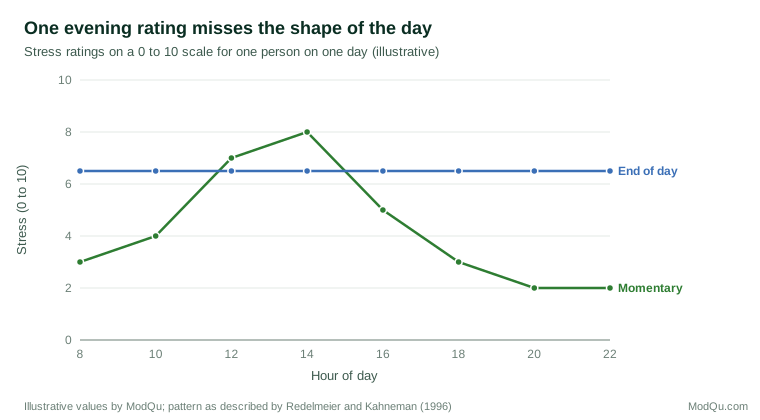
Summaries of past experiences are not simple averages. Redelmeier and Kahneman (1996) asked patients undergoing medical procedures to rate their pain every minute and, afterwards, to rate the procedure overall. The overall ratings depended mainly on the worst moment and on the final moments, not on the duration or the average. A longer procedure with a less painful ending was remembered as less unpleasant than a shorter one that ended at a painful moment. This peak-end pattern means that retrospective reports can give a distorted picture of what people actually experienced. Figure 2 illustrates how a single end-of-day rating can differ from moment-by-moment reports.
Variation within people
Real-time methods also reveal how much experience varies within the same person. Mood, stress, engagement and pain change from hour to hour and day to day, and a single measurement captures only one point in that variation. Studies of employees have found that a large share of the variation in engagement occurs within people from week to week, rather than between people (Bakker & Bal, 2010). Experience sampling makes it possible to study what drives these fluctuations: which activities, places and companions are associated with better or worse moments. In a large smartphone study, Killingsworth and Gilbert (2010) found that people's minds wandered from what they were doing in nearly half of the sampled moments, and that they were less happy when their minds wandered.
Context
Because reports are made in daily life, they capture experience in its natural setting rather than in a laboratory or interview. This increases the ecological validity of the findings, the extent to which they reflect real life (Trull & Ebner-Priemer, 2013).
Problems and limitations
Burden and compliance
Diary and experience sampling studies are demanding. Participants may be asked to respond several times a day for one or two weeks, which interrupts work, family life and sleep. Not everyone agrees to take part, and those who do may miss some prompts. A meta-analysis of studies across many research fields found average compliance of about 80 per cent of prompts, lower in studies with more prompts per day and in some populations (Wrzus & Neubauer, 2023). In studies of substance users, compliance was lower among people who used drugs more heavily, which can bias results if the missed moments differ from the reported ones (Jones et al., 2019).
Paper diaries create a particular problem: participants may fill them in later, all at once, instead of at the required times. Stone et al. (2002) gave patients paper diaries in a binder with a hidden electronic sensor that recorded when it was opened. Although patients reported 90 per cent compliance, the sensor showed that actual compliance was only 11 per cent, and many entries were filled in on days when the diary had not been opened. Electronic diaries, which record the time of each entry and do not allow late entries, largely solve this problem.
Reactivity
Recording one's behaviour or feelings repeatedly can change them. Participants asked to record every cigarette may smoke less; those asked to rate their mood several times a day may become more aware of it. This measurement reactivity is a concern, although studies suggest that its effects are usually modest (Barta et al., 2012).
Selection
People who agree to keep a diary for two weeks may differ from those who do not, for example in being more organised or more interested in the topic. Burden also falls unevenly: people with demanding jobs or caring responsibilities may find it hardest to respond, and their experiences may be under-represented.
Combining reports with sensors
Smartphones and wearable devices can record information passively, without asking participants anything. Location, movement, heart rate, sleep, phone use and the level of surrounding noise can all be measured continuously. Combining these passive measures with short self-reports gives a richer picture than either alone: the sensor shows where a person was and how active they were, while the report shows how they felt and what they were doing (Trull & Ebner-Priemer, 2013). Sensors can also trigger prompts, for example asking a participant how they feel when the phone detects that they have arrived home or that their heart rate has risen without physical activity.
Passive data bring their own difficulties. Sensors differ in accuracy between devices, batteries run out, and participants may leave phones behind or switch off location tracking. Most importantly, passive data describe behaviour but not its meaning or the experience that goes with it, so self-reports remain essential.
Ethics and privacy
Diary and experience sampling studies enter deeply into people's daily lives. Participants report their feelings, activities, companions and sometimes their locations many times a day, and sensors may record far more. Researchers must explain clearly what will be collected, how often and for how long, and how the data will be stored and protected. Participants should be able to pause or stop the study at any time, and to skip any prompt. Location data and recordings of other people, such as audio, require particular care, because they can identify people who never agreed to take part. Studies of mental health should have a plan for responding if a participant reports thoughts of self-harm.
Diaries in official statistics today
Statistical offices continue to rely on diaries, but they face the same pressures as other surveys. Completing a paper time use diary for one or two days, or an expenditure diary for two weeks, is a heavy task, and response rates have fallen. Many offices have therefore moved diaries to web and smartphone apps, which can suggest activities, remind participants to record purchases and allow photographs of receipts. Some expenditure surveys now ask participants to share data from their bank or loyalty cards instead of recording every purchase by hand. These changes reduce burden and may improve completeness, but they must be tested carefully so that new and old results can be compared.
Designing a study
Good practice includes (Mehl & Conner, 2012; Myin-Germeys et al., 2018):
- Keep each report short, ideally under two minutes, with simple response formats suited to a phone screen.
- Choose the number of prompts carefully, balancing the detail captured against burden. Four to eight prompts a day for one to two weeks is common in experience sampling.
- Use electronic devices that record the time of each report and limit how long after a prompt a report can be made.
- Avoid prompts at sensitive times, such as during sleep, and let participants set their waking hours.
- Pilot the protocol with people from the target population.
- Provide incentives linked to the number of reports completed, while avoiding incentives so strong that participants complete reports carelessly.
- Monitor compliance during the study and contact participants who stop responding.
Analysing intensive longitudinal data
Diary and experience sampling studies produce intensive longitudinal data: many repeated measurements nested within each person. Standard methods that assume independent observations are not appropriate. Multilevel models separate variation within people over time from variation between people, and allow researchers to ask, for example, whether a person feels more stressed at moments when their workload is higher than usual for them, as distinct from whether people with higher average workloads are more stressed (Bolger & Laurenceau, 2013).
Time-series and dynamic models go further, examining how one moment's state predicts the next. Hamaker and Wichers (2017) argued that such methods can reveal individual patterns of change, such as how quickly a person's mood recovers after a negative event, that are invisible in data collected less frequently. These patterns are of particular interest in mental health research, where the dynamics of emotion may signal risk of illness (Myin-Germeys et al., 2018).
Uses in market and applied research
Diary methods are widely used outside academic research. Market researchers ask consumers to keep diaries of media use, purchases or product use, sometimes with photographs or short videos. Mobile diaries capture how people use products in daily life, which they may not remember in an interview. Employers use short daily or weekly check-ins to understand how workload and wellbeing vary. Health services use symptom diaries to monitor chronic conditions between appointments.
An example
A research team wants to understand stress among nurses. Instead of asking nurses how stressed they usually feel, it gives 120 nurses a smartphone app that prompts them five times during each shift for two weeks, asking how stressed they feel, what they are doing and whether they have had a break. Compliance averages 76 per cent of prompts. A standard questionnaire at the start suggests that stress is similar on all wards. The momentary data show that stress rises sharply in the hour before shift handover and on shifts without a break, and that nurses who had a break of at least 20 minutes reported lower stress for the rest of the shift. The hospital adjusts break scheduling around handover (illustrative example).
Conclusion
Diary and experience sampling methods bring survey measurement close to the moment of experience. They reduce the errors of memory and summarising, reveal how experience varies within people and capture life in its natural context. They demand much from participants and need careful design, electronic data collection and appropriate analysis. Used well, they answer questions about everyday life that retrospective surveys cannot.
References
Bakker, A. B., & Bal, P. M. (2010). Weekly work engagement and performance: A study among starting teachers. Journal of Occupational and Organizational Psychology, 83(1), 189–206. https://doi.org/10.1348/096317909X402596
Barta, W. D., Tennen, H., & Litt, M. D. (2012). Measurement reactivity in diary research. In M. R. Mehl & T. S. Conner (Eds.), Handbook of research methods for studying daily life (pp. 108–123). Guilford Press.
Bolger, N., & Laurenceau, J.-P. (2013). Intensive longitudinal methods: An introduction to diary and experience sampling research. Guilford Press.
Bolger, N., Davis, A., & Rafaeli, E. (2003). Diary methods: Capturing life as it is lived. Annual Review of Psychology, 54, 579–616. https://doi.org/10.1146/annurev.psych.54.101601.145030
Csikszentmihalyi, M., & Larson, R. (1987). Validity and reliability of the experience-sampling method. Journal of Nervous and Mental Disease, 175(9), 526–536. https://doi.org/10.1097/00005053-198709000-00004
Gershuny, J. (2000). Changing times: Work and leisure in postindustrial society. Oxford University Press.
Hamaker, E. L., & Wichers, M. (2017). No time like the present: Discovering the hidden dynamics in intensive longitudinal data. Current Directions in Psychological Science, 26(1), 10–15. https://doi.org/10.1177/0963721416666518
Hektner, J. M., Schmidt, J. A., & Csikszentmihalyi, M. (2007). Experience sampling method: Measuring the quality of everyday life. SAGE. https://doi.org/10.4135/9781412984201
Jones, A., Remmerswaal, D., Verveer, I., Robinson, E., Franken, I. H. A., Wen, C. K. F., & Field, M. (2019). Compliance with ecological momentary assessment protocols in substance users: A meta-analysis. Addiction, 114(4), 609–619. https://doi.org/10.1111/add.14503
Juster, F. T., Ono, H., & Stafford, F. P. (2003). An assessment of alternative measures of time use. Sociological Methodology, 33(1), 19–54. https://doi.org/10.1111/j.0081-1750.2003.t01-1-00126.x
Kahneman, D., Krueger, A. B., Schkade, D. A., Schwarz, N., & Stone, A. A. (2004). A survey method for characterizing daily life experience: The day reconstruction method. Science, 306(5702), 1776–1780. https://doi.org/10.1126/science.1103572
Killingsworth, M. A., & Gilbert, D. T. (2010). A wandering mind is an unhappy mind. Science, 330(6006), 932. https://doi.org/10.1126/science.1192439
Larson, R., & Csikszentmihalyi, M. (1983). The experience sampling method. New Directions for Methodology of Social and Behavioral Science, 15, 41–56.
Mehl, M. R., & Conner, T. S. (Eds.). (2012). Handbook of research methods for studying daily life. Guilford Press.
Myin-Germeys, I., Kasanova, Z., Vaessen, T., Vachon, H., Kirtley, O., Viechtbauer, W., & Reininghaus, U. (2018). Experience sampling methodology in mental health research: New insights and technical developments. World Psychiatry, 17(2), 123–132. https://doi.org/10.1002/wps.20513
Redelmeier, D. A., & Kahneman, D. (1996). Patients' memories of painful medical treatments: Real-time and retrospective evaluations of two minimally invasive procedures. Pain, 66(1), 3–8. https://doi.org/10.1016/0304-3959(96)02994-6
Robinson, M. D., & Clore, G. L. (2002). Belief and feeling: Evidence for an accessibility model of emotional self-report. Psychological Bulletin, 128(6), 934–960. https://doi.org/10.1037/0033-2909.128.6.934
Schwarz, N. (2012). Why researchers should think "real-time": A cognitive rationale. In M. R. Mehl & T. S. Conner (Eds.), Handbook of research methods for studying daily life (pp. 22–42). Guilford Press.
Shiffman, S., Stone, A. A., & Hufford, M. R. (2008). Ecological momentary assessment. Annual Review of Clinical Psychology, 4, 1–32. https://doi.org/10.1146/annurev.clinpsy.3.022806.091415
Sonnentag, S. (2003). Recovery, work engagement, and proactive behavior: A new look at the interface between nonwork and work. Journal of Applied Psychology, 88(3), 518–528. https://doi.org/10.1037/0021-9010.88.3.518
Stone, A. A., & Shiffman, S. (1994). Ecological momentary assessment (EMA) in behavioral medicine. Annals of Behavioral Medicine, 16(3), 199–202. https://doi.org/10.1093/abm/16.3.199
Stone, A. A., Shiffman, S., Schwartz, J. E., Broderick, J. E., & Hufford, M. R. (2002). Patient non-compliance with paper diaries. BMJ, 324(7347), 1193–1194. https://doi.org/10.1136/bmj.324.7347.1193
Sudman, S., & Ferber, R. (1971). Experiments in obtaining consumer expenditures by diary methods. Journal of the American Statistical Association, 66(336), 725–735. https://doi.org/10.1080/01621459.1971.10482336
Trull, T. J., & Ebner-Priemer, U. (2013). Ambulatory assessment. Annual Review of Clinical Psychology, 9, 151–176. https://doi.org/10.1146/annurev-clinpsy-050212-185510
Wrzus, C., & Neubauer, A. B. (2023). Ecological momentary assessment: A meta-analysis on designs, samples, and compliance across research fields. Assessment, 30(3), 825–846. https://doi.org/10.1177/10731911211067538