
Share your experience of preschool
Tell us whether your child attends preschool, how you chose it and what it costs. Your answers are combined with other people's and reported only as totals.
Start the early childhood education surveyAbout 5 minutes. No account needed. You can stop at any time.
What early childhood education is
Early childhood education (ECE) refers to organized learning and care for children from birth to the start of primary school, usually around age five to seven depending on the country. It is often grouped with childcare under the term early childhood education and care (ECEC).
Names for settings differ between countries and can be confusing. "Kindergarten" means the first year of primary school in some places and a preschool for three- to six-year-olds in others. Other common names include nursery, preschool, pre-primary, playgroup, crèche and day care. The UNESCO international classification of education calls this stage ISCED level 0.
Main kinds of settings
Families use several kinds of early education and care:
- Public preschools or pre-primary classes, often attached to a primary school and free or low-cost.
- Private nurseries and preschools, run as businesses or charities.
- Community and religious preschools, run by local groups or faith organizations.
- Day care centres offering full-day care with learning activities, often for working parents.
- Home-based childminders who look after small groups of children in their own home.
- Playgroups, often run by parents, for a few hours a week.
- Informal care by grandparents, relatives or neighbours.
Many children use a mix, such as a morning preschool and afternoon care by a grandparent.
Example
A family with a three-year-old uses a free public pre-primary class from 8 a.m. to noon. Because both parents work, a neighbour who is a registered childminder collects the child at noon and looks after them until 5 p.m. The family pays only for the childminder.
How parents choose
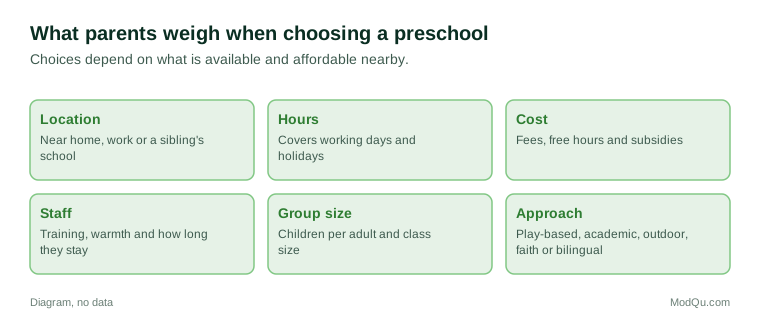
Parents' choices depend on what is available and affordable, but they commonly consider:
- Location: near home, work or an older sibling's school.
- Hours: whether the setting covers working hours and holidays.
- Cost and any public funding or subsidies.
- Staff: qualifications, warmth and how long staff stay.
- Group size and adult-to-child ratios.
- Approach: play-based, academic, outdoor, religious, bilingual or a named method such as Montessori.
- Reputation: inspection reports, recommendations from other parents and visits.
- Waiting lists: in many cities, popular places fill long in advance.
Costs and public support
The cost of early education varies more than almost any other part of education. Some countries offer free places for all children from age three or earlier. Others provide a set number of free hours a week, means-tested subsidies, tax credits or vouchers. In some places, families pay the full cost of private settings, which can be a large share of household income.
Example (hypothetical figures)
A parent's city offers 15 free hours a week for children aged three and over. Their child attends 40 hours a week at a private nursery that charges 6 an hour, in local currency. The family pays for 25 hours a week, which is 150 a week, or about 650 a month.
Cost affects whether parents, especially mothers, can return to work, and how many hours they work. It is also a factor in family size decisions.
Quality and what children learn
Good early education is usually play-based. Children learn through games, stories, songs, building, drawing, outdoor play and talking with adults and each other. Common goals include language and early literacy, early mathematics, social skills, self-control, physical development and curiosity.
Quality is commonly judged on:
- trained, stable and well-supported staff;
- small groups and enough adults per child;
- warm, responsive relationships;
- safe, clean and stimulating spaces;
- links with families;
- a plan for learning that suits the child's age.
Many countries have inspections, licensing rules and minimum ratios. Research, including long-running studies that followed children into adulthood, has linked high-quality early education with later benefits, especially for children from disadvantaged backgrounds. Low-quality care shows much weaker benefits.
Example
Parents visit two nurseries. One has new toys and a large building but staff change often. The other is older and smaller but the same three staff have worked there for years and greet each child by name. The parents choose the second, saying the staff mattered most.
Staffing
Early childhood staff often earn less than school teachers, even when they have similar qualifications. Low pay and demanding work lead to high staff turnover in many countries, which parents notice and which affects quality. Governments trying to expand free places often face shortages of trained staff.
What people disagree about
People disagree on the best age to start, whether early years should focus on play or on formal reading and numbers, how much governments should fund, and whether care by family at home is as good as or better than group settings. Some parents value a structured academic start; others want children to have time to play before formal school.
Questions that schools, nurseries, local authorities and education firms want answered include whether children attend preschool, how parents chose, what it costs and how satisfied they are with quality.
Moving from preschool to school
The move from early education to primary school is a big step for children and parents. Children may move from a small group with lots of play to a larger class with more structure. Many preschools and schools work together to prepare children, with visits, shared information and gradual starts. Parents often worry about whether their child is ready, especially if the child is young for their year group. Some countries allow parents to delay school entry by a year; others do not.
The age at which children start school also varies. In many countries children begin formal schooling at five or six, while in some Nordic countries they begin at seven, with longer time in play-based early education first.
Key terms
- Early childhood educationOrganized learning and care for children before primary school.
- ECECEarly childhood education and care.
- KindergartenA word for preschool in some countries and the first school year in others.
- ChildminderA person who looks after a small group of children in their own home.
- Adult-to-child ratioThe number of children for each adult in a setting.
- Play-based learningLearning through play, guided by adults.
- SubsidyPublic money that reduces the price a family pays.
- Waiting listA list of children waiting for a place in a setting.
Full glossary: early childhood education terms on EditingTests.com.
Early childhood education vocabulary test
How well do you know the language of this topic? Try 8 quick questions. Your score is shown straight away and is not saved.
What the early childhood education survey asks
This survey is part of ModQu's Education and Learning survey. The early childhood education part takes about five minutes and covers:
- Whether your child attends preschool, nursery, day care or another setting.
- How many hours a week, and who else helps with care.
- How you chose the setting and what mattered most.
- How much it costs each month and whether you receive public support.
- How satisfied you are with quality, staff and hours.
- Whether cost or availability affected your work.
After that you can choose to continue with other short parts of the Education and Learning survey, such as choosing a college or university or online learning, or stop.
Ready to take part?
Your answers help show what people really think and do. Results are only ever reported as totals; no one can see your individual answers.
Start the surveyQuestions about this survey
Who can take part?
Parents of children under six.
Do I have to give my name?
No. You may be asked for your age group, region and similar details so results can be broken down, but not your name. ModQu never asks for passwords, card numbers or account numbers.
How are the results used?
Answers are combined into totals and percentages and published in ModQu reports. Individual answers are never shown.
Is the vocabulary test part of the survey?
No. It is optional and separate, and your score is not stored.
Does care by grandparents count?
Yes. The survey asks about all the care and early learning your child receives, including care by relatives.
Can I answer for more than one child?
Yes. Questions ask about each child under six or about your household as a whole.
Is this survey about childcare too?
Yes. Early education and childcare overlap, and the survey covers both.