
Share your experience of vocational training
Tell us whether you have taken a vocational or technical course and whether it helped you find work. Your answers are combined with other people's and reported only as totals.
Start the vocational and technical training surveyAbout 5 minutes. No account needed. You can stop at any time.
What vocational and technical training is
Vocational education and training (often shortened to VET, or TVET for technical and vocational education and training) prepares people for specific jobs or groups of jobs. It focuses on practical skills and the knowledge needed to apply them, often with time spent in a real workplace.
Common fields include:
- construction trades: electrician, plumber, carpenter, bricklayer, welder;
- automotive and mechanical: vehicle mechanic, machinist, maintenance technician;
- health and care: care worker, nursing assistant, dental assistant, pharmacy technician;
- hospitality: chef, baker, hotel operations;
- beauty and personal services: hairdressing, beauty therapy;
- technology: IT support, network technician, programming;
- agriculture: farm management, horticulture, veterinary assistance;
- business: bookkeeping, office administration, logistics.
Main routes
People enter vocational training in several ways, and systems differ greatly between countries:
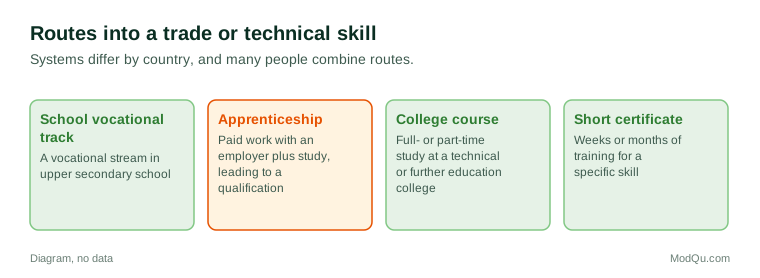
- School-based vocational tracks: in many countries, students choose a vocational stream in upper secondary school.
- Apprenticeships: paid work with an employer combined with classroom study, leading to a recognized qualification. Germany, Switzerland and Austria are well known for "dual" systems that combine workplace and school learning.
- Technical and further education colleges offering full- or part-time courses.
- Short courses and certificates from training providers, employers or industry bodies.
- On-the-job training without a formal qualification.
- Informal apprenticeships, common in parts of Africa and Asia, where young people learn a trade from a master craftsperson, often under a traditional agreement rather than a formal contract.
Example
A 17-year-old leaves general secondary school to start a three-year apprenticeship with an electrical contractor. They work four days a week on building sites and spend one day at a college. They earn a training wage that rises each year, and at the end they sit a practical and written exam to qualify.
Costs and funding
How training is paid for depends on the route and the country:
- Apprenticeships are usually paid jobs, so apprentices earn while they learn, though often at a lower training wage.
- Public vocational schools and colleges may be free or low-cost for young people.
- Adults often pay fees for college courses or private training, sometimes with loans, grants or employer support.
- Some countries fund training through levies on employers or through individual training accounts.
- Tools, equipment, uniforms and exam fees can add to costs.
Example (hypothetical figures)
An adult retraining as a welder pays 2,400 in local currency for a six-month college course, plus 300 for safety gear and 150 for a certification exam, a total of 2,850. A public grant covers 1,500, so they pay 1,350 themselves. They work part-time in a shop during the course.
From training to work
The link between training and work is one of the main reasons people choose vocational routes. Apprenticeships and work placements often lead directly to a job with the same employer. In regulated trades such as electrical work and plumbing, a recognized qualification may be legally required to work independently.
Many skilled trades report shortages of workers in many countries, and qualified tradespeople can often find work or start their own businesses. At the same time, some short courses do not lead to jobs, especially if they are not recognized by employers or are in fields with few openings. Checking whether a qualification is recognized, and by whom, is an important step.
Example
A school leaver completes a short online course in computer repair but finds that local employers ask for an industry certificate and some experience. They take a part-time unpaid placement at a repair shop for three months, which leads to a paid junior role.
How vocational training is viewed
The standing of vocational training differs between countries and families. Where it is closely linked to employers and leads to well-paid work, it is often seen as a respected choice. Elsewhere, it is sometimes seen as a second-best option for students who do not go to university. These views can affect which route young people choose, even when vocational careers offer good pay and job security.
Other common concerns include:
- training that is out of date with industry needs;
- a shortage of apprenticeship places;
- gender imbalances, with some trades mostly male and some care roles mostly female;
- difficulty getting qualifications recognized in another country;
- low training wages that make apprenticeships hard for adults with families.
What people disagree about
People disagree about whether young people are pushed too strongly toward university, how much employers should pay for training, whether vocational and academic routes should be combined, and how quickly training systems should change to match new technology. There is also debate about whether informal apprenticeships should be brought into formal systems.
Questions that colleges, training providers, employers and governments want answered include who takes vocational courses, which trades they choose, how they pay, and whether the training helped them find work.
Adults and retraining
Vocational training is not only for school leavers. Many adults take technical courses to change career, to update skills as technology changes, or to gain a formal qualification for work they already do. Part-time evening and weekend courses, online theory with in-person practical sessions, and recognition of prior learning help adults fit training around work and family. Adults often face different barriers from young people: they cannot easily live on an apprentice wage, and some employers prefer younger apprentices. Some countries offer adult apprenticeships, grants or paid training leave to address this.
Example
A 40-year-old who has worked for years as an unqualified kitchen assistant enrols in a part-time chef's certificate. Because of their experience, the college credits some practical modules, and they finish in one year instead of two.
Key terms
- Vocational trainingEducation for a particular trade or occupation.
- TVETTechnical and vocational education and training.
- ApprenticeshipPaid work combined with study, leading to a recognized qualification.
- Dual systemTraining that combines learning in a workplace and in a school.
- JourneypersonA qualified tradesperson who has completed an apprenticeship.
- Work placementA period of training or experience in a real workplace.
- CertificationFormal proof that a person has met a skill standard.
- Training levyA charge on employers used to fund training.
Full glossary: career technical education terms on EditingTests.com.
Vocational and technical training vocabulary test
How well do you know the language of this topic? Try 8 quick questions. Your score is shown straight away and is not saved.
What the vocational and technical training survey asks
This survey is part of ModQu's Education and Learning survey. The vocational and technical training part takes about five minutes and covers:
- Whether you have taken a vocational or technical course or apprenticeship.
- Which trade or skill it was for, and how long it took.
- How you paid for it, and whether you earned while training.
- Whether it helped you find work, and how quickly.
- How you think vocational training is viewed where you live.
- What would make vocational training more attractive.
After that you can choose to continue with other short parts of the Education and Learning survey, such as choosing a college or university or online learning, or stop.
Ready to take part?
Your answers help show what people really think and do. Results are only ever reported as totals; no one can see your individual answers.
Start the surveyQuestions about this survey
Who can take part?
Adults and young people.
Do I have to give my name?
No. You may be asked for your age group, region and similar details so results can be broken down, but not your name. ModQu never asks for passwords, card numbers or account numbers.
How are the results used?
Answers are combined into totals and percentages and published in ModQu reports. Individual answers are never shown.
Is the vocabulary test part of the survey?
No. It is optional and separate, and your score is not stored.
Do short online courses count?
Yes. The survey asks about all kinds of vocational and technical training, from short certificates to full apprenticeships.
Can I answer if I am still training?
Yes. You can answer about your course so far and your plans.
Is vocational training only for young people?
No. Many adults train or retrain in a trade, and the survey includes people of all ages.