
The Generation of Knowledge · Knowledge production
The Triple Helix: Universities, Industry and Government
The triple helix model of innovation, in which universities, industry and government interact and take on parts of each other's roles, its later extensions, its criticisms, and what it suggests about how useful knowledge is produced.
Where does useful new knowledge come from? For much of the twentieth century, the standard answer was a chain: universities did basic research, companies turned it into products, and governments paid for the research and regulated the market. In the 1990s Henry Etzkowitz and Loet Leydesdorff proposed a different picture. They argued that innovation increasingly comes from the interaction of three institutional spheres, universities, industry and government, which they called the triple helix (Etzkowitz & Leydesdorff, 2000).
Three spheres that overlap
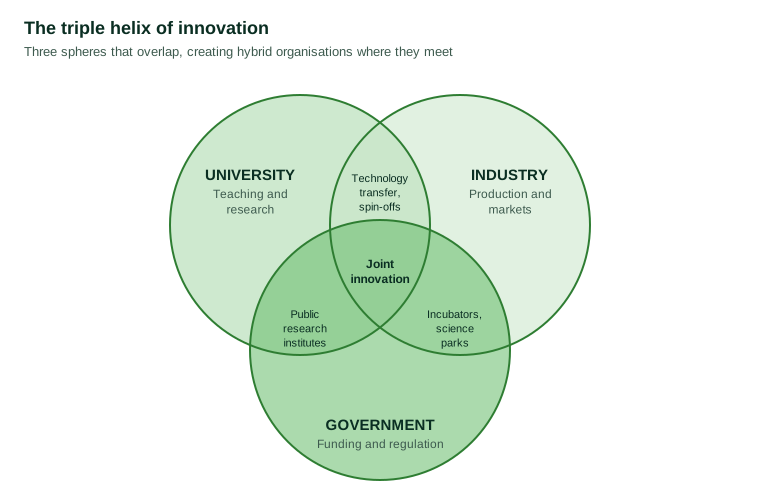
The model's central claim is that the three spheres no longer keep to separate roles. Each also takes on some of the roles of the others. Universities patent inventions, license technology and create spin-off companies, behaving partly like firms. Companies conduct research, train staff to advanced levels and collaborate with academics, behaving partly like universities. Governments act as venture capitalists and brokers, funding start-ups and building science parks and research partnerships.
Etzkowitz and Leydesdorff (2000) contrasted this with two earlier arrangements. In a statist model, government directs both universities and industry. In a laissez-faire model, the three spheres are kept apart, with strong boundaries between them. The triple helix lies between these: the spheres remain distinct, but they overlap and create hybrid organisations, such as technology transfer offices, research consortia and incubators, at their intersections.
Why interaction produces knowledge
The model also says something about how knowledge moves. In the linear model, knowledge travels in one direction, from the laboratory to the market. In the triple helix, it travels in several directions at once. Problems found in industry suggest new research questions to academics; government programmes bring researchers and companies together around shared goals; graduates and staff who move between sectors carry skills and experience that are hard to write down. Etzkowitz and Leydesdorff (2000) stressed that these interactions are continually reorganised, so that the system is always in transition rather than settling into a fixed form. Innovation, on this view, depends less on any one institution than on the quality of the links between them.
The entrepreneurial university
The model gives universities a larger role than earlier accounts did. Etzkowitz (2008) described the entrepreneurial university as one that adds economic and social development to its traditional missions of teaching and research. Policy encouraged this shift. In the United States, the Bayh–Dole Act of 1980 allowed universities to own patents arising from federally funded research. Mowery et al. (2001) found that university patenting and licensing grew rapidly in the following years, although they argued that the Act was only one of several causes, alongside the growth of biomedical research and changes in patent policy.
Extensions and criticisms
Later writers extended the model. Carayannis and Campbell (2009) proposed a quadruple helix that adds civil society and the media-based public as a fourth sphere, recognising that users, citizens and public debate also shape innovation. Ranga and Etzkowitz (2013) restated the triple helix as a system of components, relationships and functions, to make it easier to use for analysing regional and national innovation policy.
Critics have questioned whether the model explains much. Shinn (2002) argued that it was more a policy slogan than a tested theory: it describes interaction between sectors in very general terms that are hard to test. Others have worried that the entrepreneurial university may weaken academic freedom and open publication, as commercial interests influence which questions are studied and when results are released.
Lessons for applied research
The triple helix is a reminder that useful knowledge is rarely produced by one kind of organisation working alone. For research organisations, four lessons follow. First, partnerships across sectors can combine the methods of academic research with the questions and data of business and government. Second, such partnerships need clear agreements on ownership, confidentiality and publication from the start, because the spheres have different expectations. Third, researchers who understand the language and priorities of each sphere are better placed to turn evidence into action, because they can frame findings in terms that each partner can use. Fourth, independence is an asset: knowledge is most trusted when it is produced by an organisation that can show it was not shaped by the interests of any one partner.
References
Carayannis, E. G., & Campbell, D. F. J. (2009). 'Mode 3' and 'Quadruple Helix': Toward a 21st century fractal innovation ecosystem. International Journal of Technology Management, 46(3–4), 201–234. https://doi.org/10.1504/IJTM.2009.023374
Etzkowitz, H. (2008). The triple helix: University–industry–government innovation in action. Routledge.
Etzkowitz, H., & Leydesdorff, L. (2000). The dynamics of innovation: From National Systems and "Mode 2" to a Triple Helix of university–industry–government relations. Research Policy, 29(2), 109–123. https://doi.org/10.1016/S0048-7333(99)00055-4
Mowery, D. C., Nelson, R. R., Sampat, B. N., & Ziedonis, A. A. (2001). The growth of patenting and licensing by U.S. universities: An assessment of the effects of the Bayh–Dole act of 1980. Research Policy, 30(1), 99–119. https://doi.org/10.1016/S0048-7333(99)00100-6
Ranga, M., & Etzkowitz, H. (2013). Triple Helix systems: An analytical framework for innovation policy and practice in the Knowledge Society. Industry and Higher Education, 27(4), 237–262. https://doi.org/10.5367/ihe.2013.0165
Shinn, T. (2002). The triple helix and new production of knowledge: Prepackaged thinking on science and technology. Social Studies of Science, 32(4), 599–614. https://doi.org/10.1177/0306312702032004004