
The Generation of Knowledge · Knowledge production
Mode 1 and Mode 2 Knowledge Production
What Gibbons and colleagues meant by Mode 1 and Mode 2 knowledge production, the five features they used to define the new mode, the criticisms the idea has faced, and what it implies for organisations that produce applied research.
In 1994 six researchers in science policy and higher education published a short book with a large claim. In The New Production of Knowledge, Michael Gibbons, Camille Limoges, Helga Nowotny, Simon Schwartzman, Peter Scott and Martin Trow argued that a new way of producing knowledge was emerging alongside the familiar one (Gibbons et al., 1994). They called the familiar form Mode 1 and the new form Mode 2. This article explains the distinction, examines the evidence and criticisms, and considers what it means for organisations whose business is producing knowledge for others to use.
Mode 1: knowledge within the disciplines
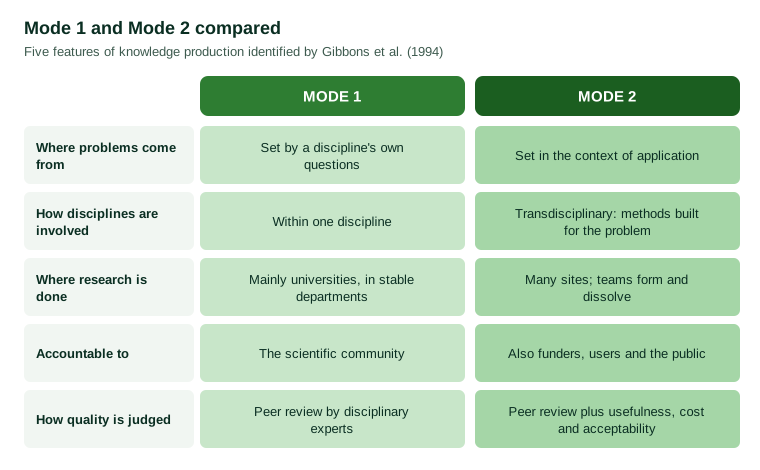
Mode 1 is the form of knowledge production that most people associate with science. Problems are set and solved within the context of an academic discipline, such as physics, chemistry or economics. The questions that matter are those that the discipline's own community considers important, and the answers are judged by the same community through peer review. Research is carried out mainly in universities and similar institutions, organised in departments that correspond to disciplines. Researchers build careers by publishing in disciplinary journals and earning the recognition of their peers. Kuhn (1962) described much of this work as "normal science": puzzle-solving within a framework of theory and method that the members of a field share and rarely question.
Gibbons et al. (1994) described Mode 1 as homogeneous, hierarchical and largely driven by the internal logic of the disciplines. The knowledge it produces is usually published first and applied later, if at all. Application is someone else's job: engineers, consultants and managers translate disciplinary findings into practical use. This division of labour was famously expressed in Vannevar Bush's report to the American president at the end of the Second World War, which argued that basic research, pursued without thought of practical ends, was the source of the new knowledge on which technology, health and prosperity depended (Bush, 1945). The resulting model, in which knowledge flows from basic research to applied research to development and finally to use, is often called the linear model of innovation.
Mode 1 also has a characteristic set of values. Merton (1973) described the norms of science as communism (sharing results), universalism (judging claims by impersonal criteria), disinterestedness and organised scepticism. These norms describe an ideal of Mode 1 science: a self-governing community that produces public knowledge and polices its own quality.
Mode 2: knowledge in the context of application
Mode 2, in contrast, is knowledge produced in the context of application. Problems are defined from the start by the needs of some user, such as an industry, a government agency, a hospital or a community. Gibbons et al. (1994) identified five features that together distinguish it from Mode 1.
1. Context of application
In Mode 2, the questions are set by the problem to be solved, not by a discipline. Research on a new medical device, the effects of a policy or the behaviour of consumers in a changing market begins with a practical need. This does not make Mode 2 the same as applied science in the traditional sense. Applied science takes knowledge that already exists and puts it to use. Mode 2 research generates new knowledge, including new theory and new methods, in the course of solving the problem.
2. Transdisciplinarity
Mode 2 is transdisciplinary. Solving a real problem usually requires knowledge from several fields, and the solution often develops its own theoretical structures, research methods and modes of practice that do not belong to any single discipline. These structures may not be easy to place on a disciplinary map, and they may not return to the disciplines at all. Instead, the knowledge travels with the people who produced it as they move on to new problems.
3. Heterogeneity and organisational diversity
Mode 2 knowledge is produced in many more kinds of places than Mode 1. Universities remain important, but research also takes place in government laboratories, companies, consultancies, think tanks and non-governmental organisations. Teams form around a problem and dissolve once it is solved, and their members are linked by networks of communication rather than by membership of a single institution. Hicks and Katz (1996) documented this spreading of research activity in their analysis of British scientific publications, which showed a growing share of papers produced through collaboration between different sectors and institutions.
4. Social accountability and reflexivity
Because Mode 2 research is tied to a context of use, it is more accountable to people outside the research community. Those who fund, use or are affected by the research expect to be consulted. Researchers become more reflexive: they must think about the values and interests involved in their work, not only about its technical content. Issues such as environmental protection, health and privacy bring the public directly into decisions about which research is done and how.
5. Quality control
Finally, quality is judged differently. In Mode 1, quality is assessed mainly through peer review by disciplinary experts. In Mode 2, the judgement of peers is joined by other criteria: whether the knowledge works, whether it is cost-effective, and whether it is socially acceptable. Quality control becomes broader, more varied and, Gibbons et al. (1994) admitted, harder to define.
Mode 2 revisited
Nowotny, Scott and Gibbons developed the argument further in Re-Thinking Science (Nowotny et al., 2001). They argued that the change was not only in science but in society. Science and society had become "transgressive": each now spoke to the other, and the boundaries between them were increasingly porous. They introduced the idea of the agora, a public space in which scientists, users, citizens and interest groups negotiate what counts as reliable knowledge. In their view, knowledge must be not only reliable in the laboratory but socially robust, able to withstand scrutiny and use in the wider world.
In a later review, Nowotny et al. (2003) responded to their critics and clarified their position. They emphasised that Mode 2 did not replace Mode 1, and that the two coexisted. They also acknowledged that the original account had been partly a description of what was happening and partly an argument about what should happen. Gibbons (1999) made the normative point explicitly, arguing that science needed a new social contract with society in which the production of socially robust knowledge was a central goal.
Similar ideas from other authors
The Mode 2 thesis was not the only attempt to describe changes in knowledge production at the end of the twentieth century. Several other frameworks address the same changes from different angles.
Funtowicz and Ravetz (1993) described post-normal science, which applies when facts are uncertain, values are in dispute, stakes are high and decisions are urgent, as in many environmental and health problems. In such conditions, they argued, the quality of knowledge cannot be ensured by experts alone and must involve an "extended peer community" of stakeholders.
Etzkowitz and Leydesdorff (2000) developed the triple helix model, which focuses on the institutional relationships between universities, industry and government and on the growing entrepreneurial role of universities. Slaughter and Leslie (1997) used the term academic capitalism for the efforts of universities and academics to secure external, market-related income, a development that they saw as reshaping academic work.
Ziman (2000) described a shift from "academic science" to post-academic science, in which research is increasingly collective, managed, utilitarian and subject to external assessment. Stokes (1997) challenged the linear model directly. His concept of Pasteur's quadrant described research that seeks fundamental understanding while also being inspired by considerations of use, as in Louis Pasteur's work on microbiology. Stokes argued that much of the most productive research had always been of this kind, so that the strict separation of basic and applied research, on which the linear model depended, was misleading.
Jasanoff (2004) used the idea of co-production to describe how scientific knowledge and social order are produced together, each shaping the other.
Criticisms of the Mode 2 thesis
The Mode 2 idea has been widely criticised as well as widely used. Hessels and van Lente (2008) reviewed the literature it generated and identified three main criticisms.
Is it new? Several historians argued that Mode 2 is not new at all. Godin (1998) pointed out that much research before the Second World War, in industry, agriculture, medicine and engineering, was carried out in the context of application. Pestre (2003) argued that the history of science shows many different regimes of knowledge production and that the idea of a single shift from one mode to another oversimplifies this history. On this view, the period of relatively autonomous, disciplinary science after 1945 was the exception rather than the rule. Weingart (1997) compared Mode 2 with an earlier German theory of the "finalization" of science, from the 1970s, which had made similar claims, and asked whether the Mode 2 thesis was old wine in new bottles.
Is it true? Critics questioned whether the empirical evidence supported the claims. Many of the features of Mode 2, such as transdisciplinarity and the involvement of users, can be found in some fields but not in others. Hessels and van Lente (2008) concluded that there was evidence for some trends, such as the growth of collaboration across sectors and the increasing emphasis on societal relevance, but that the five features did not always occur together and could not be taken as a single coherent mode.
Is it a description or a programme? Shinn (2002) argued that both the Mode 2 thesis and the triple helix model were "prepackaged thinking": loose, general accounts that appealed to policymakers but lacked the empirical and theoretical rigour expected of scholarship. Godin (1998) made a similar point, arguing that the Mode 2 book was "performative": by describing a new mode as inevitable, it helped bring it about by encouraging governments and universities to adopt it as policy.
These criticisms are important, but they have not removed the concepts from use. Even critics generally accept that the terms capture something real about changes in how research is organised, funded and evaluated.
Mode 2 in practice: impact and transdisciplinary research
Whatever its theoretical status, the Mode 2 thesis influenced research policy. Many research funders now ask applicants to describe the expected benefits of their work for society and to show how users will be involved. Bornmann (2013) reviewed the growing literature on how the societal impact of research can be defined and measured, noting the difficulty of attributing practical effects to particular projects and the long and uncertain delays between research and impact.
Transdisciplinary research has also developed its own methods. Lang et al. (2012) described principles for transdisciplinary research in sustainability science, which include defining the problem jointly with practitioners, building a shared understanding across disciplines, producing knowledge that can be used in practice, and reintegrating results into both scientific and practical settings. They also identified common difficulties, such as unclear framing of the problem, conflicting methods and a lack of legitimacy among stakeholders.
What this means for applied research organisations
Organisations that conduct market research, opinion polling, social research and business intelligence work almost entirely in Mode 2. Their questions come from clients; their teams combine statisticians, subject experts, designers and analysts; their work is judged by whether it helps decisions as well as by technical standards. The Mode 2 literature offers several lessons for such work.
Define the problem with the user. In Mode 2, the problem is not handed over complete. Time spent with the client clarifying the decision to be made, and the information that would change it, is part of the research, not a preliminary to it.
Combine kinds of expertise deliberately. Good applied research needs knowledge of the subject, of the methods and of the context of use. Teams should be built to include all three, and they need time to develop a shared language.
Keep disciplinary standards. Mode 2 does not mean abandoning rigour. The danger in applied research is that the pressure to be useful weakens the checks that make findings reliable. Sound sampling, careful questionnaire design and transparent analysis remain the foundation, and peer-style review of methods inside the organisation preserves some of the strengths of Mode 1.
Aim for socially robust knowledge. Findings should be able to withstand scrutiny from the people they affect, not only from the client who commissioned them. Being open about methods, assumptions and limitations is the most practical way to achieve this.
Account for values. Applied research often bears on decisions in which interests conflict. Researchers should be clear about who commissioned the work and what questions they were asked to answer, and should resist pressure to frame questions in ways that produce a preferred result.
Learn across projects. Mode 2 teams often dissolve when a project ends, and with them goes much of what was learned. Recording methods, lessons and reusable tools allows an organisation to build cumulative expertise from one project to the next.
Conclusion
The distinction between Mode 1 and Mode 2 is better understood as a pair of ideal types than as a description of two separate worlds. Most research combines elements of both, and the balance between them has shifted many times in history. Yet the concepts remain useful. They draw attention to the contexts in which problems are defined, to the range of people and organisations involved in producing knowledge, and to the different ways in which its quality can be judged. For applied research organisations, the lesson is to combine the problem focus and accountability of Mode 2 with the rigour and openness of Mode 1, producing knowledge that is both useful and trustworthy.
References
Bornmann, L. (2013). What is societal impact of research and how can it be assessed? A literature survey. Journal of the American Society for Information Science and Technology, 64(2), 217–233. https://doi.org/10.1002/asi.22803
Bush, V. (1945). Science, the endless frontier: A report to the President. United States Government Printing Office.
Etzkowitz, H., & Leydesdorff, L. (2000). The dynamics of innovation: From National Systems and "Mode 2" to a Triple Helix of university–industry–government relations. Research Policy, 29(2), 109–123. https://doi.org/10.1016/S0048-7333(99)00055-4
Funtowicz, S. O., & Ravetz, J. R. (1993). Science for the post-normal age. Futures, 25(7), 739–755. https://doi.org/10.1016/0016-3287(93)90022-L
Gibbons, M. (1999). Science's new social contract with society. Nature, 402(Suppl. 6761), C81–C84. https://doi.org/10.1038/35011576
Gibbons, M., Limoges, C., Nowotny, H., Schwartzman, S., Scott, P., & Trow, M. (1994). The new production of knowledge: The dynamics of science and research in contemporary societies. SAGE.
Godin, B. (1998). Writing performative history: The new New Atlantis? Social Studies of Science, 28(3), 465–483. https://doi.org/10.1177/030631298028003004
Hessels, L. K., & van Lente, H. (2008). Re-thinking new knowledge production: A literature review and a research agenda. Research Policy, 37(4), 740–760. https://doi.org/10.1016/j.respol.2008.01.008
Hicks, D. M., & Katz, J. S. (1996). Where is science going? Science, Technology, & Human Values, 21(4), 379–406. https://doi.org/10.1177/016224399602100401
Jasanoff, S. (Ed.). (2004). States of knowledge: The co-production of science and social order. Routledge.
Kuhn, T. S. (1962). The structure of scientific revolutions. University of Chicago Press.
Lang, D. J., Wiek, A., Bergmann, M., Stauffacher, M., Martens, P., Moll, P., Swilling, M., & Thomas, C. J. (2012). Transdisciplinary research in sustainability science: Practice, principles, and challenges. Sustainability Science, 7(Suppl. 1), 25–43. https://doi.org/10.1007/s11625-011-0149-x
Merton, R. K. (1973). The sociology of science: Theoretical and empirical investigations. University of Chicago Press.
Nowotny, H., Scott, P., & Gibbons, M. (2001). Re-thinking science: Knowledge and the public in an age of uncertainty. Polity Press.
Nowotny, H., Scott, P., & Gibbons, M. (2003). Introduction: "Mode 2" revisited: The new production of knowledge. Minerva, 41(3), 179–194. https://doi.org/10.1023/A:1025505528250
Pestre, D. (2003). Regimes of knowledge production in society: Towards a more political and social reading. Minerva, 41(3), 245–261. https://doi.org/10.1023/A:1025553311412
Shinn, T. (2002). The triple helix and new production of knowledge: Prepackaged thinking on science and technology. Social Studies of Science, 32(4), 599–614. https://doi.org/10.1177/0306312702032004004
Slaughter, S., & Leslie, L. L. (1997). Academic capitalism: Politics, policies, and the entrepreneurial university. Johns Hopkins University Press.
Stokes, D. E. (1997). Pasteur's quadrant: Basic science and technological innovation. Brookings Institution Press.
Weingart, P. (1997). From "finalization" to "Mode 2": Old wine in new bottles? Social Science Information, 36(4), 591–613. https://doi.org/10.1177/053901897036004002
Ziman, J. (2000). Real science: What it is, and what it means. Cambridge University Press. https://doi.org/10.1017/CBO9780511541391