
Share your experience of studying abroad
Tell us whether you have studied or plan to study abroad, where and how you are paying for it. Your answers are combined with other people's and reported only as totals.
Start the studying abroad surveyAbout 5 minutes. No account needed. You can stop at any time.
What studying abroad covers
Studying abroad can mean several different things:
- A full degree at a university in another country, from bachelor's to doctorate.
- An exchange of one term or one year, where a student stays enrolled at their home university and earns credit abroad. The European Union's Erasmus+ program is one of the best-known exchange schemes.
- Short programs: summer schools, study tours and field courses.
- Language courses in a country where the language is spoken.
- Secondary school abroad, including exchange years and boarding schools.
- Branch campuses and joint programs, where a foreign university teaches in the student's own country, or two universities share a degree.
- Online degrees from foreign universities, studied from home.
UNESCO counts internationally mobile students as those who have crossed a border to study. Their number has grown greatly over recent decades, and the main destinations and sending countries continue to change.
Why students go abroad
Students give a wide range of reasons:
- the quality or reputation of a university or course;
- a course that is not available, or has too few places, at home;
- learning or improving a language;
- better job prospects, at home or abroad;
- the chance to live and work abroad after graduating;
- experience of another culture and independence;
- family ties or advice;
- scholarships that cover costs.
Example
A student from a small country wants to study marine engineering, which is not offered at home. They apply to universities in three countries with large shipping industries and choose the one where a scholarship covers part of the fees and English is the teaching language.
Choosing a destination
Choosing where to study involves many factors at once:
- Cost: tuition fees and living costs differ greatly between countries and cities. Some countries charge international students much higher fees than local students; others charge low or no tuition at public universities.
- Language: whether the course is taught in a language the student knows, and whether a language test is needed.
- Visa and work rules: how easy it is to get a student visa, whether students can work part-time, and whether graduates can stay to work.
- Recognition: whether the degree will be recognized by employers and professional bodies at home.
- Safety and welcome: how safe the student expects to feel and how international students are treated.
- Community: whether there are other students or a community from their home country.
Costs and how students pay
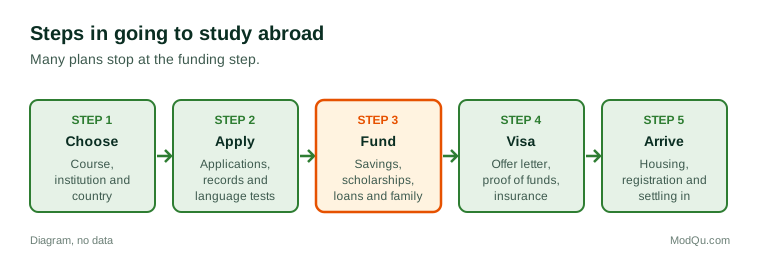
The total cost of studying abroad includes tuition, accommodation, food, travel, health insurance, visa fees and course materials. Living costs in a large city can be higher than tuition.
Students pay in different ways:
- family savings or support;
- scholarships from governments, universities or foundations;
- loans from banks or public schemes;
- part-time work during study, where visa rules allow;
- sponsorship by an employer.
Example (hypothetical figures)
A student plans a two-year master's degree. Tuition is 12,000 a year and living costs are about 9,000 a year, in local currency, so the two years cost 42,000. A university scholarship covers half the tuition, or 12,000 over two years. Their family provides 20,000. The remaining 10,000 must come from part-time work or a loan.
Paperwork: visas, tests and documents
Studying abroad usually involves:
- an offer letter from the institution;
- proof of language ability, often through a recognized test;
- a student visa or permit, often requiring proof of funds and health insurance;
- certified copies and translations of school records;
- in some cases, a health check or police certificate.
Rules change often and differ by country. Students are usually advised to use official government and university sources, because unofficial agents and websites can give out-of-date or misleading information.
Settling in
Arriving in a new country brings practical and personal challenges. Students need to find housing, open a bank account, register with local authorities or a doctor, and learn how teaching and assessment work in the new system. Many experience homesickness, loneliness or culture shock, especially in the first months.
Example
An exchange student arrives in a city where they do not speak the local language well. Their classes are in English, but shopping, renting and making local friends are hard. They join a language café run by the university and, after three months, say they feel at home for the first time.
Universities often provide orientation, international student offices, mentoring and counselling. How well these work varies.
After graduating
Graduates may return home, stay to work, or move to a third country. Some countries offer post-study work visas to attract skilled graduates; others require students to leave soon after finishing. Returning graduates sometimes find that foreign degrees and experience help them; others find employers do not recognize their qualifications or value their time away.
What people disagree about
International students are a frequent subject of public debate. Universities often depend on their fees, while governments balance this against housing pressure and migration targets. Sending countries debate whether students who stay abroad represent a loss of talent or bring benefits through money sent home, links and returning skills. Students themselves weigh the high cost against uncertain returns.
Questions that universities, colleges and education agents want answered include who plans to study abroad, where, how they will pay, and what influences their choice of country.
Studying abroad without leaving home
Not everyone who wants an international education can travel. Some students study for a foreign degree online, or at a branch campus of a foreign university in their own country. Others take part in short virtual exchanges, joint classes with students abroad, or international programs taught at home. These options usually cost less and avoid visa and housing problems, but students miss the experience of living in another country, which many say is the main benefit.
Key terms
- International studentA student who has crossed a border to study.
- Exchange programA scheme where students study abroad for a term or year and earn credit at home.
- Student visaPermission to enter and stay in a country to study.
- Proof of fundsEvidence that a student can pay fees and living costs.
- Language testA recognized exam showing ability in a language.
- Credit transferCounting study completed at one institution toward a qualification at another.
- Culture shockFeelings of confusion or stress when adjusting to a new culture.
- Post-study work visaPermission for graduates to stay and work after finishing a course.
Full glossary: international education terms on EditingTests.com.
Studying abroad vocabulary test
How well do you know the language of this topic? Try 8 quick questions. Your score is shown straight away and is not saved.
What the studying abroad survey asks
This survey is part of ModQu's Education and Learning survey. The studying abroad part takes about five minutes and covers:
- Whether you have studied, are studying or plan to study abroad.
- Which country and what kind of study: degree, exchange, language course or other.
- Why you chose that country and institution.
- How you are paying, and the total cost you expect.
- What was hardest: applications, visas, money, language or settling in.
- Whether you plan to stay, return home or move elsewhere afterwards.
After that you can choose to continue with other short parts of the Education and Learning survey, such as choosing a college or university or online learning, or stop.
Ready to take part?
Your answers help show what people really think and do. Results are only ever reported as totals; no one can see your individual answers.
Start the surveyQuestions about this survey
Who can take part?
Students and recent graduates.
Do I have to give my name?
No. You may be asked for your age group, region and similar details so results can be broken down, but not your name. ModQu never asks for passwords, card numbers or account numbers.
How are the results used?
Answers are combined into totals and percentages and published in ModQu reports. Individual answers are never shown.
Is the vocabulary test part of the survey?
No. It is optional and separate, and your score is not stored.
Can I answer if I only plan to study abroad?
Yes. The survey includes people who are planning or thinking about it, as well as those who have done it.
Does online study from a foreign university count?
Yes. The survey asks you to say which kind of study it is, so online programs are included.
Can parents answer?
Parents can answer about a child's plans, and students can answer for themselves.