
Share your experience of tutoring
Tell us whether your household uses tutoring, for which subjects and what it costs. Your answers are combined with other people's and reported only as totals.
Start the tutoring and test preparation surveyAbout 5 minutes. No account needed. You can stop at any time.
What tutoring and test preparation cover
Private tutoring means paid lessons outside the normal school timetable that cover school subjects or exam skills. It is sometimes called supplementary education or, in research, "shadow education", because it follows and mirrors what happens in school.
Test preparation is a narrower part of tutoring. It focuses on a particular exam, such as an entrance test for a selective school, end-of-school exams, university admission tests or language tests for study and migration. It often includes practice papers, timing drills and exam techniques rather than broader teaching of a subject.
Tutoring is used at every stage, from young children learning to read to adults preparing for professional exams. It is common in many parts of East and South Asia, where after-school classes are a regular part of student life, and it is widespread in many other regions too. The scale, cost and rules differ between countries.
Why families use tutoring
Families give many reasons, and they often overlap:
- Catching up: a child is behind in a subject or has missed school.
- Keeping up: worry that school classes move too fast or are too large.
- Getting ahead: aiming for top grades or a competitive school or university place.
- High-stakes exams: a single test decides a school place, a university course or a scholarship.
- Specific needs: support for learning difficulties, or help in the language of instruction for children whose home language differs.
- Confidence: a child is anxious or has lost interest.
- Childcare and structure: a supervised activity after school.
Example
A student is a year away from end-of-school exams and is struggling with mathematics. Their parents pay for one hour a week with a university student who studied the subject. After a term, the student's marks improve and they say the main help was being able to ask questions they felt too embarrassed to ask in class.
Main formats
Tutoring comes in several forms, each with different costs and strengths:
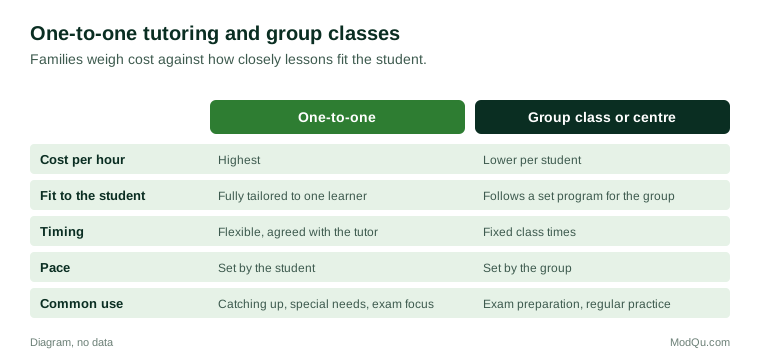
- One-to-one tutoring at home, at the tutor's home or online, usually the most expensive per hour.
- Small-group tutoring of two to six students, which lowers the cost per student.
- Tutoring centres and cram schools, with classes after school or at weekends, sometimes with large groups.
- Online tutoring platforms connecting students with tutors anywhere.
- Self-study test preparation: books, apps, video courses and practice tests.
- Peer tutoring, where older students help younger ones, sometimes run by schools.
- School-run or publicly funded tutoring, offered free to pupils who need extra help in some systems.
Costs
The cost of tutoring varies with the subject, the tutor's qualifications, the format, the location and how close an important exam is. Many families pay weekly or by the term. For some households, tutoring is one of the largest education costs after school fees.
Example (hypothetical figures)
A family pays 30 an hour, in local currency, for one-to-one maths tutoring, once a week for 36 weeks of the school year. That costs 1,080. In the final term before an entrance exam they add a weekend group class at 15 a session for 12 sessions, adding 180. The year's total is 1,260.
Families often say they would cut other spending before cutting tutoring in an exam year. Others cannot afford it at all, which is one reason for publicly funded programs.
Choosing a tutor
Parents and students choose tutors through word of mouth, school recommendations, agencies, online platforms and local adverts. What they look for includes subject knowledge, experience with the exam, teaching skill, reviews from other families, price and how well the tutor gets on with the student.
In many places tutoring is not regulated, so anyone can offer lessons. Some countries require tutoring centres to register, set limits on their hours or fees, or require background checks for people working with children. Parents are often advised to check references and to make sure lessons happen where others can see or hear, or online with a record.
Example
A parent looks for an online English tutor for their 12-year-old. They try two tutors through a platform with free first lessons. The first has strong qualifications but talks most of the lesson. The second gets their child talking and reading aloud. They choose the second, even though the price is a little higher.
Does tutoring work?
Research shows that well-organized tutoring, especially frequent sessions in small groups or one-to-one linked to what the student is learning in school, can improve results. Effects vary widely depending on the tutor, the quality of teaching and whether the student attends regularly. Test preparation can raise scores on a specific test, partly by teaching familiarity with the format. Whether it improves underlying knowledge is less clear.
Fairness and other concerns
Tutoring raises questions that families, schools and governments disagree about:
- Inequality: families who can pay may gain an advantage in competitive exams, widening gaps between rich and poor.
- Pressure: long hours of after-school classes can reduce sleep, play and rest.
- Effect on schools: some worry that teachers rely on tutoring to cover what is not taught in class, or that teachers tutor their own pupils for money.
- Quality: unregulated tutoring varies widely.
Some governments have responded with free tutoring for disadvantaged pupils, limits on private centres, or reforms to exams so that coaching matters less.
Questions that schools, tutoring services and education technology firms want answered include how many children have a tutor, which subjects, how much families spend, and how they choose a tutor.
Online tutoring
Online tutoring has grown quickly. A student can now work with a tutor in another city or country through video calls, shared whiteboards and screen sharing. Families value the wider choice, lower travel time and, often, lower prices. Some students find it harder to concentrate on a screen, and younger children may need an adult nearby. Online platforms also make it easier to compare tutors by reviews and price, but quality still varies and checks on tutors differ between platforms.
Key terms
- Private tutoringPaid lessons outside the school timetable in school subjects or exam skills.
- Shadow educationA research term for tutoring that mirrors the school system.
- Test preparationTeaching aimed at doing well on a particular exam.
- Cram schoolA centre offering intensive classes, usually for exams.
- Mock examA practice exam taken under real conditions.
- Peer tutoringStudents teaching or helping other students.
- Entrance examA test used to choose who gets a place at a school or university.
- Learning centreA business offering tutoring classes in a set location.
Full glossary: test preparation services terms on EditingTests.com.
Tutoring and test preparation vocabulary test
How well do you know the language of this topic? Try 8 quick questions. Your score is shown straight away and is not saved.
What the tutoring and test preparation survey asks
This survey is part of ModQu's Education and Learning survey. The tutoring and test preparation part takes about five minutes and covers:
- Whether your child, or you, had a tutor or test preparation in the last year.
- Which subjects or exams it was for.
- What format you used: one-to-one, group, centre, online or self-study.
- How much you spent and how you paid.
- How you chose the tutor or service.
- Whether you think it helped, and why.
After that you can choose to continue with other short parts of the Education and Learning survey, such as choosing a college or university or online learning, or stop.
Ready to take part?
Your answers help show what people really think and do. Results are only ever reported as totals; no one can see your individual answers.
Start the surveyQuestions about this survey
Who can take part?
Parents and students.
Do I have to give my name?
No. You may be asked for your age group, region and similar details so results can be broken down, but not your name. ModQu never asks for passwords, card numbers or account numbers.
How are the results used?
Answers are combined into totals and percentages and published in ModQu reports. Individual answers are never shown.
Is the vocabulary test part of the survey?
No. It is optional and separate, and your score is not stored.
Does the survey ask about free help from family or friends?
It mainly asks about paid tutoring and test preparation, but you can mention unpaid help where the questions allow.
Can students answer, or only parents?
Both. Parents answer about their children, and students can answer about tutoring they arranged or used themselves.
Is tutoring the same as homework help?
Homework help is one kind of tutoring. Tutoring can also cover whole subjects, exam skills or catching up on missed learning.