
Share your views on men's health
Tell us when you last had a health check, what concerns you and what stops men seeing a doctor. Your answers are combined with other people's and reported only as totals.
Start the men's health surveyAbout 5 minutes. No account needed. You can stop at any time.
Why men's health is a topic
Life expectancy for men is lower than for women in most countries. Men also have higher rates of some causes of death, such as heart disease at younger ages, accidents and suicide, and in many countries are more likely to smoke, drink heavily and work in dangerous jobs. Men's health campaigns aim to address these differences and to encourage men to seek help earlier.
Common health concerns for men
Areas often highlighted in men's health include:
- Heart disease and high blood pressure, which often have no symptoms until serious.
- Prostate health, including enlarged prostate in older men and prostate cancer.
- Testicular cancer, more common in younger men.
- Type 2 diabetes and weight-related conditions.
- Mental health, including depression, anxiety and suicide risk.
- Alcohol and drug use.
- Sexual health and erectile problems, which can be linked to other conditions.
- Work-related injury and illness.
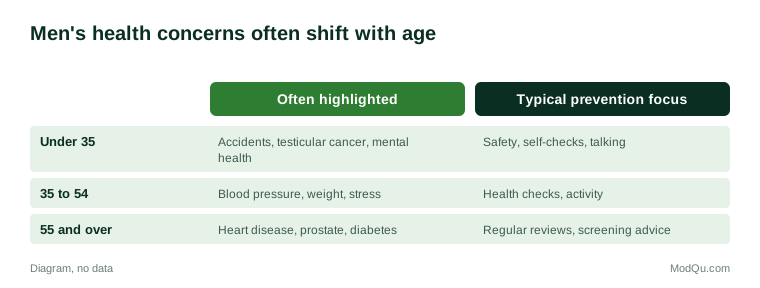
The figure below shows how concerns often shift across age groups.
Check-up habits
Surveys in several countries find that men are less likely than women to have regular check-ups or to see a doctor when they notice a symptom. Some health systems offer free health checks at certain ages, which test blood pressure, cholesterol and diabetes risk. Uptake among men is often lower than among women.
Example
A man in his late forties receives a letter inviting him to a free health check. He ignores it twice. When his partner books the appointment for him, the check shows high blood pressure. He starts treatment and says he would not have gone on his own.
Why men delay seeking help
Reasons men give for not seeing a doctor include:
- not wanting to seem weak or to make a fuss;
- believing symptoms will go away;
- difficulty getting time off work;
- embarrassment about some symptoms;
- not having a regular doctor;
- fear of what they might find out;
- appointment systems that are hard to use.
Researchers note that these patterns are shaped by social expectations about masculinity, work and self-reliance, and that they vary between countries, cultures and age groups.
Mental health and suicide
In many countries, men account for a large majority of suicides, yet are less likely to seek help for mental health problems. Men may express distress differently, for example through anger, alcohol use or overwork, which can make depression harder to recognize. Programs that use peer support, sport, workplaces and community groups have been developed to reach men who would not attend traditional services.
Example
A group of former construction workers sets up a weekly walking group at a local football club. Members talk while they walk. One says it was the first time he admitted he was struggling after being laid off, and a volunteer helped him contact a counsellor.
Prostate and testicular health
Prostate problems become more common with age. Symptoms of an enlarged prostate, such as needing to urinate often, are common in older men and are usually not cancer, but men are encouraged to have symptoms checked. Approaches to testing for prostate cancer differ between countries, and men are often advised to discuss the benefits and drawbacks with a doctor. Testicular cancer is most common in younger men, and campaigns encourage awareness of changes.
Health at work
Men make up a large share of workers in physically demanding and dangerous jobs, such as construction, transport, farming and manufacturing. Occupational injuries, exposure to noise, dust and chemicals, shift work and long hours all affect health. Workplace health checks and mental health programs aim to reach men who might not otherwise seek care.
Example (hypothetical figures)
A transport firm offers free health checks to its 400 drivers. In the first year, 260 take part. Of these, 45 are found to have high blood pressure they did not know about. The firm repeats the checks the next year and adds healthier options to depot canteens.
Lifestyle and prevention
Common prevention messages for men include not smoking, drinking within recommended limits, being active, eating well, getting enough sleep and maintaining a healthy weight. Campaigns increasingly use sport, humour, online tools and workplaces to reach men, and some focus on specific groups such as fathers, older men or men in rural areas.
Fathers and family health
New fathers can experience stress and depression too, though this is less often recognized than in mothers. Fathers also influence the health habits of their children. Some services now include fathers in antenatal classes and offer support after birth.
Older men and loneliness
Older men can be at particular risk of loneliness after retirement, bereavement or divorce, as their social networks are often linked to work. Loneliness is associated with poorer physical and mental health. Community projects such as men's sheds, where men meet to work on practical projects together, have spread to many countries and are often cited as a way to reach men who would not join other groups.
Example
A widower in his seventies rarely leaves home after his wife dies. A neighbour invites him to a local men's shed. He starts going twice a week to help repair bicycles for a charity. His daughter says he is more cheerful and has started seeing his doctor about a long-ignored hip problem.
What people disagree about
Some argue that men's health needs a dedicated focus, with targeted services and research. Others say that health services should improve access for everyone, and that framing health by gender can reinforce stereotypes. There is also debate about routine testing for prostate cancer and about how best to reach men who avoid services.
Questions that businesses want answered include when men last had a health check, which health issues concern them, what stops them seeing a doctor, where they look for information, and which kinds of services they would use.
Key terms
- Health checkA routine check of blood pressure, cholesterol and other risk factors.
- Life expectancyThe average number of years a person can expect to live.
- ProstateA gland in men that can enlarge with age.
- Testicular self-checkChecking for changes in the testicles.
- Blood pressureThe force of blood against artery walls; high levels raise heart risk.
- Peer supportHelp from people with similar experiences.
- Occupational healthHealth issues and services related to work.
- Risk factorSomething that increases the chance of a disease.
Full glossary: primary care terms on EditingTests.com.
Men's health vocabulary test
How well do you know the language of this topic? Try 8 quick questions. Your score is shown straight away and is not saved.
What the men's health survey asks
This survey is part of ModQu's Health and Wellness survey. The men's health part takes about five minutes and covers:
- When you last had a health check or saw a doctor about a concern.
- Which health issues concern you most.
- What, if anything, has stopped you seeking help.
- How you look after your mental health and where you would go for help.
- Whether your workplace offers health checks or support.
- Which kinds of services or formats you would be most likely to use.
After that you can choose to continue with other short parts of the Health and Wellness survey, such as access to family doctors or virtual care and telehealth, or stop.
Ready to take part?
Your answers help show what people really think and do. Results are only ever reported as totals; no one can see your individual answers.
Start the surveyQuestions about this survey
Who can take part?
Men aged 16 and over.
Do I have to give my name?
No. You may be asked for your age group, region and similar details so results can be broken down, but not your name. ModQu never asks for passwords, card numbers or account numbers.
How are the results used?
Answers are combined into totals and percentages and published in ModQu reports. Individual answers are never shown.
Is the vocabulary test part of the survey?
No. It is optional and separate, and your score is not stored.
Does this page give medical advice?
No. Speak to a health professional about any symptoms or concerns.
Are free health checks available?
Some countries offer them at certain ages. Check with your local health service.