
Share how you pay for your studies
Tell us how you are paying for your studies and how you feel about repaying any loan. Your answers are combined with other people's and reported only as totals.
Start the student loans and scholarships surveyAbout 5 minutes. No account needed. You can stop at any time.
What studying costs
The cost of higher education has two parts. Tuition fees pay for teaching and are charged by the institution. Living costs cover rent, food, transport, books, devices and other daily needs. Tuition varies greatly between countries: in some, public universities charge little or nothing; in others, fees are high. Living costs depend on whether students live at home and on the city.
For many students living costs are the larger problem, especially in cities with high rents. Students who move away from home, international students and students with children face the highest costs.
Main sources of funding
Students usually combine several sources:
- Family support and personal savings.
- Part-time work during term and full-time work in holidays.
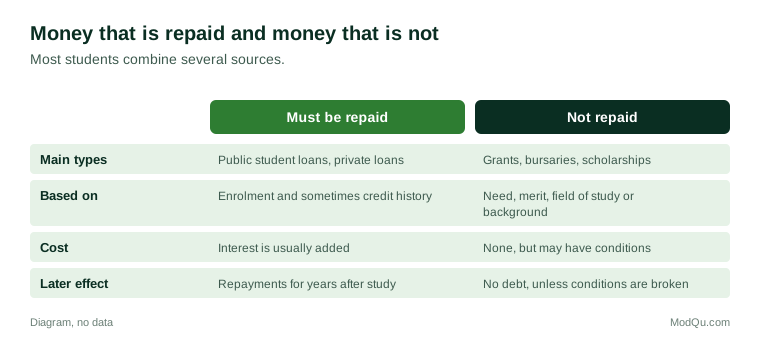
- Grants and bursaries, which do not have to be repaid and are usually based on need.
- Scholarships, also not repaid, usually based on merit, talent, field of study or background.
- Public student loans from government schemes.
- Private loans from banks or other lenders.
- Employer sponsorship, where an employer pays in return for work afterwards.
- Work-study programs, where students work on campus as part of their aid.
Example
A first-generation university student receives a means-tested public grant that covers part of their rent, a small scholarship from a local community foundation, and a public student loan for tuition. They also work 12 hours a week in a supermarket. Their parents cannot contribute money but let them keep a bedroom at home for the holidays.
How student loans work
Student loan systems differ greatly between countries, but most fall into two broad types.
Fixed or mortgage-style loans require set monthly payments over a period of years, whatever the borrower earns. Missing payments can lead to penalties, damaged credit and collection action. Many private loans work this way.
Income-contingent loans are repaid as a share of income above a threshold, often collected through the tax or payroll system. If income is low, repayments are low or zero, and any balance left after a set number of years may be written off. Australia introduced such a scheme in 1989, and countries including the United Kingdom and New Zealand use similar systems.
Some systems mix the two, offering income-driven repayment plans as an option. Interest rates, thresholds, repayment periods and forgiveness rules differ widely and change over time.
Example (hypothetical figures)
A graduate has an income-contingent loan. They repay 9% of their income above a threshold of 25,000 a year, in local currency. In their first job they earn 31,000, so they repay 9% of 6,000, which is 540 a year, or 45 a month. A friend on a fixed loan of the same size pays 200 a month regardless of income.
Scholarships and how to find them
Scholarships come from governments, universities, companies, foundations, religious bodies and community groups. They may be awarded for academic results, sporting or artistic talent, financial need, field of study, place of origin, or a combination. Some cover full costs; many are small.
Students find them through school and university advisers, government websites, scholarship directories and community organizations. Many scholarships receive few applicants because students do not know they exist. Students are advised to be wary of services that charge fees to find or apply for scholarships.
Worries about debt
Many students and graduates worry about repaying loans. Common concerns include:
- how long repayment will take;
- whether they will earn enough to repay;
- interest adding to the balance;
- the effect on buying a home, starting a family or saving for retirement;
- whether the degree will lead to a well-paid job.
Some students choose cheaper courses, live at home, work long hours or avoid study altogether because of worry about debt. Others see borrowing as a reasonable investment in future earnings. Worry is often linked as much to uncertainty about the rules as to the amount owed.
Example
A student is offered places at two universities. One is in their home city and the other, with a better reputation for their subject, is far away. Living away would mean borrowing an extra amount for rent each year. After working out the difference, they choose the home city and plan to apply for a postgraduate place elsewhere later.
What people disagree about
Paying for higher education is debated in many countries. Points of disagreement include:
- whether tuition should be free and paid for by taxes, or paid by students who benefit;
- whether loans should be cancelled or forgiven, and for whom;
- whether income-contingent loans are fairer than fixed loans;
- whether grants should be based on need or merit;
- whether high costs discourage students from poorer families.
Questions that universities, colleges, lenders and policy groups want answered include how students pay for study, how many have loans, how worried they are about repayment, and whether cost affected their choice of course or institution.
Students with extra costs
Some students face costs beyond tuition and rent. Students with children need childcare. Students with disabilities may need equipment, support workers or accessible housing. Students who care for relatives may be unable to work part-time. Mature students may have mortgages or family bills. Many funding systems offer extra grants or allowances for these groups, but students often do not know about them, and the amounts and rules differ widely. International students usually cannot use the host country's public loans or grants and must rely on family, scholarships or their own country's schemes.
Example
A mature student with two children returns to study nursing. On top of a tuition loan, they apply for a childcare grant and a public allowance for parents in study. Together these cover most of their childcare costs during placement weeks.
Key terms
- Tuition feeA charge for teaching at a college or university.
- GrantMoney for study that does not have to be repaid.
- ScholarshipAn award for study, usually based on merit or other criteria, not repaid.
- Means-testedBased on the income or wealth of the student or family.
- Income-contingent loanA loan repaid as a share of income above a threshold.
- Repayment thresholdThe income level above which loan repayments begin.
- Loan forgivenessCancelling some or all of a remaining loan balance.
- InterestThe cost of borrowing, added to the amount owed.
Full glossary: consumer lending terms on EditingTests.com.
Student loans and scholarships vocabulary test
How well do you know the language of this topic? Try 8 quick questions. Your score is shown straight away and is not saved.
What the student loans and scholarships survey asks
This survey is part of ModQu's Education and Learning survey. The student loans and scholarships part takes about five minutes and covers:
- How you are paying, or paid, for your studies.
- Whether you have a student loan, and what kind.
- Whether you received a grant, bursary or scholarship.
- How many hours you work alongside study.
- How worried you are about repaying, and what worries you most.
- Whether cost affected your choice of course or institution.
After that you can choose to continue with other short parts of the Education and Learning survey, such as choosing a college or university or online learning, or stop.
Ready to take part?
Your answers help show what people really think and do. Results are only ever reported as totals; no one can see your individual answers.
Start the surveyQuestions about this survey
Who can take part?
Students and graduates.
Do I have to give my name?
No. You may be asked for your age group, region and similar details so results can be broken down, but not your name. ModQu never asks for passwords, card numbers or account numbers.
How are the results used?
Answers are combined into totals and percentages and published in ModQu reports. Individual answers are never shown.
Is the vocabulary test part of the survey?
No. It is optional and separate, and your score is not stored.
Do I need to give my loan balance?
No. The survey may ask for a range, which you can skip.
Can graduates who have finished study answer?
Yes. Graduates can answer about how they paid and about repaying their loans now.
Does the survey give advice on loans?
No. It asks about your experience. For advice, use official government or institution sources.