
Share your experience as a landlord
Tell us whether you own property you rent out, whether you manage it yourself and what your biggest challenge is. Your answers are combined with other people's and reported only as totals.
Start the landlords and property investing surveyAbout 5 minutes. No account needed. You can stop at any time.
What this topic covers
A landlord is a person or organization that owns property and rents it to tenants. This topic focuses on individuals who own one or a few rental properties, sometimes called small or private landlords, and on people thinking of becoming one. It covers:
- why people invest in rental property;
- how they finance it;
- rental income, costs and returns;
- whether they manage the property themselves or use an agent;
- the challenges landlords face;
- rules, taxes and debates about renting.
This page describes how property investing works and what landlords report. It does not give investment, tax or legal advice.
Why people become landlords
People become landlords for different reasons:
- Income: rent as a regular source of money, for example in retirement.
- Long-term growth: hoping the property will rise in value.
- Retirement planning: property as an alternative or addition to a pension.
- Accidental landlords: people who rent out a home they cannot sell or have moved away from, or a home they inherited.
- Family: buying property to house children or relatives later.
- Diversification: owning a different kind of asset from savings or shares.
In some countries, buying property to rent out is a very common form of saving for middle-income families; in others, rental housing is mostly owned by companies, public bodies or housing associations.
Kinds of rental property
Landlords rent out many kinds of property:
- Long-term residential lets: houses and apartments rented to tenants for months or years.
- Rooms in a shared home, including houses in multiple occupation.
- Student housing.
- Short-term or holiday rentals, let by the night or week, often through online platforms. Many cities now restrict or license these.
- Rooms in the landlord's own home.
- Commercial property, such as shops and offices, which follows different rules.
Financing and returns
Landlords may buy with cash or with a mortgage. Buy-to-let or investment mortgages often need larger deposits and higher interest rates than mortgages for homes people live in.
Landlords often describe returns in two ways:
- Rental yield: yearly rent as a percentage of the property's price. Gross yield ignores costs; net yield subtracts them.
- Capital growth: any rise in the property's value over time, which is not guaranteed and can be negative.
Example (hypothetical figures)
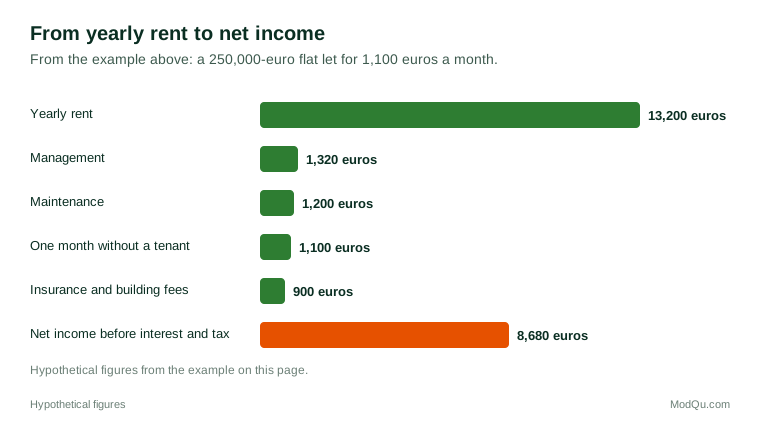
A landlord buys a flat for 250,000 euros and rents it for 1,100 euros a month, which is 13,200 euros a year, a gross yield of 5.28%. Yearly costs are 1,320 euros for management, 900 euros for insurance and building fees, 1,200 euros for maintenance and 1,100 euros allowed for one month without a tenant: 4,520 euros in total. Net income before mortgage interest and tax is 8,680 euros, a net yield of about 3.5%.
Figure 1 shows how the rent in that example is used. Mortgage interest, taxes and changes in the property's value would all change the final return.
Costs landlords face
Running a rental property involves many costs:
- mortgage interest;
- insurance, including landlord insurance;
- maintenance and repairs;
- agent or management fees;
- building or service charges for apartments;
- safety checks required by law, such as gas, electrical or fire safety inspections in some countries;
- licensing fees in some areas;
- periods with no tenant;
- legal costs if disputes arise;
- taxes on rental income and, when selling, on gains.
Managing it yourself or using an agent
Landlords choose between:
- Self-management: finding tenants, collecting rent, arranging repairs and dealing with problems themselves. This saves fees but takes time and knowledge.
- Letting only: an agent finds tenants, and the landlord manages after that.
- Full management: an agent handles tenants, rent, repairs and inspections for a percentage of the rent.
Example
A nurse rents out a flat she owned before moving in with her partner. She manages it herself, but finds it hard to arrange repairs around her shifts. After a leak that took a week to fix, she hires a management agent. The fee reduces her income, but she says she no longer worries about calls from tenants at work.
Common challenges
Landlords commonly report challenges including:
- Rent arrears: tenants not paying on time;
- Repairs and maintenance, especially urgent ones;
- Finding good tenants and long gaps between tenants;
- Changing rules: new regulations on safety, energy efficiency, deposits, evictions and rent increases;
- Taxes: changes in how rental income is taxed;
- Interest rates rising and raising mortgage costs;
- Disputes over deposits, damage and ending tenancies;
- Time and stress.
Example
A landlord with two small houses finds that a new law requires rented homes to reach a minimum energy rating. One house needs insulation and new windows to qualify. The work costs more than a year's rent, and the landlord considers selling the house instead of upgrading it.
Rules and debates
Rules on private renting differ a great deal between countries, regions and cities. They can cover tenants' rights, notice periods, deposits, rent increases or rent controls, minimum standards, licensing of landlords, and short-term rentals. Some places have strong tenant protections and rent regulation; others leave more to contracts between landlords and tenants.
Debates about private landlords include:
- whether small landlords help or hurt housing affordability;
- whether rent controls protect tenants or reduce the supply of rental homes;
- how short-term rentals affect neighbourhoods;
- how to balance tenants' security with landlords' rights;
- tax treatment of rental property compared with other investments.
Questions that businesses want answered here include why people invest in rental property, whether they manage it themselves, what returns and costs they report and what their biggest challenges are.
Key terms
- LandlordA person or organization that owns property and rents it to tenants.
- Buy-to-letBuying a property specifically to rent it out.
- Rental yieldYearly rent as a percentage of the property's price.
- Net yieldRental yield after costs are subtracted.
- Capital growthAn increase in a property's value over time.
- Void periodTime when a rental property has no tenant.
- Rent arrearsRent that is overdue and unpaid.
- Letting agentA company that finds tenants and may manage a rental property for a fee.
Full glossary: real estate investment terms on EditingTests.com.
Landlords and property investing vocabulary test
How well do you know the language of this topic? Try 8 quick questions. Your score is shown straight away and is not saved.
What the landlords and property investing survey asks
This survey is part of ModQu's Home and Property survey. The landlords and property investing part takes about five minutes and covers:
- Whether you own a property you rent out, or plan to.
- Why you became a landlord, and what kind of property you rent.
- How you financed the property.
- Whether you manage it yourself or use an agent.
- What income and costs you have, and how you view the return.
- What your biggest challenge as a landlord is.
After that you can choose to continue with other short parts of the Home and Property survey, such as buying a home or renting, or stop.
Ready to take part?
Your answers help show what people really think and do. Results are only ever reported as totals; no one can see your individual answers.
Start the surveyQuestions about this survey
Who can take part?
Adults who own rental property or plan to.
Do I have to give my name?
No. You may be asked for your age group, region and similar details so results can be broken down, but not your name. ModQu never asks for passwords, card numbers or account numbers.
How are the results used?
Answers are combined into totals and percentages and published in ModQu reports. Individual answers are never shown.
Is the vocabulary test part of the survey?
No. It is optional and separate, and your score is not stored.
Is rental property a safe investment?
No investment is without risk. Property values can fall, interest rates can rise, tenants may not pay and rules can change. Many people weigh these risks against other ways of saving.
What does a letting agent usually charge?
Fees vary by country and service level. Letting-only services often charge a one-off fee, while full management usually charges a percentage of the monthly rent.
What is a gross yield compared with a net yield?
Gross yield is yearly rent divided by the property's price. Net yield subtracts running costs first, so it is lower and gives a truer picture of income.