
Share your experience of condo living
Tell us how satisfied you are with your condo board, how your fees have changed and which rules cause problems. Your answers are combined with other people's and reported only as totals.
Start the condos and strata living surveyAbout 5 minutes. No account needed. You can stop at any time.
What this topic covers
A condominium is a form of ownership, not a type of building. Each owner owns their own unit and shares ownership of the common property, such as hallways, roofs, elevators, grounds and parking garages, with the other owners. In British Columbia this is called strata ownership; in Quebec it is called divided co-ownership. This topic covers:
- condo apartments in low-rise and high-rise buildings;
- townhouse and other condos where each owner has a house-like unit;
- condo fees and what they pay for;
- reserve funds and special assessments;
- boards, meetings and voting;
- rules and bylaws;
- renting in a condo, where the tenant deals with both an owner and the building's rules.
Condo law is set by each province, so details differ. This page describes common features in general terms and does not give legal advice.
Why people choose condos
People choose condo living for reasons such as:
- lower purchase price than a detached house in the same area;
- location, often close to transit, work and services;
- less maintenance, since the corporation looks after exterior and common areas;
- amenities, such as a gym, party room, pool or concierge;
- security, with controlled entry;
- lifestyle, including downsizing for older adults and first homes for younger buyers.
Some people choose a condo as an investment and rent it out. In many buildings, a significant share of units are rented.
Condo fees and what they cover
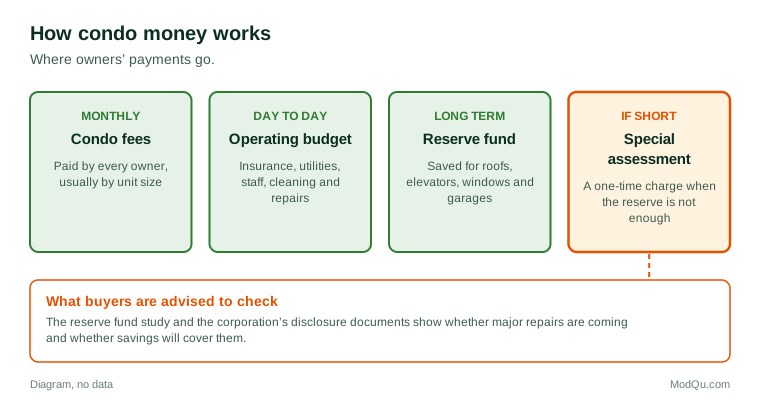
Owners pay monthly condo fees, also called maintenance fees or strata fees, usually based on the size of their unit. Fees often pay for:
- insurance on the building;
- maintenance and repairs of common areas;
- utilities for common areas, and sometimes for units;
- property management and staff;
- amenities;
- contributions to the reserve fund.
Fees usually rise over time as buildings age and costs increase. Owners often compare fees between buildings when buying, but the level of fees alone does not show whether a building is well run.
Example (hypothetical figures)
An owner pays $0.60 per square foot each month for an 800-square-foot unit, or $480. After a large rise in building insurance costs, the board raises fees by 9 percent to about $523 a month. Over a year, the owner pays about $518 more than before.
Reserve funds and special assessments
A reserve fund is money saved by the condo corporation for major repairs and replacements, such as a new roof, elevators, windows or a garage membrane. Most provinces require a reserve fund and a regular study, often called a reserve fund study or depreciation report, that estimates future costs.
If the reserve fund is not enough for a repair, the corporation may charge owners a special assessment, a one-time payment that can be large. Buyers are usually advised to review the reserve fund study and the status certificate or disclosure documents before buying.
Example
Two years after buying a condo townhouse, a family receives notice of a special assessment of several thousand dollars to replace leaking windows across the complex. They learn that the reserve fund study had warned the windows were near the end of their life, but they had not read it closely before buying.
Boards, managers and meetings
Each condo corporation is run by a board of directors elected by the owners. The board sets the budget, makes decisions on repairs and rules, and usually hires a property manager to handle day-to-day operations. Owners vote at annual general meetings and can raise concerns, but many do not attend.
Owner satisfaction with boards varies widely. Common complaints include:
- slow responses to problems;
- poor communication about decisions and spending;
- disagreements over priorities, such as repairs versus amenities;
- concerns about conflicts of interest;
- difficulty getting records.
In Ontario, the Condominium Authority Tribunal handles some types of condo disputes online, and other provinces have their own processes, such as the Civil Resolution Tribunal in British Columbia for strata disputes.
Example
A condo owner who works from home joins the board after years of complaining about slow repairs to the garage door. They find the board is short of volunteers and the property manager handles several buildings. They push for a monthly newsletter, which owners say helps them understand what is being done.
Rules and bylaws
Condo corporations have bylaws and rules that owners and residents must follow. Common topics include:
- pets, including limits on number and size;
- short-term rentals, which many buildings restrict;
- noise and quiet hours;
- renovations, such as flooring that affects neighbours below;
- balcony use, including barbecues, storage and plants;
- parking and storage;
- smoking and cannabis;
- move-in and move-out times and elevator bookings.
Rules are a frequent source of conflict between neighbours, and between owners and boards.
Common problems in condo living
Beyond fees and rules, residents report problems such as:
- noise between units, through walls and floors;
- water leaks from one unit to another;
- elevator outages in high-rise buildings;
- construction defects in newer buildings;
- disputes with neighbours;
- amenities that close or need costly repairs.
Example
Water from a burst pipe in a unit on the eighth floor leaks into two units below. The owners, the board and three insurance companies spend weeks working out who pays for what. The affected owners say they had not known until then which parts of their unit the building's insurance covered and which their own policy had to cover.
In Ontario, new condos usually come with warranty coverage through Tarion, the province's new home warranty program, and other provinces have similar home warranty requirements.
What people disagree about
Opinion is divided on whether condo fees are good value, how much power boards should have, whether short-term rentals should be allowed, how strict pet and renovation rules should be, and whether condos are a good long-term home for families. These views often differ between owners who live in their units, owners who rent them out and tenants.
Key terms
- CondominiumA form of ownership where each owner owns a unit and shares common property.
- StrataThe term used for condominium ownership in British Columbia.
- Common elementsShared parts of a condo, such as hallways, roofs and grounds.
- Condo feesMonthly payments for shared costs and the reserve fund.
- Reserve fundMoney saved for major repairs and replacements.
- Special assessmentA one-time charge to owners for a cost the reserve does not cover.
- Status certificateA document showing a condo corporation's finances and issues, used by buyers.
- BylawsRules adopted by a condo corporation.
Full glossary: residential property management terms on EditingTests.com.
Condos and strata living vocabulary test
How well do you know the language of this topic? Try 8 quick questions. Your score is shown straight away and is not saved.
What the condos and strata living survey asks
This survey is part of ModQu's Home and Property survey. The condos and strata living part takes about five minutes and covers:
- Whether you own or rent a condo, and what kind of building it is.
- How satisfied you are with your condo board and property manager.
- Whether your fees have gone up this year, and by how much.
- Whether you have faced a special assessment.
- Which rules cause the most problems in your building.
- Whether you would choose condo living again, and why.
After that you can choose to continue with other short parts of the Home and Property survey, such as buying a home or renting, or stop.
Ready to take part?
Your answers help show what people really think and do. Results are only ever reported as totals; no one can see your individual answers.
Start the surveyQuestions about this survey
Who can take part?
Condominium owners and renters.
Do I have to give my name?
No. You may be asked for your age group, region and similar details so results can be broken down, but not your name. ModQu never asks for passwords, card numbers or account numbers.
How are the results used?
Answers are combined into totals and percentages and published in ModQu reports. Individual answers are never shown.
Is the vocabulary test part of the survey?
No. It is optional and separate, and your score is not stored.
Can tenants in condos take part?
Yes. Tenants are asked about living in the building and its rules, though some fee questions are for owners only.